When Markets Turn Choppy, Canadian Low-Volatility ETFs Stand Their Ground
Canadian equities remain resilient despite rising volatility, and low-volatility ETFs offer a way to stay invested while reducing drawdown risk.


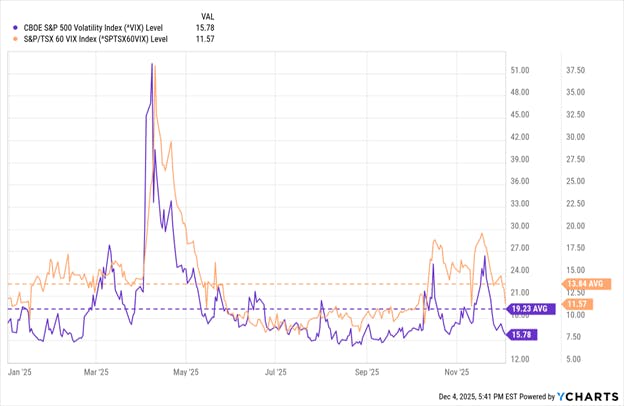
Despite the uncertainty that has troubled global markets throughout the year, Canadian equities have performed remarkably well, with the S&P/TSX Composite Index returning 29.09% as of December 3, 2025. While the ‘liberation day’ announcement by President Trump was undoubtedly a key market moment in the year, as shown by the spike in the VIX for both the S&P 500 Index and S&P/TSX 60 Index, there was a recent rise in market volatility during late October and mid-November 2025.
Momentary rise in volatility
During the period in question, the rise in volatility can be attributed to investors' increasing nervousness about stretched valuations in large technology companies and AI-linked names. As shown in the chart, the increase in Canadian equity volatility mirrors that of the U.S., albeit with a larger magnitude. Given the pervasiveness of the AI theme in the market, a sudden shift in sentiment can have far-reaching ramifications. As mentioned in a previous article, there is an increasing desire to limit or minimize one’s exposure to the dominant firms in the AI ecosystem.
Managing Volatility
For investors seeking to reduce volatility exposure while maintaining participation in equity markets, low-volatility investing is a turnkey approach.
Low-volatility strategies generally comprise individual equities within a benchmark that are less volatile than their peers, enabling strong risk-adjusted performance.
It should be noted that low volatility strategies are not immune to market drawdowns; however, the expectation is that they will ‘lose less’ than the broader market.
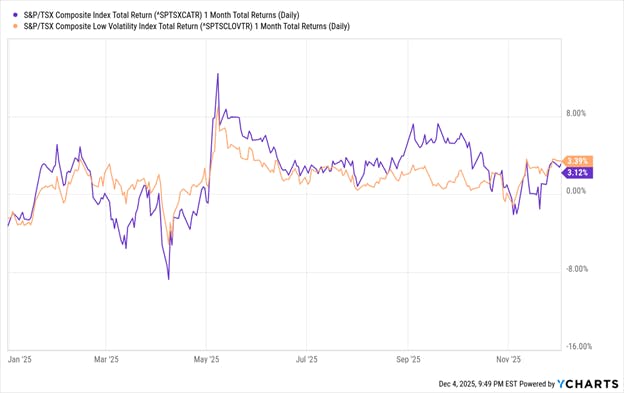
The effectiveness of low volatility investing is observable when looking at the year-to-date performance of the S&P/TSX Composite Index TR and S&P/TSX Composite Low Volatility Index TR. As shown in the following rolling returns chart, during periods of elevated volatility, the S&P/TSX Low Volatility Index lost less than its parent index. However, it is also worth noting that during the recovery period, the parent index outperformed the low-volatility index.
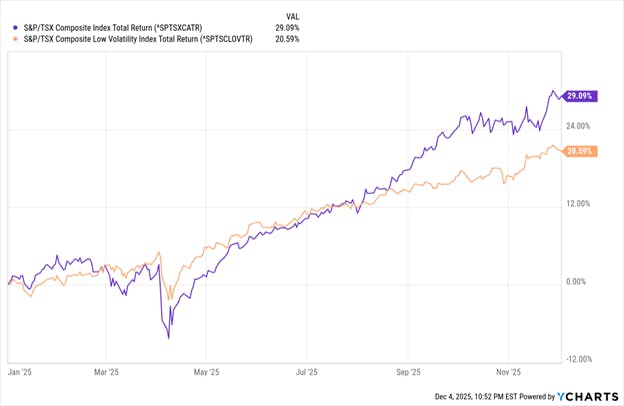
Looking at the top-line performance of both indices, the S&P/TSX Composite Low Volatility index has delivered compelling year-to-date returns, allowing investors to participate in the market’s upward movement while limiting the severity of drawdowns.
Investing in Canadian Low Volatility
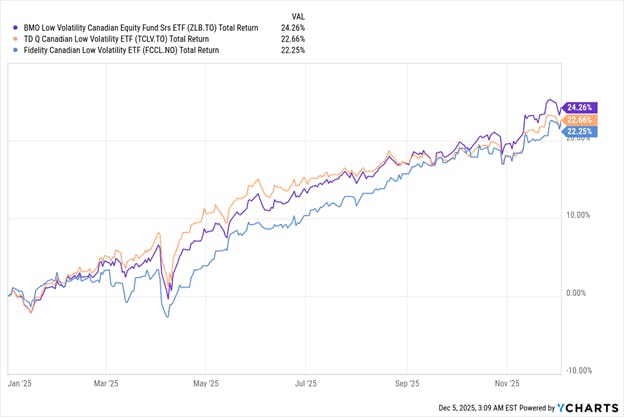
For investors interested in Canadian low-volatility solutions, the BMO Low Volatility Canadian Equity ETF (Ticker: ZLB), TD Q Canadian Low Volatility ETF (Ticker: TCLV), and Fidelity Canadian Low Volatility ETF (Ticker: FCCL) are examples of low-volatility strategies currently available. As shown in the image below, all three options have offered Canadian investors a similar experience of reducing overall risk exposure while still providing strong equity returns.
For income-focused investors, the Franklin Canadian Low Volatility High Dividend Index ETF (Ticker: FLVC) presents a compelling hybrid strategy. By tracking the Franklin Canadian Low Volatility High Dividend Index NTR, FLVC provides exposure to profitable Canadian companies that offer high dividend yields combined with low price and earnings volatility.
Launched in March 2024, it uses a rules-based, multi-factor screening process to select stocks with strong fundamentals, projected earnings growth over the next four quarters, and a stable yield score that balances dividends against volatility.
Please note this article is for information purposes only and does not in any way constitute investment advice. It is essential that you seek advice from a registered financial professional prior to making any investment decision.