Why Going Low-Cost Beta for Your Core International Equity Exposure Is Important
International equity diversification is important, but how much you pay for it matters.

Investors often exhibit a 'home country bias', preferring to invest in domestic equities due to familiarity or perceived patriotism.
In Canada, this bias is particularly evident; despite Canadian equities comprising around 3% of global market capitalization, many Canadian investors disproportionately favor their home market. It's not uncommon to see asset allocation ETFs with 20-30% invested in Canadian stocks, significantly overweighting a slice that, globally, is relatively small.
However, if one subscribes to the principles of efficient markets, mean reversion and the cyclical nature of winning sectors and regions, it's hard to justify ignoring 97% of the investable global market. Limiting oneself to Canada excludes a world of opportunities.
Moreover, diversification isn't just about adding U.S. stocks or holding the S&P 500. While the U.S. market is a behemoth and has been a strong performer, it doesn't encompass the entire spectrum of global investment opportunities.
Developed and emerging international markets offer exposure to different economic cycles, currency movements, and innovative companies that one simply cannot find in North America. Here's the argument for low-cost international equity exposure.
Why developed market exposure?
This sector concentration can increase risk due to a lack of diversification and exposure to the volatility of commodity prices, especially in the energy sector.
In contrast, developed markets offer a broader diversification across industries. Looking at the MSCI EAFE index, which includes stocks from Europe, Australasia, and the Far East, we see a far more balanced allocation.
Financials still hold a substantial proportion, but there's a more even spread with industrials, health care, consumer discretionary, and other sectors forming a significant part of the index. This mix helps mitigate the sector-specific risks inherent in the Canadian market.
Key international companies play vital roles in this diversified exposure. Giants like Novo Nordisk and AstraZeneca in health care, Nestlé in consumer staples, ASML Holding in information technology, and Toyota Motor in consumer discretionary, to name a few, are important to global markets.
These companies, along with others like Shell and TotalEnergies in energy and luxury goods conglomerate LVMH Moet Hennessy, contribute to a global economic footprint.
Their inclusion in a portfolio helps Canadian investors gain exposure to various economic sectors and geographic regions, reducing volatility and improving the potential for long-term growth.
Why emerging market exposure?
Emerging markets have often been overlooked in the past decade, largely due to what can be described as recency bias.
The perception that these markets have underperformed is not entirely unfounded; however, it's important to note that the U.S. market's exceptional performance during this time has been disproportionately influenced by the astronomical growth of a select group of mega-cap tech companies.
This concentration in a few high-growth stocks has skewed overall perceptions of U.S. market performance. To put this in perspective, it's instructive to consider the 'Lost Decade' for U.S. stocks from 1999 to 2009.
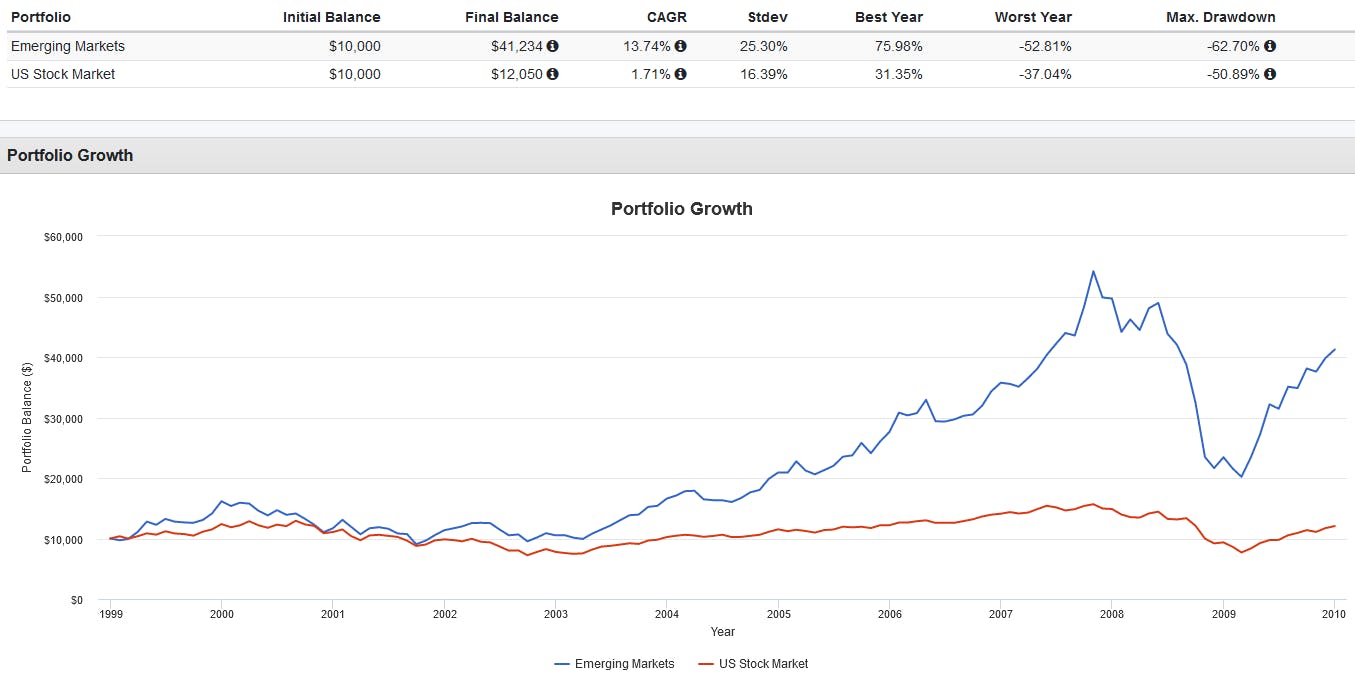
This was period during which the U.S. market was relatively flat, while emerging markets experienced robust double-digit returns. This serves as a reminder that market leadership is cyclical, and the recent dominance of U.S. equities does not guarantee future outperformance.
Emerging markets do carry additional risks, including political instability, currency volatility, and less mature economic systems. Investors taking on these risks should, in theory, be rewarded over the long term for their tolerance of these uncertainties.
Finally, including emerging markets in a portfolio can be a strategic decision for diversified, long-term growth. These markets are often characterized by young, growing populations and increasing urbanization, which drive consumer demand and could lead to significant economic expansion.
ETFs to watch for developed and emerging market equities
When it comes to building out the international equity allocation in a portfolio, my primary goal here is to secure low-cost exposure to market beta. This strategy involves passively tracking large indexes, which brings several benefits.
By aligning with broad market movements, investors can expect lower tracking error – the divergence from the benchmark performance – which can be critical for those seeking predictable outcomes.
Additionally, this approach often results in less turnover, meaning fewer transactions and associated costs, which helps in maintaining efficiency and preserving returns.
Moreover, the lower expense ratios associated with passively managed ETFs are a significant advantage. They reduce the drag on performance that comes with higher-cost investment options, making them an easily controllable source of risk.
Two of the ETFs on my radar right now are the Franklin International Equity Index ETF (FLUR) and the Franklin Emerging Markets Equity Index ETF (FLEM).
With a management fee of 0.09% and 0.15% respectively, both of these ETFs offer affordable exposure to the Solactive GBS Developed Markets ex-North America Large & Mid Cap Index and the Solactive GBS Emerging Markets Large & Mid Cap Index.
Transitioning to portfolio construction, adopting a "core and explore" approach can offer a structured yet flexible framework for international exposure. ETFs such as FLUR and FLEM can serve as the foundational 'core' of the international allocation, providing broad, diversified exposure to developed and emerging markets, respectively.
Around this core, investors can 'explore' with factor or style-specific international ETFs. This could involve tilting towards dividends for income, quality for stability, low volatility for risk management, momentum for growth, or value for potential outperformance.
Please note this article is for information purposes only and does not in any way constitute investment advice. It is essential that you seek advice from a registered financial professional prior to making any investment decision.