A Look at International Equity ETFs
A look at why international equities continue to outperform into 2026, led by Japan, and three ETF options for Canadian investors seeking exposure.


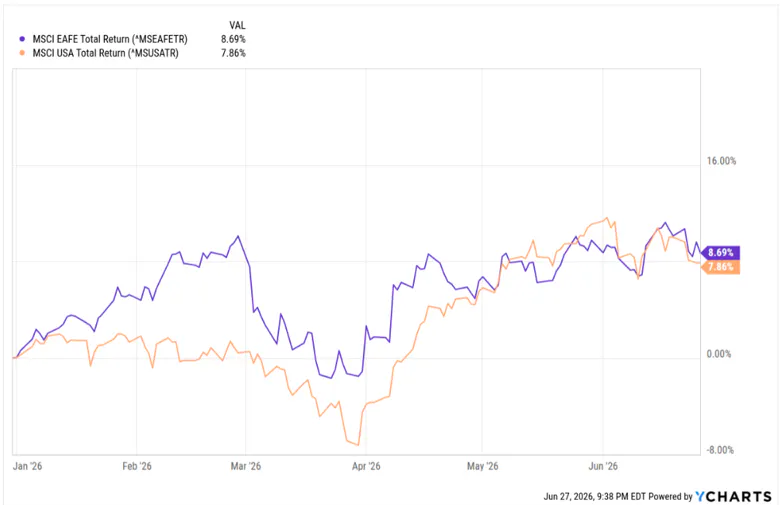
The strong performance of international equities was a prevailing theme throughout 2025, and as we approach the mid-year mark of 2026, the asset class continues to demonstrate its strength. Year to date, the MSCI EAFE (Europe, Australasia, and the Far East) Index has outperformed the MSCI USA, with the former returning 8.69% versus the latter’s 7.86% as of June 26th, 2026. While the topline performance of both indices is telling, as shown in the following chart, the investment experience of both asset classes has differed against the backdrop of macroeconomic uncertainty (i.e., the Strait of Hormuz closure) that has shaped markets in the first half of 2026.
Japan’s Seminal Contribution to International Equities
International equity investing provides investors with broad, diversified exposure, allowing them to benefit from developments across distinct regional economies. In reviewing the MSCI EAFE Index’s recent factsheet, the significant exposure to Japan (approx. 24%) has been additive to topline performance, given Japanese equities' recent performance and the net new economic developments occurring within the nation. As illustrated in the following chart, Japanese equities have performed well compared with other leading regional equity exposures in the MSCI EAFE Index and the MSCI USA Index.
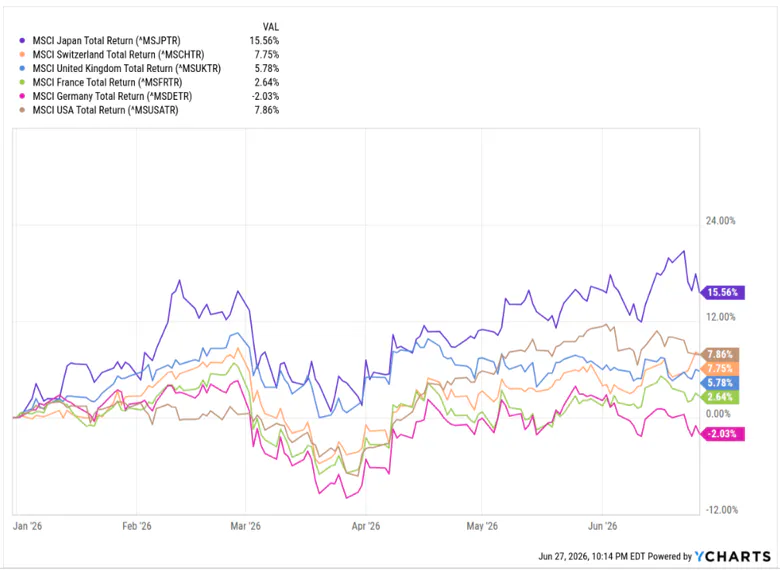
As detailed in an article published earlier this year, the strong performance of Japanese equities thus far in 2026 stems from corporate governance reforms and the policy shift under Japanese Prime Minister Sanae Takaichi, reshaping the country’s investment outlook. From a policy standpoint, Japan’s new Prime Minister wasted no time unveiling a massive ¥21.3 trillion stimulus package, sparking a market rally now dubbed the "Takaichi Trade." Her policy approach — centred on aggressive fiscal spending and easing — has drawn comparisons to Abenomics. Since taking office, Takaichi has proposed suspending the 8% food tax to ease cost-of-living issues and a broader $100+ billion stimulus package. The fiscal expansion is historically significant in scale. Beyond the one-time stimulus, there will be a more permanent increase in government spending, mainly on the military and strategic technologies, of ¥7–10 trillion per year, which amounts to about 1.2–1.8% of GDP.
Japan is also making its presence known within the AI ecosystem. Recently, Japan's Ministry of Economy, Trade and Industry announced that the government had made an additional ¥150 billion ($960 million) in equity investment in Rapidus Corporation, a semiconductor manufacturer backed by a consortium of major Japanese enterprises and the national government. The investment flows through the Information-technology Promotion Agency (IPA) and is earmarked for manufacturing equipment for 2nm mass production and research into the next-generation 1.4nm process. Combined with prior investments, total projected government support is on track to exceed ¥3 trillion — roughly $18.8 billion — by the end of fiscal 2027. Japan's total chip market share has fallen from roughly 50 percent in the late 1980s to approximately 10 percent today — the scale of the decline that this program is designed to reverse.
Other Notable Developments
Following the closure of the Strait of Hormuz, the equity market drawdown left investors anxious. The announcement of the Iran-U.S. Memorandum of Understanding (MoU) offered a measure of hope that normalization was imminent. Although reopening the Strait and resuming normal sea-borne trade would take time, the MoU is a good starting point for improving the global macroeconomic environment.
Investing in International Equity via ETFs
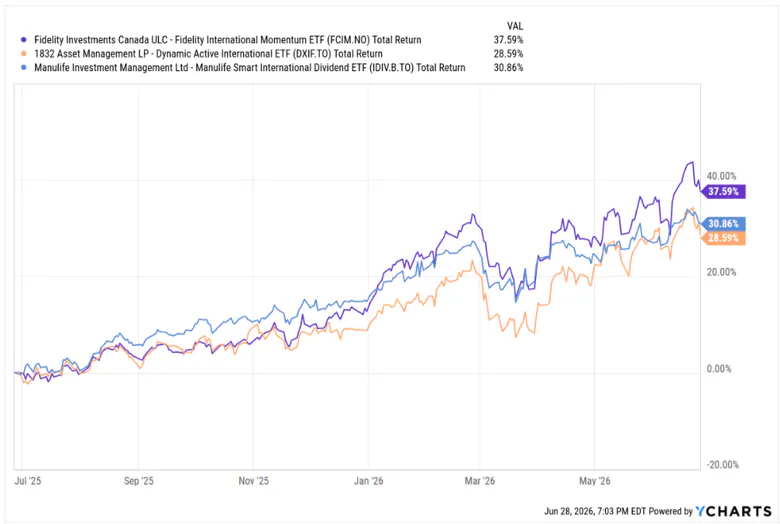
For Canadian investors seeking exposure to international equities, there are several ETF solutions that provide turnkey exposure, namely:
Fidelity International Momentum Index ETF (Ticker: FCIM), which seeks to replicate the Fidelity Canadian International Momentum Index that invests primarily in equity securities or large and mid-capitalization companies that have their principal business activities or interest outside of North America and exhibit positive momentum signals.
Dynamic Active International ETF (Ticker: DXIF), an actively managed solution that focuses on Non-North American high-quality companies with a market capitalization over $5 billion that are profitable, well-financed, and attractively valued.
Manulife Smart International Dividend ETF (Ticker: IDIV.B) is a diversified portfolio of international dividend-paying companies. The strategy employs a quantitative approach focused on companies with the potential to pay a consistent, growing dividend over time – not just the highest dividend payers in the market. Their approach screens out companies across market capitalizations, sectors and industries.
This article was written on June 28th, 2026. Please note this article is for information purposes only and does not in any way constitute investment advice. It is essential that you seek advice from a registered financial professional prior to making any investment decision.