Attaining Savings Longevity
A brief look at decumulation and an ETF solution aimed at facilitating this strategy.


Among investors pursuing long-term objectives like retirement, there is an understandable tendency to focus on the accumulation of assets. However, as populations worldwide age and increasingly need to tap into accumulated wealth, there is a growing focus on and demand for sound decumulation solutions. This article focuses on the decumulation investing challenge and highlights Guardian Capital’s GuardPath™ Managed Decumulation 2042 Fund (Ticker: GPMD), a multi-asset solution that utilizes pension-style risk management in managing volatility and extending the longevity of the portfolio.
Setting the stage
While the term decumulation may sound daunting, it refers to the post-working stage of the investor lifecycle; where individuals begin to draw down and use their savings to generate retirement income. The conundrum that is faced by many as they approach or begin this lifecycle stage is understanding whether they have enough set aside to adequately support themselves. This is where the need for a decumulation strategy takes precedence.
A decumulation strategy ensures that a retirement plan can support regular withdrawals from a portfolio regardless of the performance of the underlying investments. The strategy needs to ensure that sufficient returns are generated, otherwise withdrawals will reduce the principal amount below a desired level or completely deplete it, resulting in longevity risk.
Creating a strong foundation
With the sustainability of withdrawals being crucial for a decumulation of strategy, the composition of the underlying portfolio and its ability to generate strong returns is of great importance too. While ‘smaller withdrawals’ would intuitively allow for investors to have a more consistent and sustainable income stream for a longer period, lessening the possibility of principal depletion and longevity risk; the consumption needs of the investors may not allow for such an action. Thus, ensuring the underlying portfolio is well-designed and reflective of asset classes capable of growing capital and generating income over time is needed.
For decumulation strategies, multi-asset investing provides a proven pathway towards achieving strong performance, especially given the need for these strategies to achieve an expected return above that of the withdrawal rate. Broadly speaking, the higher the return above the withdrawal rate, the greater the likelihood of success. However, higher returns are also often associated with higher risk, which can worsen portfolio outcomes. Thus, a multi-asset investing approach strikes a necessary balance, allowing for adequate exposure to income-generating and growth-oriented solutions, while benefiting from broad-based diversification that reduces the impact of poor performance in any single category, thereby lowering overall portfolio risk.
Decumulation in a single-ticket solution
According to an analysis derived from Environics Analytics, as of April 2023, seniors make up approximately 19.3% of Canada’s total population, outnumbering children under the age of 15, who make up 15.5% of the population. With the greying and prolonged life expectancy of Canada’s population, decumulation investment solutions, such as Guardian Capital’s GuardPath™ Managed Decumulation 2042 Fund (Ticker: GPMDTicker: GPMD) will serve a growing segment of the Canadian population.
The objective of GPMD is to make consistent, high monthly distributions over a twenty-year period. The fund’s assets will be invested in a well-diversified portfolio selected to achieve income generation and preservation of capital while minimizing the overall volatility of returns. Of note, the ETF has an 8% target cash flow, which is significant. In achieving this objective, the mandate utilizes a combination of proprietary (and external) solutions to achieve its overarching goal.
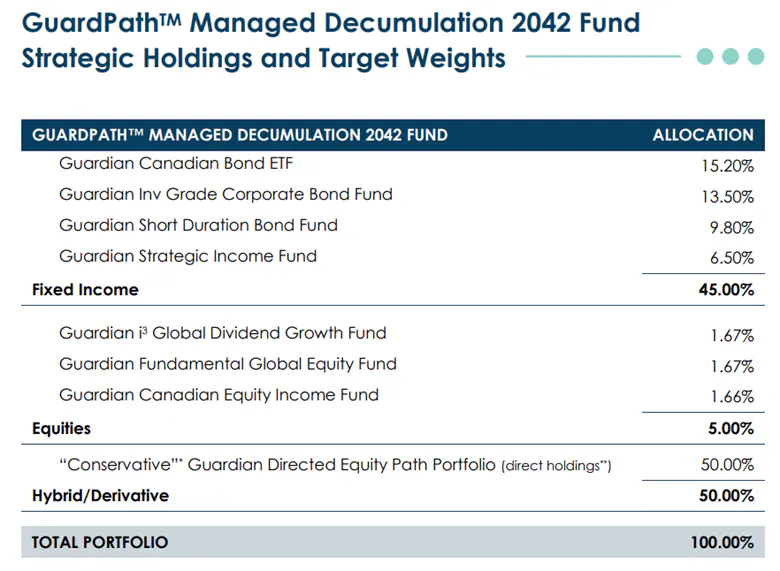
Though GPMD’s strategic asset allocation provides broad exposure to differing asset classes, the manager can implement derivative strategies designed to achieve higher levels of tax efficient cashflow and reduce losses from market declines. Regarding performance, the ETF has attained a 1-year performance track record in late 2023. As of December 2023, its trailing 1-year performance was 6.34%.
Conclusion
Within the broader concept of decumulation, there are different ways for investors to drawdown their retirement income. For individuals entering the decumulation stage of their lives, GPMD is now one of the various options investors can access to manage their savings and make it last as long as possible.
Please note this article is for information purposes only and does not in any way constitute investment advice. It is essential that you seek advice from a registered financial professional prior to making any investment decision.