Benefiting from Multi-Asset Investing
Having broad exposure to various asset classes has proven to be a cogent investment strategy.


While the strong performance of U.S. equities in 2023 has been top of mind for many investors, it was not the only asset class that performed well over the past year; across the investment landscape various types performed well, especially given their returns in 2022. While many individuals are aware of the benefits of having broad exposure to differing asset classes within their portfolio, in practice it may be difficult due to human tendencies such as home bias – the preference to invest mainly in domestic equities, rather than diversify with foreign investments. This paper will focus on multi-asset investing, highlighting its ability to provide investors with a balanced and diversified portfolio that can provide a stable return profile over time.
A little bit of everything
Across the investment landscape, performance leadership, and the degree to which one asset class outperforms another, change every year. But instead of trying to guess and gauge which asset class will be the best, multi-asset investing provides for a broad exposure to all of them.
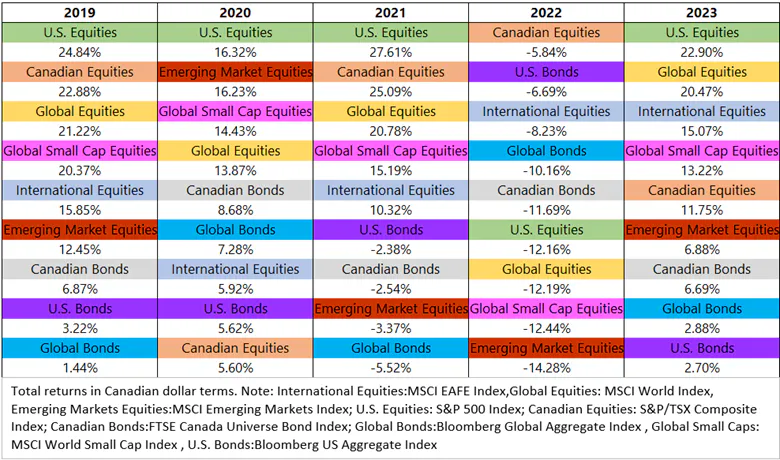
Multi-asset investing has gained prominence among investors as a means of navigating the complexities of today's dynamic markets. Instead of concentrating investments on a single type of asset, such as stocks or bonds, multi-asset investing seeks to spread risk and enhance potential returns by including a mix of different asset types in a portfolio. These asset classes can include equities, fixed-income securities, real estate, commodities, and other investment instruments.
The benefits of a multi-asset approach
The key principle behind multi-asset investing is to achieve a balanced and diversified portfolio, offering a range of benefits that contribute to risk management and potential returns. These benefits can be described as the following:
Diversification for Risk Mitigation:
One of the primary advantages of multi-asset investing is risk mitigation through diversification. Different asset classes tend to react differently to economic events and market conditions. By spreading investments across various assets, investors can reduce the impact of poor performance in any single category, thereby lowering overall portfolio risk.
Enhanced Return Potential:
Multi-asset investing also provides the opportunity for enhanced return potential. While diversification helps manage risk, it can also contribute to improved returns. The goal is to have assets that perform well in different market environments, allowing the portfolio to capture positive returns from various sources.
Adaptability to Market Conditions:
Financial markets are dynamic and subject to constant change. Whether facing inflationary pressures, interest rate changes, or geopolitical uncertainties, a mix of assets can provide a more resilient investment strategy that adjusts to the prevailing environment.
Income Generation and Capital Preservation:
Different asset classes offer distinct income-generation characteristics. By combining income-generating assets, investors can create a steady cash flow within their portfolios, providing financial stability and potentially preserving capital during market downturns. This income can also be reinvested or used to meet ongoing financial needs.
Risk-Adjusted Returns:
Multi-asset investing focuses not only on maximizing returns but also on optimizing risk-adjusted returns. The goal is not just to achieve the highest possible return, but to do so while considering the level of risk taken. By strategically combining assets with different risk profiles, investors can construct portfolios that aim to provide an optimal balance between risk and return.
A look at multi-asset solutions
For investors interested in multi-asset investing, the following ETF solutions provide broad exposure to different market segments in a single-ticket solution.
The Horizons Seasonal Rotation ETF (Ticker: HAC) is a tactically managed solution that provides exposure to equities, fixed income, commodities and currencies during periods that have historically demonstrated seasonal trends. The premise of the fund’s investment strategy is broad markets and sectors may earn higher returns during certain periods of the year when compared to other periods of the same duration. HAC seeks to gain exposure to those broad markets and sectors during their favourable market seasons. The manager consistently engages in this opportunistic rotation strategy throughout the year.
As of December 2023, HAC had a 1-year performance of 19.33% and a since inception return of 7.97%
The IA Clarington Loomis Global Allocation Fund ETF (Ticker: IGAF) is an unconstrained solution that invests across multiple asset classes, sectors, regions, countries and currencies in pursuit of a strong total return. In equities, the manager believes that investing in companies that exhibit the alpha drivers of quality, intrinsic value growth and valuation can help create long-term outperformance potential. With fixed income, their approach is to be selective in bond issuers that exhibit strong fundamentals with resilient business models.
As of December 2023, IGAF has 1-year performance of 19.60%, with a since inception return of 6.7%
Fidelity’s All-in-One ETF Suite provide investors with the option to choose from pre-designed portfolios based on criteria such as their risk tolerance, desired level of income generation, and preferred asset mix. All portfolios are built using factor-based ETFs and are diversified based on geographic region, market capitalization, and investment styles.
As of December 2023, the Fidelity All-in-One Conservative ETF (Ticker: FCNS) had a 1-year return of 11.59% and a since inception return of 1.84%.
As of December 2023, the Fidelity All-in-One Balanced ETF (Ticker: FBAL) had a 1-year return of 14.08% and a since inception return of 4.79%.
As of December 2023, the Fidelity All-in-One Growth ETF (Ticker: FGRO) had a 1-year return of 16.88% and a since inception return of 7.60%.
As of December 2023, the Fidelity All-in-One Equity ETF (Ticker: FEQT) had a 1-year return of 18.05% and a since inception return of 6.33%.
Conclusion
As financial markets continue to evolve, multi-asset investing offers a comprehensive framework for investors to navigate uncertainties and pursue their financial goals. By recognizing the advantages of multi-asset investing, investors can make informed decisions that align with their risk tolerance, investment objectives, and the ever-changing dynamics of the global economy.
Please note this article is for information purposes only and does not in any way constitute investment advice. It is essential that you seek advice from a registered financial professional prior to making any investment decision.