Building a "Lazy" Investment Portfolio Using Canadian ETFs
Buying, holding, and rebalancing just three funds can set investors up for success.


South of the border, some U.S. investors adhere to what they call the "Bogleheads" investment strategy. Named after the late John "Jack" Bogle, founder and chairperson of Vanguard, Bogleheads believe in using low-cost passive index funds to match the market's return.
A popular strategy among Bogleheads is the so-called "three-fund portfolio," which consists of the following assets:
- A total U.S. stock market fund;
- A total ex-U.S. international stock market fund; and
- An aggregate U.S. bond market fund.
Bogleheads use this combination to achieve the market's average return for a low cost, ensuring maximum diversification and simplicity for a long-term portfolio. Canadians can do the same using domestic ETFs, albeit with some differences. Let's figure this out!
The Canadian 3-Fund "Lazy" Portfolio
I call the Canadian variant a "lazy" portfolio because well, it doesn't take much effort. Creating and maintaining this portfolio amounts to the following steps:
- Purchasing three ETFs (I'll discuss the exact allocation later).
- Rebalancing them annually to your desired proportions.
- Do nothing and enjoy life.
I cannot over-emphasize the importance of step #3. Investment portfolios are like a bar of soap – the more you touch them, the smaller they get. Ideally, investing should be dead simple, boring, and hands-off. If you want excitement, consider buying a lottery ticket or going to Vegas.
Fund #1: All-World Ex-Canada
Our first fund should track the world's stock market outside of Canada. This usually means a mixture of U.S., international developed, and international emerging markets. While investors can hold funds that track each of those individually (and I went over some good options in this article about alternatives to asset allocation ETFs), a better way is through either of the following iShares and Vanguard funds:
- Vanguard FTSE Global All-Cap ex Canada Index ETF (VXC): 0.21% expense ratio.
- iShares Core MSCI All Country World ex Canada Index ETF (XAW): 0.22 expense ratio.
Fund #2: Canadian Equity All-Cap
Our second fund should track the domestic Canadian stock market, and not just large-cap blue chips. An allocation to medium and small caps ensures better diversification and exposure to different risk factors that can improve returns slightly over time. Overweighting Canadian equities to anywhere from 20-30% of our portfolio is called a home country bias, and has numerous benefits, which I went over in a previous article. The following iShares and Vanguard funds will work:
- Vanguard FTSE Canada All Cap Index ETF (VCN): 0.05% expense ratio.
- iShares Core S&P/TSX Capped Composite Index ETF (XIC): 0.06 expense ratio.
Fund #3: Canadian Aggregate Bond Fund
Call me old-fashioned, but in my opinion, no portfolio is complete without at least a small allocation to fixed income. While young investors can go 100% equities, the approach is inefficient and results in taking on excessive volatility, which can cause panic selling should a bad crash occur. Sizing an appropriate allocation to investment grade government and corporate bonds based on your risk tolerance and time horizon (to match bond duration) is prudent. The following iShares and Vanguard funds will work:
- Vanguard Canadian Aggregate Bond Index ETF (VAB): 0.09% expense ratio.
- iShares Canadian Universe Bond Index ETF (XBB): 0.10% expense ratio.
Constructing the 3-Fund Lazy Portfolio
My preferred allocation for the Canadian 3-Fund Lazy Portfolio is set out below. Keep in mind that this is a general rule of thumb based on my views toward future equity and bond returns. You may wish to vary them depending on your outlook and risk tolerance. I would personally opt for an 80/20 stock/bond allocation for a long-term (20+ year) holding given my current age of 26 and retirement goal of 55, but anywhere from 90/10 to 40/60 could be appropriate.
· 60% VXC or XAW;
· 20% VCN or XIC;
· 20% VAB or XBB.
The overall portfolio fees work out as follows:
· Using Vanguard ETFs: 0.154% expense ratio.
· Using iShares ETFs: 0.164% expense ratio.
Vanguard comes out very slightly cheaper, but overall, it's still a coin flip. A great way to utilize both sets of Vanguard and iShares funds is as tax-loss harvesting pairs.
Finally, we have to rebalance the portfolio annually. This ensures we sell the winners at their highs and buy the losers at their lows. For example, if stocks crash and the bonds maintain value or even soar, we need to sell enough bonds to get their allocation back down to our target, and buy enough stocks to get their allocation back up to our target.
Historical Performance
Finally, here's the historical performance of both portfolios: a solid 7% CAGR since 2016:
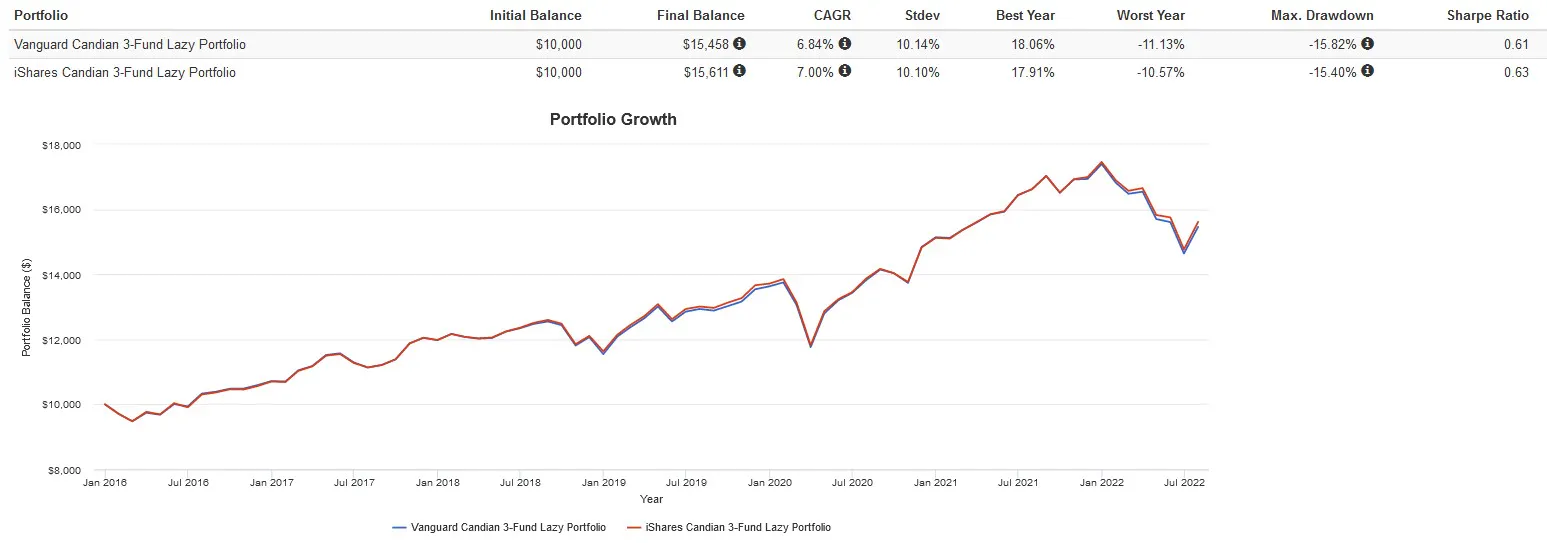
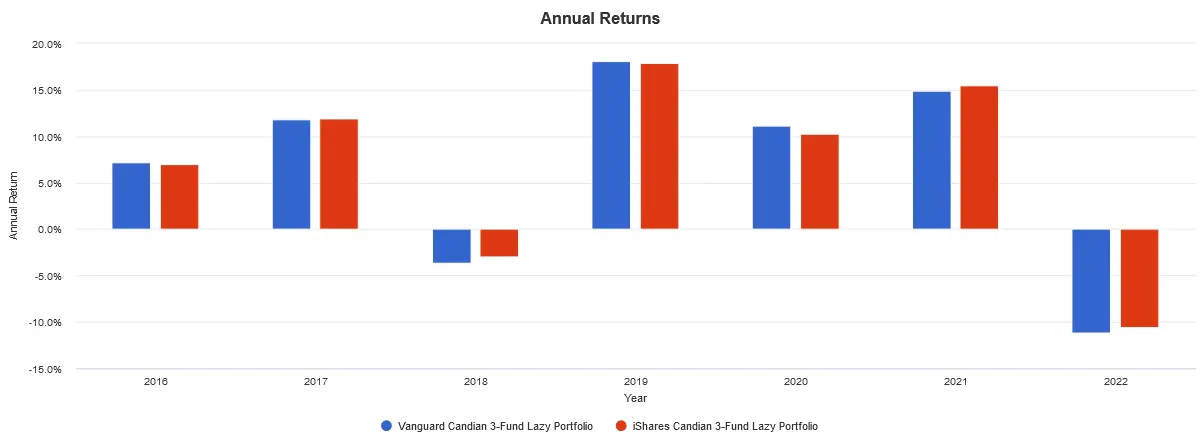
Yes, you could have achieved higher by just buying large-cap U.S. stocks, but why fall prey to recency bias and chase performance if your goal is long-term? Predicting the markets is hard, if not impossible, and that's where the merits of the lazy portfolio shine.
Investing in the lazy portfolio ensures a return that matches the market's average, with a low cost and little attention needed. High fees and bad behaviours are easily controllable sources of risk that can cripple returns, so focusing on those is important, and a lazy portfolio goes a long way there.
Disclaimer: This article is limited to the dissemination of general information pertaining to investment strategies and financial planning and does not constitute an offer to issue or sell, or a solicitation of an offer to subscribe, buy, or acquire an interest in, any securities, financial instruments or other services, nor does it constitute a financial promotion, investment advice or an inducement or incitement to participate in any product, offering or investment.