3 Multi-Crypto ETFs for Canadians Eyeing a Crypto Comeback
September’s rebound put crypto back in focus. Here’s how three Canadian ETFs spread exposure across multiple coins.


For much of 2026, crypto investors watched U.S. equities and commodities pull ahead. Tariff tensions, uncertainty over interest rates and unresolved regulatory questions kept digital assets under pressure.
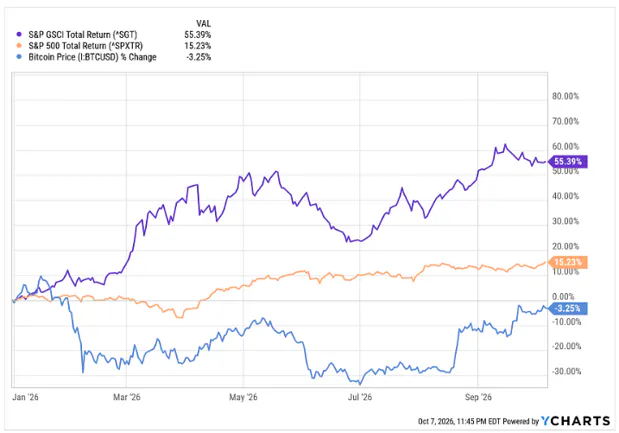
September marked a comeback, with several cryptocurrencies posting strong gains as investors digested the Federal Reserve’s latest decision and large crypto holders added to their positions.
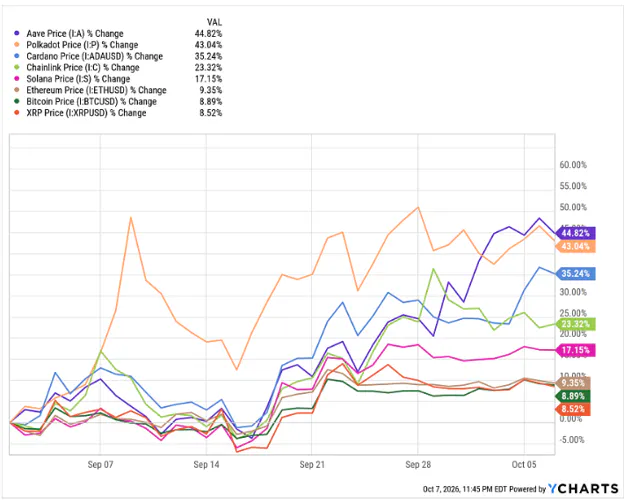
For investors who think the rally has more room to run, the question is how to get in on it.
Bitcoin and Ether may be the first names that come to mind, but Canadians have ways to spread their exposure.
Multi-crypto ETFs offer access to several digital assets in one fund, without having to pick and manage each coin individually.
What Was Behind September’s Crypto Recovery?
The Fed Decision Gave Markets Some Clarity
The Federal Reserve’s September interest rate decision removed an immediate source of uncertainty. Investors had spent the lead-up weighing the possible outcome, adding to an already unsettled macroeconomic backdrop.
Once the decision arrived, broader markets stabilized. The improvement in sentiment appears to have helped crypto regain ground, providing some relief after months of weak performance.
U.S. Crypto Legislation Hit a Roadblock
The regulatory picture also drew attention. The Digital Asset Market Clarity Act, which passed the House in July 2025, failed to advance in a Senate vote in September 2026.
The bill sought to resolve a central question for the industry: when should a cryptocurrency token be regulated as an investment contract, and when should it be treated as a digital commodity?
Its proposed framework would divide responsibilities between the Commodity Futures Trading Commission and the Securities and Exchange Commission.
The CFTC would oversee spot transactions in decentralized digital commodities such as Bitcoin and Ethereum, while the SEC would retain jurisdiction over capital-raising tokens classified as investment contract assets.
The bill fell 10 votes short of the 60 needed to proceed.
With Congress recessing ahead of November’s midterm elections, the proposed overhaul stalled, leaving the existing framework in place for now.
Large Holders Continued to Accumulate
While prices struggled earlier in the year, some of crypto’s largest holders kept buying.
CryptoQuant’s Smart Money report, published on August 5, 2026, noted that the biggest holders of Bitcoin, Ether and XRP had added to their positions during the decline.
Strategy (MSTR) provided a prominent example. In September, the company acquired 2,615 bitcoins for $219 million. Its open ledger showed total holdings of 848,000 bitcoins as of this writing.
Continued buying by large holders helped reinforce confidence as the market recovered.
Alongside greater clarity following the Fed decision, that accumulation formed part of the backdrop to September’s rally.
Multi-Crypto ETFs: The Allocation Strategy Matters
Buying several cryptocurrencies through one ETF simplifies access. It does not make every multi-crypto fund interchangeable.
The assets included, the rules governing their weights and the manager’s discretion can produce quite different portfolios. For Canadian investors, the following three funds illustrate how much the approach can vary.
CI Galaxy Multi-Crypto Navigator ETF: A Momentum-Based Approach
The CI Galaxy Multi-Crypto Navigator ETF (CMCX, CMCX.B, CMCX.U) uses momentum signals to guide its allocation across Bitcoin, Ethereum and Solana.
The fund builds that exposure through three underlying CI cryptocurrency ETFs: the CI Galaxy Bitcoin ETF, US$ Series (BTCX.U), CI Galaxy Ethereum ETF, US$ Series (ETHX.U), and CI Galaxy Solana ETF, US$ Series (SOLX.U).
The defining feature is its allocation process.
Investors are buying a rules-based strategy that uses momentum to determine exposure across the three assets.
The management expense ratio, or MER, is 1.20% for the two Canadian-dollar series and 1.16% for the U.S.-dollar series.
Evolve Cryptocurrencies ETF: Market Size Drives the Portfolio
The Evolve Cryptocurrencies ETF (ETC, ETC.U) takes a market-cap-weighted approach to Bitcoin, Ether, Solana and XRP.
Larger cryptocurrencies receive larger allocations.
Bitcoin therefore carries the greatest weight, with exposure delivered through the Evolve Bitcoin ETF (EBIT).
The remaining holdings are the Evolve Ether ETF (ETHR), Evolve XRP ETF (XRP) and Evolve Solana ETF (SOLA), in descending order of weight.
Investors get exposure to four cryptocurrencies, with their relative market sizes determining the portfolio’s balance. The Canadian-dollar series has an MER of 1.79%.
Dynamic Active Multi-Crypto ETF: A Broader Active Mandate
The Dynamic Active Multi-Crypto ETF (DXMC) extends its reach beyond digital assets themselves.
Alongside leading cryptocurrencies such as Bitcoin, Ether, Solana and XRP, the fund can invest in companies deploying blockchain technology in real-world applications.
Its active approach covers asset selection, rebalancing and staking.
The result is a broader mandate, with the manager deciding how to combine crypto assets and blockchain-related businesses.
Because the fund is less than a year old, an MER is not yet available.
A temporary waiver reduces the annual management fee to 0.25% through March 1, 2027. The fee returns to 0.45% on March 2, 2027, subject to applicable taxes.
Investors comparing costs should keep the distinction in view: a management fee is only one component of a fund’s MER.
This article was written on October 8th, 2026. Please note this article is for information purposes only and does not in any way constitute investment advice. It is essential that you seek advice from a registered financial professional prior to making any investment decision.