Clean Energy ETFs Gain Momentum Amid Hormuz Crisis
Rising oil and gas volatility is pushing investors back toward clean energy ETFs.


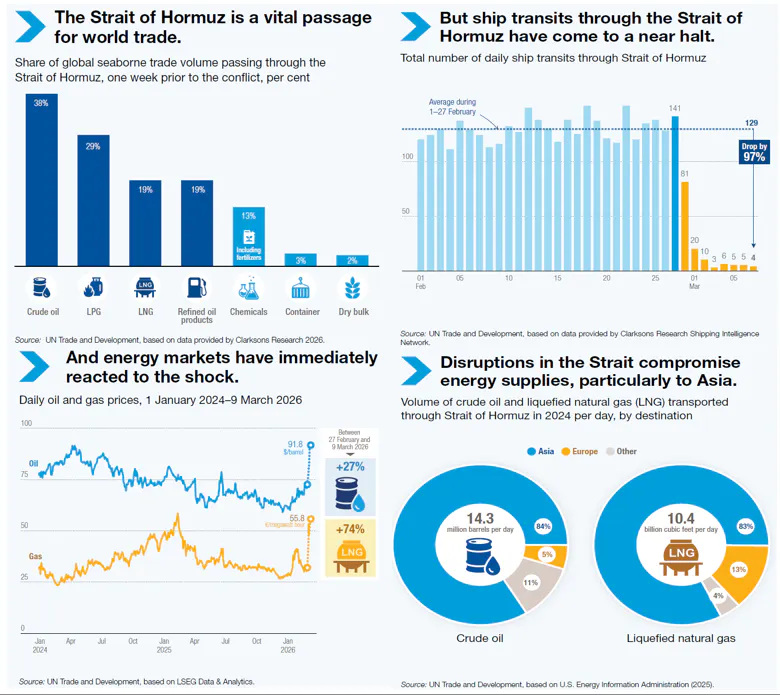
The war in Iran and the associated blocking of the Strait of Hormuz have highlighted how precarious energy access can be. Against this backdrop, the value proposition of alternative energy sources has been emphasized, underscoring why they remain an area of keen investment interest. As one of the world’s most critical marine chokepoints, the ongoing military conflict within the region has had reverberations on the global economy, affecting energy markets, maritime transport, and global supply chains.
The Opportunity for Clean Energy
The closure of the Strait of Hormuz has highlighted a seminal vulnerability in the global economy. Against this backdrop, the value proposition of alternative energy sources has once again come to the forefront. The Energy Transitions Commission (ETC), a global coalition of leaders from across the energy landscape committed to achieving net-zero emissions by mid-century, recently released a report titled Lessons on Energy Security after the Hormuz Crisis, emphasizing the urgent need for governments to accelerate the transition to clean energy systems. The recent Hormuz crisis, which caused the largest supply shock on record, disrupted 18.4 million barrels per day of oil, 20% of global LNG trade, and one-third of global fertilizer trade.
This disruption has led to significant economic impacts, including elevated oil and gas prices that could add $1–2 trillion to annual global gross fuel expenditure. The ETC argues that clean energy systems, which require upfront capital investment and are less exposed to market disruptions, offer a more resilient and cost-effective approach to energy security challenges. A practical example of the benefits of clean energy amidst the crisis is seen in Spain, where renewables account for 52% of power generation, recorded the EU's lowest energy price increases post-Hormuz, with prices at $50/MWh. Conversely, Singapore, with 95% gas-dependent power generation, faced prices above $200/MWh in April.
At the start of the year, BloombergNEF’s (BNEF) annual Energy Transition Investment Trends (ETIT) reported that global investment in the energy transition reached a record $2.3 trillion in 2025, up 8% from the prior year. The largest investment drivers were electrified transport ($893 billion), renewable energy ($690 billion), and grid investment ($483 billion). However, renewable energy investment fell 9.5% year over year as changing power market regulations in China, the world’s largest market, introduced new uncertainty. The blocking of the Strait of Hormuz could prove to be an inflection point that catalyzes renewed (pun intended) interest in advancing renewable energy investment.
Investing in Clean Energy via ETFs
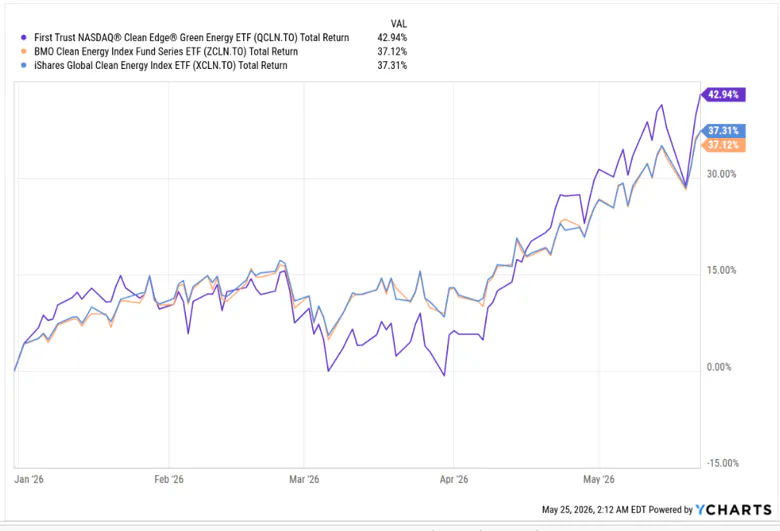
Year to date, the performance of clean energy ETFs has been notably strong, as volatility in energy markets has led investors to broaden their perspective on energy investments. As global economies move towards energy independence, adopting and integrating renewable energy within a nation’s energy mix is becoming a baseline course of action.
For Canadian investors looking to gain exposure to renewable energy investments, the First Trust Nasdaq Clean Edge Green Energy ETF (Ticker: QCLN), BMO Clean Energy Index Fund Series ETF (Ticker: ZCLN), and iShares Global Clean Energy Index ETF (Ticker: XCLN) are turnkey solutions that provide exposure to diverse opportunities in the renewable energy landscape.
This article was written on May 25th, 2026. Please note this article is for information purposes only and does not in any way constitute investment advice. It is essential that you seek advice from a registered financial professional prior to making any investment decision.