Emerging Market ETFs: A Shield Against Trump’s Tariff Threats?
With Trump using tariffs as a threat, investing in countries not dependent on the U.S. market may be a course of action. A look at emerging market ETFs.


The phrase, ‘When the U.S. sneezes, the world catches a cold,’ conveys the U.S. market’s overarching impact and influence on the world. President Trump’s recent tariff threat to several countries underscores the importance of the U.S. to the global market, as it is still the largest consumer market. However, his threats have also highlighted how much of global trade is now down through companies themselves—with goods being moved within the subsidiaries or contracted firms of multinational companies as part of their complex supply chain networks. The automotive industry best exemplifies this fact, as even the smallest component of a motor vehicle may travel multiple times across the U.S., Mexico, and Canada border. A 2019 article from Bloomberg News demonstrated this by mapping the supply chain movement for a company that makes printed circuit boards for auto parts, such as automotive seat controls.
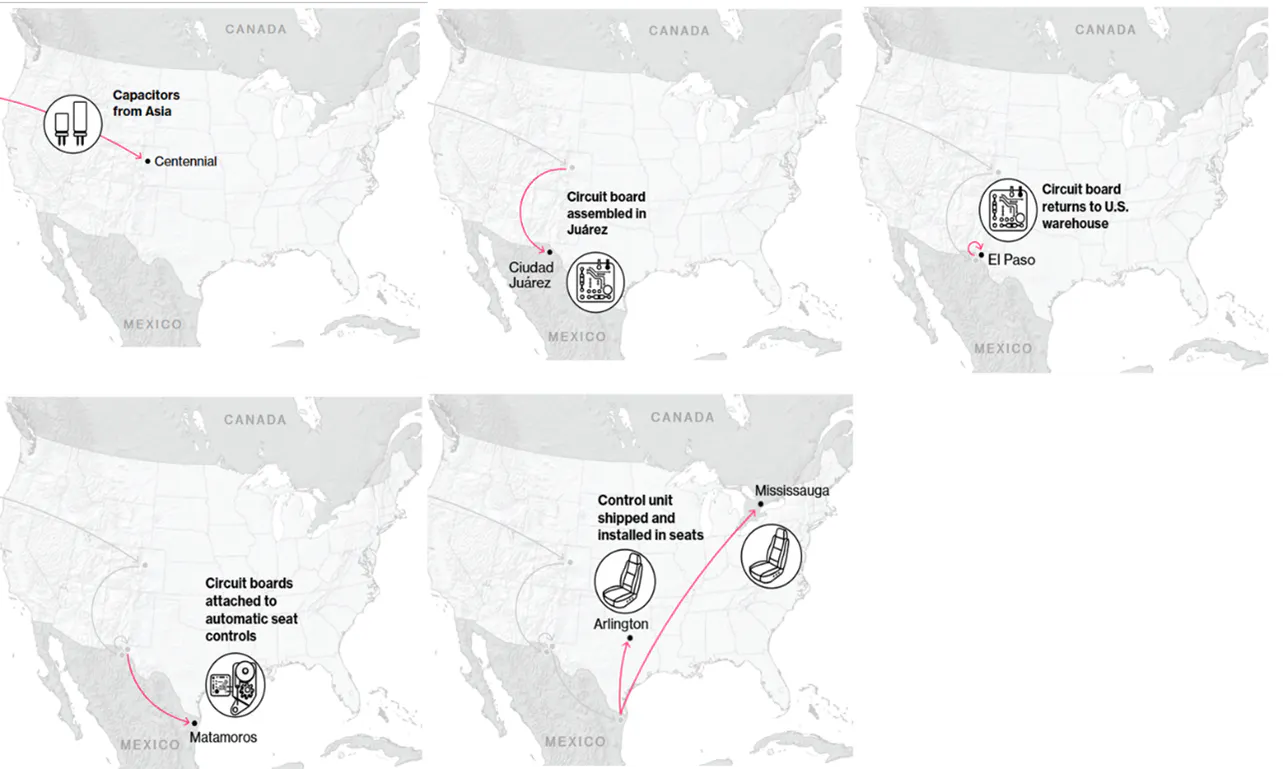
As illustrated in the above image, there are multiple cross-border movements that occur. So, when a 25% tariff is applied to goods that cross a border numerous times, the cost of production increases rather quickly, and the ability to pass said costs to consumers begins to come into question.
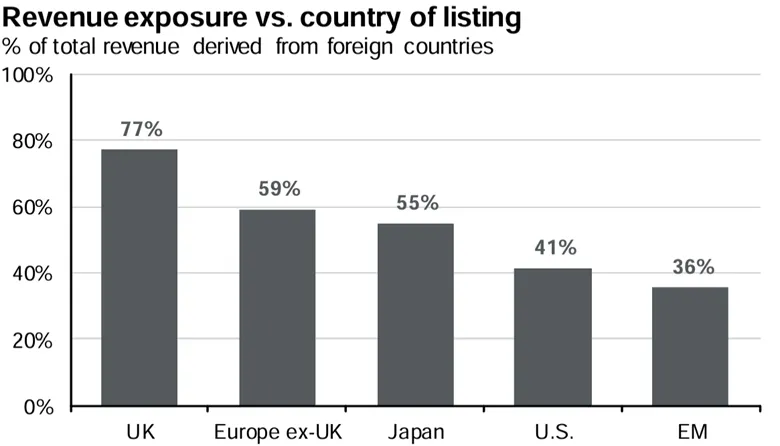
Revenue derived from foreign countries
While globalization has arguably made the world more prosperous, it has also made it more interconnected, allowing businesses to gain access to diverse markets. This interconnectedness and dependence have been beneficial, generally, for all parties. However, President Trump’s protectionist rhetoric and policies seek to limit foreign entities’ access to the U.S. market, which in turn would have far-reaching economic implications.
Recent JP Morgan Asset Management research shows that approximately 40% of U.S.-listed companies’ total revenues are derived from foreign countries. In contrast, other developed countries or regions have higher exposures.
Most notably, emerging market companies had the lowest exposure. Naturally, companies that service their domestic market primarily would be less affected by the protectionist policies enacted by President Trump. In contrast, multinational corporations would be adversely affected.
Though President Trump has paused the tariffs placed on Mexico and Canada for now, his America First Trade Policy is seemingly a cornerstone of his political agenda, as such, the threat and eventual implementation of broad-scale tariffs is not off the table. Conversely, given that protectionist policies are typically met with retaliatory actions, U.S. companies exporting to or operating in foreign countries will be negatively impacted (i.e., China displays multiple weapons in retaliation for Trump’s tariffs) based on the severity of the trade policies President Trump chooses to implement.
The Emerging Market Opportunity
For Canadian investors seeking or considering exposure to emerging market equities, the following ETFs provide exposure to this asset class, allowing for turnkey exposure, and in some instances utilize a strategic or thematic element within their investment strategy.
The iShares Emerging Markets Fundamental Index ETF (CWO) tracks the performance of the FTSE RAFI Emerging Markets Index, which is comprised of 350 companies with the largest RAFI fundamental scores selected from the FTSE Emerging All Cap Index. The index constituents are weighted using a composite of fundamental factors, including total cash dividends, free cash flow, total sales and book equity value.
For the 2024 calendar year, CWO’s performance was 23.8%.
The RBC Quant Emerging Markets Dividend Leaders ETF (RXD) is an actively managed investment vehicle offering diversified exposure to high-quality emerging market equities. It aims to deliver a combination of regular dividend income and long-term capital appreciation. For the 2024 calendar year, RXD’s performance was 17.7%.
The Desjardins RI Emerging Markets Multifactor - Net-Zero Emissions Pathway ETF (DRFE) is an actively managed fund employing a multifactor approach. It aims to progressively lower the portfolio's financed emissions while controlling active risk. The fund invests primarily in equity and equity-related securities of large and mid-cap emerging market companies, ensuring all holdings meet pre-determined ESG standards.
For the 2024 calendar year, DRFE’s performance was 20.17%.
Please note this article is for information purposes only and does not in any way constitute investment advice. It is essential that you seek advice from a registered financial professional prior to making any investment decision.