ETFs Paving the Way for Sustainable Infrastructure Growth
Sustainable infrastructure ETFs offer investors resilient, future-ready exposure to climate-focused growth.


As an asset class, infrastructure is broad, encompassing facilities, services, and installations considered essential to a society's functioning and economic productivity. Sustainable Infrastructure further refines what is included in the asset class, with projects like renewable energy sources like wind, solar, and hydroelectric power, energy-efficient buildings, sustainable water management systems, green transportation networks, and waste management solutions.
At its core, sustainable infrastructure aims to create resilient systems that can withstand the challenges posed by climate change, urbanization, and population growth. These systems reduce greenhouse gas emissions and improve the quality of life by providing cleaner air, safer transportation, and more efficient resource management. Moreover, sustainable infrastructure projects often incorporate innovative technologies and practices that enhance their efficiency and effectiveness, further amplifying their positive impact.
The Opportunity Present In Sustainable Infrastructure
Given the impending risks posed by climate change, climate resilience has become an increasingly important consideration when evaluating infrastructure investment opportunities. Climate resilience is a core tenet of sustainable infrastructure, given its ability to withstand and adapt to evolving climate conditions. Ensuring reliability and longevity while minimizing disruptions and financial loss is a key value proposition of this asset class.
As noted in a recent whitepaper by Global Infrastructure Basel and Ortec Finance titled "Improved Financial Performance of Sustainable Infrastructure in the Context of Climate Change," allocating to sustainable infrastructure within one’s portfolio can be beneficial under limited climate action scenarios and net-zero market disruption scenarios. The image that follows illustrates the relative impact on expected returns of sustainable infrastructure compared to conventional infrastructure. Lower exposure of sustainable infrastructure to both transition and physical risk leads to higher expected returns compared to traditional infrastructure under both modelled scenarios.
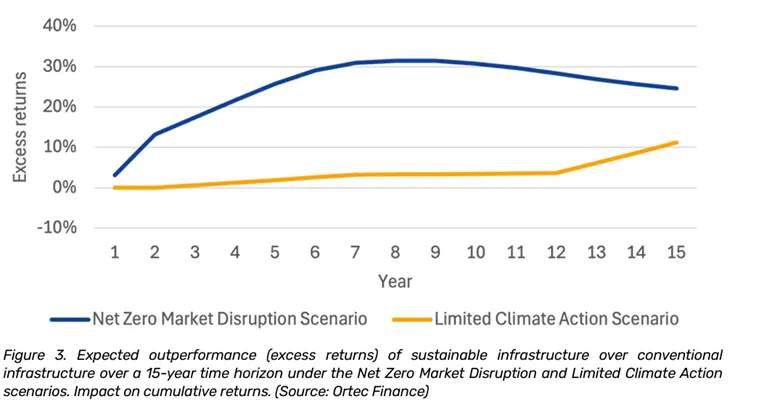
As explained in the whitepaper, under a rapid transition scenario, sustainable infrastructure is more resilient, compared to conventional infrastructure, and outperforms the latter with mean cumulative returns 20-30% higher over the 5- to 15-year time horizon. These relative benefits stem from lower exposure to at-risk fossil fuel infrastructure assets that would be prematurely retired in this scenario, where returns would be adversely affected by lower demand for, and lower wholesale prices of, fossil fuels.
For a scenario with limited climate action, the impacts of chronic and acute physical risks are significant. Based on the modeling used in this analysis, a sustainable infrastructure portfolio is expected to be more resilient to physical risks and outperforms conventional infrastructure by approximately 2% cumulatively over a 5-year horizon and by 10% cumulatively over a 15-year horizon. This is due to investments in infrastructure assets that incorporate adaptation measures designed with the changing climate in mind.
Investing in Sustainable Infrastructure with ETFs
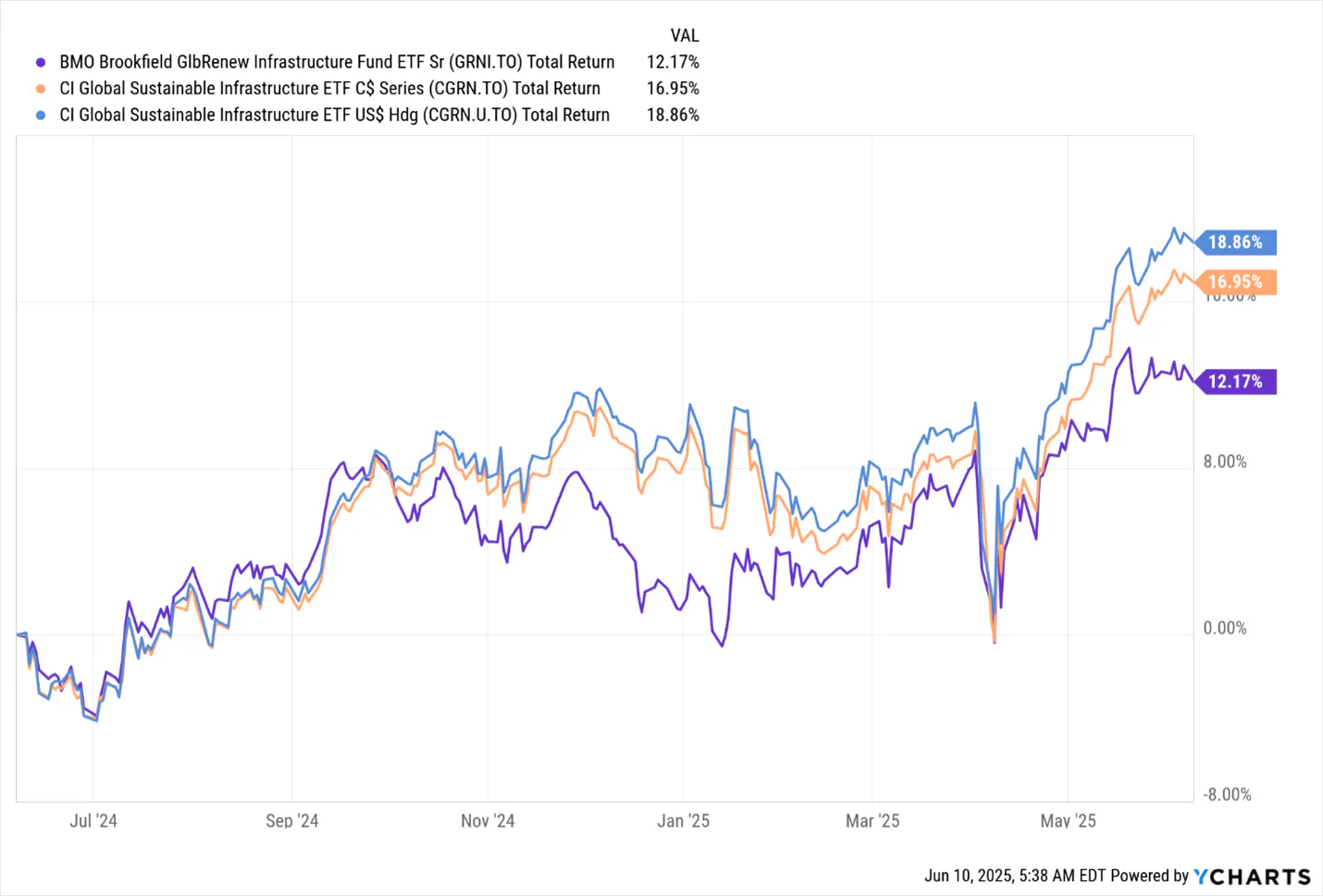
For Canadian investors looking to capitalize on the growth and potential of sustainable infrastructure can do so through distinct ETFs that provide such a thematic focus. Following are two ETFs that have a dedicated focus on sustainable infrastructure but employ differing investment strategies in achieving their objectives.
BMO Brookfield Global Renewables Infrastructure Fund (Ticker: GRNI)
The BMO Brookfield Global Renewables Infrastructure Fund focuses on renewable energy infrastructure projects globally. This ETF provides investors access to a diversified portfolio of companies involved in producing, transmitting, and distributing renewable energy.
As a globally focused mandate, the fund can invest in renewable energy projects across various regions, reducing geographical risk and enhancing potential returns. The value proposition of the fund is its ability to provide exposure to industry leaders in renewable energy, including companies specializing in wind, solar, and hydroelectric power.
CI Global Sustainable Infrastructure Fund (Ticker: CGRN/CGRN.U)
The CI Global Sustainable Infrastructure Fund offers broad exposure to sustainable infrastructure projects worldwide. This ETF emphasizes the integration of environmental, social, and governance factors into its investment strategy, which is the basis upon which companies are selected for inclusion in the fund. The investment strategy includes many sustainable infrastructure projects, from renewable energy to water management and green building technologies.
Takeaway
For Canadian investors, investing in sustainable infrastructure is a strategic investment decision and a commitment to supporting the transition to a more sustainable and resilient future. As the world continues to prioritize sustainability, the growth and development of sustainable infrastructure present a promising investment opportunity for future-focused individuals.
Please note this article is for information purposes only and does not in any way constitute investment advice. It is essential that you seek advice from a registered financial professional prior to making any investment decision.