High-Yield Monthly Income ETFs: What are the Options?
Investors seeking high monthly income can utilize these unique funds for their needs.


Investment income usually isn't a priority for investors in the accumulation stage. At this point, maximizing total returns is important. This means reinvesting dividend payments as soon as they come in and taking advantage of compounding over many years.
The same cannot be said for investors relying on their portfolio withdrawals to sustain living expenses. This often includes retirees or financially independent folks. The goal here is to be able to meet living expenses and beat inflation without depleting the portfolio prematurely. Ensuring a perpetual, safe withdrawal rate is key here, with 4% being often cited as the ideal figure.
So, we've covered a variety of options before. You have the usual high-yield dividend funds and covered call funds, but did you know about the existence of various income-oriented funds? These funds utilize a mix of more…uncommon assets, such as corporate bonds, preferred shares, and income trusts to boost yields without derivatives. Let's take a look at some options from iShares and see if they're worth it.
iShares S&P/TSX Canadian Preferred Share Index ETF (CPD)
Our first ETF uses an asset class rarely seen in ETFs: preferred shares. Compared to common shares, preferred shares have the following characteristics:
- Preferred shareholders are entitled to be paid from company assets before common stockholders in the event of bankruptcy or liquidation.
- Preferred shareholders are entitled to dividends before common shareholders are paid.
- Preferred shareholders have no voting rights, whereas common shareholders do.
From an investment perspective, the dividend part is important to note. Preferred shares often pay a much higher and more consistent yield than their common counterparts do. For example, CPD currently holds 214 preferred shares from various companies, with an average 12-month trailing yield of 4.74%.
Another quirk of preferred shares is their tendency to behave like a hybrid of fixed-income and equity securities. This makes them more sensitive to macroeconomic factors like interest rate changes, while still being affected by the idiosyncratic factors of the company issuing them. They also have credit ratings, with scores going from preferred 1L, 2H, 2, 2L, 4H, 3, and 3L.
CPD currently holds the majority of its preferred shares from large Canadian banks (26%) and insurance (20%) companies, with energy (19%) and utilities (13%) companies coming in close. In terms of expenses, the ETF charges a fairly hefty expense ratio of 0.50%.
iShares Canadian Financial Monthly Income ETF (FIE)
A far more diversified approach to maximizing income is with FIE, which holds 20% in CPD and the rest in a smattering of corporate bonds from the Canadian financial sector (banks and insurance companies). Compared to government bonds, corporate bonds have more credit risk (given that companies default much easier compared to the government) but make up for it with higher coupons (interest).
We see this in play with FIE, which currently pays a 12-month trailing yield of 6.78%. For comparison, this is higher than the dividend yield of Enbridge (ENB), without the idiosyncratic risk of investing in a single energy stock. However, the higher expense ratio of 0.81% can eat into returns.
The interesting thing is that FIE is really an asset allocation ETF of sorts (albeit narrowly constrained to just financial sector stocks and corporate bonds). Its allocation can roughly be described as 20/80 preferred shares / corporate bonds. This might seem like a fairly conservative mix, but corporate bonds don't do a great job of reducing drawdowns during a market crash, given their higher correlation to equities.
Head-to-head stress test
For fun, I decided to stress-test each of these ETFs alongside a vanilla index ETF, the iShares S&P/TSX 60 Index ETF (XIU), under the following conditions:
- Investor who retired in 2011 with $1,000,000 in their portfolio.
- An expected annual withdrawal rate of 5% (targeting at least $50,000 income).
- All distributions are reinvested when received.
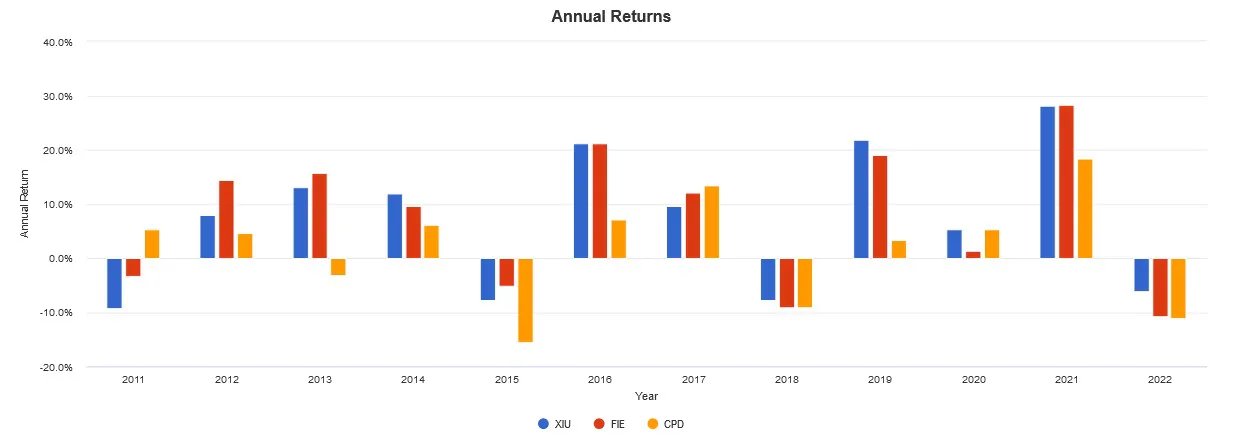
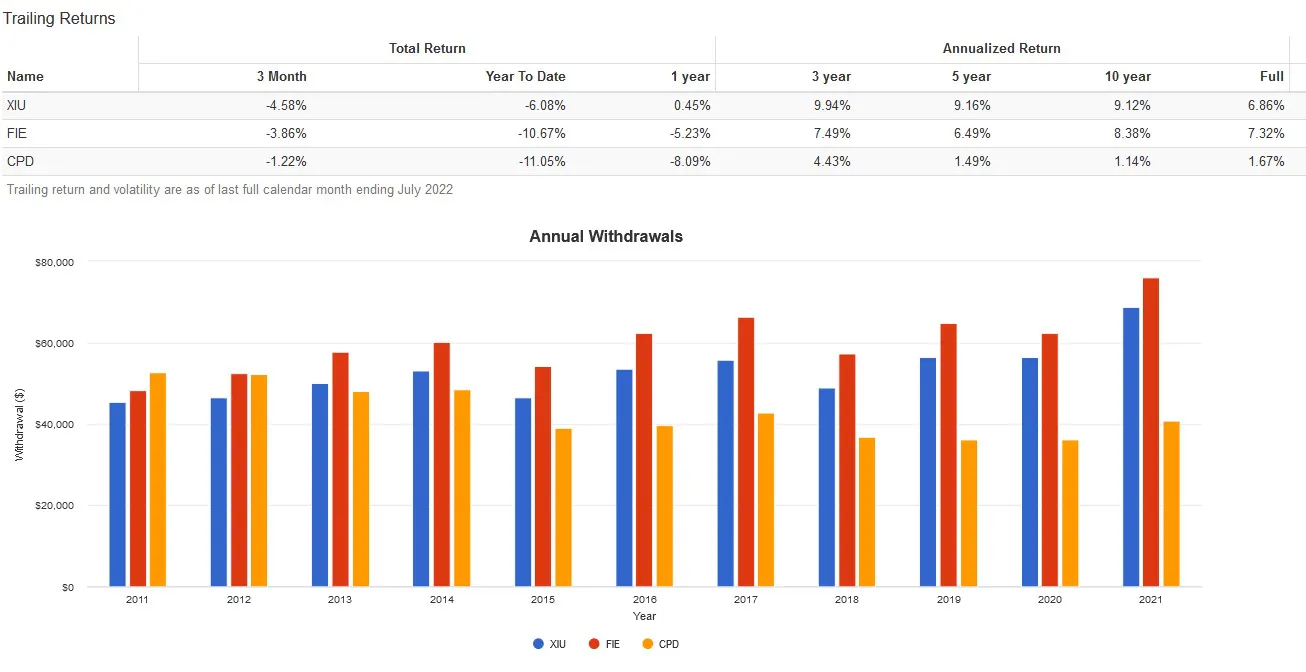
Some interesting results to discuss:
- FIE ended up with the highest final balance and CAGR. I attribute this to the strong outperformance of the TSX financial sector in recent years and the past low-interest rate environment that boosted bond returns.
- FIE and CPD both suffered hard in 2022 when interest rates rose sharply, which is to be expected given the former's high allocation of corporate bonds and the latter's high allocation of preferred shares.
- Both CPD and FIE suffered higher maximum drawdowns than XIU, despite often-parroted claims that corporate bonds and preferred shares are "less risky." That might be true in terms of volatility, but not so much when a crash occurs.
- An investor in FIE and XIU would have ended up with an account balance that exceeded their initial deposit 11 years later, even with 5% withdrawals, while an investor in CPD would not. However, when adjusted for inflation, none of the portfolios maintained a value above the initial $1,000,000 deposit.
- Investors were able to withdraw significantly more than their $50,000 target (5% of the initial $1,000,000 deposit if they invested in FIE or XIU. Investors in CPD were unable to hit the $50,000 target after 2012, as 5% of their depleted portfolio came out to less than that.
My two takeaways from this are as such:
- Maximizing total returns over yield is ideal for all investors, even those in the withdrawal phase. If you need income, sell shares as needed. Don't get caught up in the mental accounting bias of favouring distributions.
- Aim for broad diversification. Chasing yields often lead to overconcentration in certain sectors or riskier fixed-income allocations. Minimizing drawdowns is more important to keep your overall portfolio value high, so your withdrawal percentage consistently ensures a sufficient income.
Disclaimer: This article is limited to the dissemination of general information pertaining to investment strategies and financial planning and does not constitute an offer to issue or sell, or a solicitation of an offer to subscribe, buy, or acquire an interest in, any securities, financial instruments or other services, nor does it constitute a financial promotion, investment advice or an inducement or incitement to participate in any product, offering or investment.