Should You Consider Small-Cap ETFs in Canada Right Now? Here’s What to Know
Canadian small-cap ETFs are outperforming large caps in 2026, but rising rates and geopolitical risks could shape the outlook for this higher-beta segment.


The phrase ‘small in size, big in impact’ is seemingly reflective of the performance of Small Cap Canadian equities thus far in the year (as of March 13th, 2026). The year-to-date performance of the S&P/TSX Small Cap Index has outpaced that of the S&P/TSX Completion Index (i.e. mid-cap equities) and S&P/TSX 60 Index (i.e. large-cap equities).
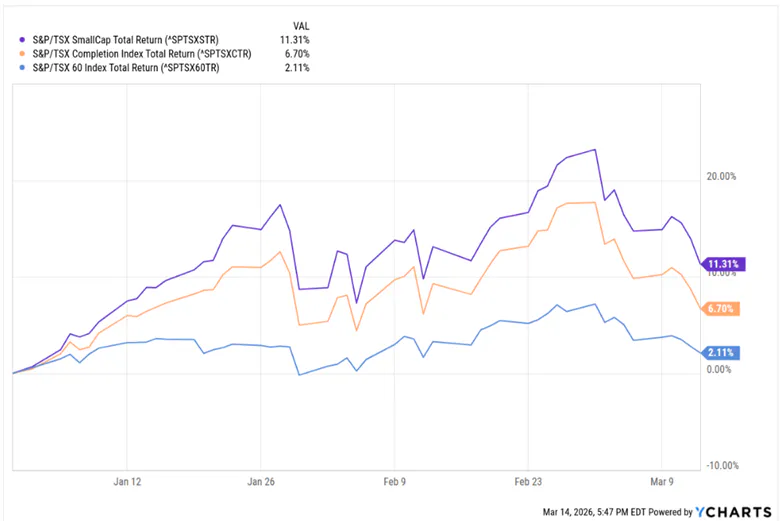
Small Caps Led the Rally. Now They’re First in the Line of Fire
While Canadian small-cap equities have exhibited a leading top-line performance, relative to mid and large cap, thus far in the year, the backdrop of increasing market uncertainty and economic precarity—the former stemming from geopolitical events in the Middle East (i.e., the Iran War), the latter evident in Canada’s rising unemployment rate—will likely have a notable impact on the asset class going forward.
Generally, small-cap equities are more sensitive to broader economic changes; therefore, the market developments mentioned earlier will continue to negatively affect the asset class’s performance.
As seen in the following drawdown chart, the recent market decline affected Canadian small-cap equities the most, and began on February 28th, the same date when Israel and the United States launched surprise airstrikes on multiple sites and cities across Iran.
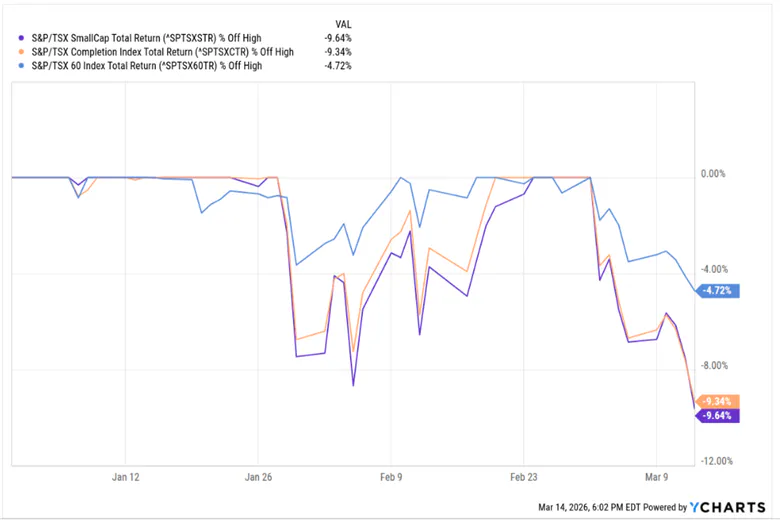
Small-cap equities are highly sensitive to shifts in the interest rate environment because these companies often rely on external financing to support their growth. They also usually face less favourable borrowing terms because, as a group, they are more exposed to default risk than larger firms. This makes them more vulnerable to interest rate changes. Given the current developments in the global and national economy, the decision taken by the Bank of Canada regarding the policy rate will be of seminal importance.
Investing in Small-Cap Equities via ETFs
For investors looking to diversify their Canadian equity holdings, small-cap equities can be beneficial. Many Canadian equity ETFs offer exposure to the largest companies, which often exclude many emerging, high-growth firms. Combining large-cap Canadian equities with small-cap equities provides broader exposure by mixing established companies with emerging ones. Although small-cap stocks are riskier, part of their appeal is that some have the potential for faster growth, which could catch the attention of large-cap companies.
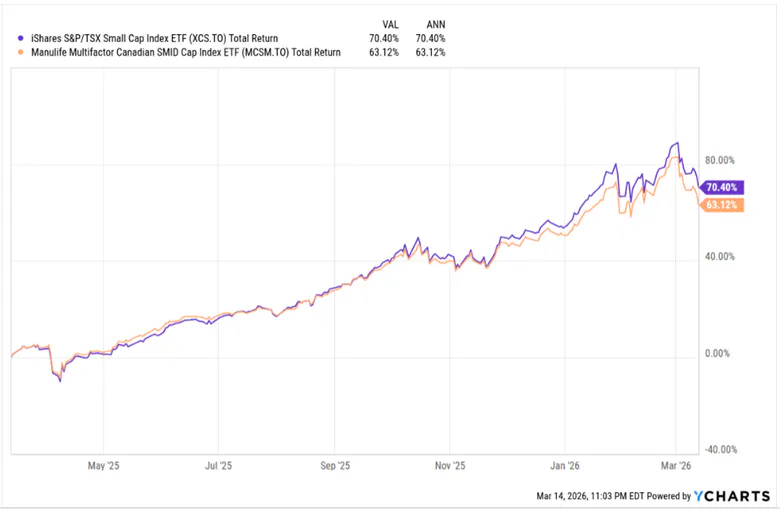
For Canadian investors interested in small-cap equities, the following ETFs offer turnkey exposure.
Manulife Multifactor Canadian SMID Cap Index ETF (Ticker: MCSM) seeks to replicate the John Hancock Dimensional Canadian SMID Cap Equity Index (CAD), which is designed to include a subset of equity securities in the Canadian universe issued by companies with market capitalisations generally between the 75th and 251st largest Canadian companies, as of the rebalancing date, with reduced exposure to companies with both high relative prices and low profitability characteristics in the Canadian market.
iShares S&P/TSX Small Cap Index ETF (Ticker: XCS)seeks to replicate the performance of the S&P/TSX SmallCap Index.
This article was written on March 14th, 2026. Please note this article is for information purposes only and does not in any way constitute investment advice. It is essential that you seek advice from a registered financial professional prior to making any investment decision.