How to Invest Like the Canada Pension Plan (CPP) with ETFs
The CPP investment portfolio uses a highly effective asset allocation. Here's how you can replicate it using ETFs.


One of the most successful asset managers in Canada and worldwide is the Canada Pension Plan (CPP) Investment Board, also known as CPP Investments. This crown corporation was established in 1997 to oversee, invest, and administer the funds in the eponymous Canada Pension Plan (CPP).
The CPP isn’t your typical investment portfolio. It's a highly effective, well-governed, and forward-thinking blend of different asset classes, allocated in a manner that has historically produced very good risk-adjusted returns. The fund currently boasts a 10.8% 10-year annualized rate of return.
Year-to-date, the fund has strongly outperformed its benchmark. By June 30, the first quarter end of its 2023 fiscal year, the fund returned -4.2%, compared to the -22.44% loss suffered by the S&P 500 index, -12.05% loss suffered by the S&P/TSX 60, and -15.08% loss suffered by the average 60/40 stock/bond portfolio.
The working parts behind CPP's investment options are fascinating, and their 2022 annual report is certainly worth a read. Today I'm going to break down their asset allocation as simply as I can, with the goal of replicating it as closely as possible using Canadian-listed ETFs.
Of course, my attempt will be an oversimplification. That being said, an understanding of why the CPP portfolio is constructed the way it is, and how it produces superior risk-adjusted returns is a valuable takeaway that can benefit many retail investors' portfolios.
CPP’s Asset Allocation at a Glance
From their 2022 annual report, we see that as of March 2022, the CPP portfolio has the following allocations:
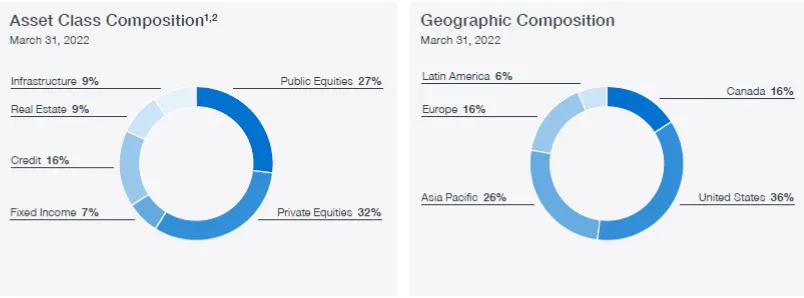
Some of these asset classes can easily be accessed via ETFs. Others may be a bit more difficult, so we'll have to substitute funds that only offer proxy exposure.
Overall, the CPP strategy is soundly rooted in modern portfolio theory: mix together a bunch of assets, all with positive expected returns but low correlation to each other, allocate them for mean-variance optimization, and apply some modest leverage.
CPP's Stock Allocation
CPP's 27% equity allocation is split between five different markets: Canada at 16%, the U.S. at 36%, Latin America at 6%, Europe at 16%, and Asia Pacific at 26%. We can roughly replicate this with four passive equity index ETFs:
- Canada: Vanguard FTSE Canada All Cap Index ETF (VCN)
- U.S.: Vanguard U.S. Total Market Index ETF (VUN)
- Europe and part of Asia Pacific (Japan, Korea Australia): Vanguard FTSE Developed All Cap ex North America Index ETF (VIU)
- Latin America and part of Asia Pacific (China, Vietnam, Taiwan): Vanguard FTSE Emerging Markets All Cap Index ETF (VEE)
CPP's Private Equity Allocation
Private equities are the shares of companies not traded on stock exchanges. Usually, investing in these is locked behind the funds of private equity or venture capital firms, limited to high-net-worth or accredited institutional investors.
A proxy for retail investors is ETFs that hold publicly traded private equity companies. This approach has some differences. Namely, you're investing in the private equity company, and not their underlying funds directly. This does change the risk/return profile of your investment.
The following ETF could work here:
CPP's Fixed Income and Credit Allocation
CPP allocates around 7% to fixed income and 16% to credit instruments, lower than many risk-averse retail investors. This has helped them avoid the bulk of losses resulting this year from rising interest rates. When you have alternative sources of risk and return like private equity and absolute return strategies, the necessity of a high fixed-income allocation becomes less important.
CPP's fixed income and credit allocation is globally diversified and includes government bonds (federal and provincial), agency bonds, investment-grade corporate debt, and also private credit with an average credit rating of B+. Investors can mix and match the following ETFs:
- Vanguard Global Aggregate Bond Index ETF (VGAB)
- BMO Long-Term U.S. Treasury Bond Index ETF (ZTL)
- iShares 1-10 Year Laddered Government Bond Index ETF (CLG)
- iShares Canadian Short Term Bond Index ETF (XSB)
- BMO Corporate Bond Index ETF (ZCB)
CPP's Real Estate and Infrastructure Allocation
CPP also allocates 9% to real estate and 9% to infrastructure. This includes both private and public sources. This allocation delivers a combination of income and capital growth, while providing some inflation protection. Underlying sources include renewable and non-renewable energy infrastructure, such as pipelines and utilities. The following ETFs could work:
CPP's Absolute Return Strategy Allocation
And finally, not shown in the picture above is CPP's use of absolute return strategies. These are investments designed to provide a positive expected return under all market conditions, with less correlation to stocks and bonds while providing lower volatility.
They can use a variety of strategies, including systematic trend-following, global macro, long/short, and market-neutral in multiple different asset classes (equities, fixed income, commodities, currencies) to achieve this goal. Some investors might be familiar with them under the guise of "liquid alternatives."
- NBI Liquid Alternatives ETF (NALT)
- Horizons Tactical Absolute Return Bond ETF (HARB)
- Horizons Absolute Return Global Currency ETF (HARC)
Disclaimer: This article is limited to the dissemination of general information pertaining to investment strategies and financial planning and does not constitute an offer to issue or sell, or a solicitation of an offer to subscribe, buy, or acquire an interest in, any securities, financial instruments or other services, nor does it constitute a financial promotion, investment advice or an inducement or incitement to participate in any product, offering or investment.