How Much Crypto Is Enough? Allocation and ETF Ideas
A look at how investors can size cryptocurrency allocations and the ETF options available for bitcoin, ether, and multi-crypto exposure.


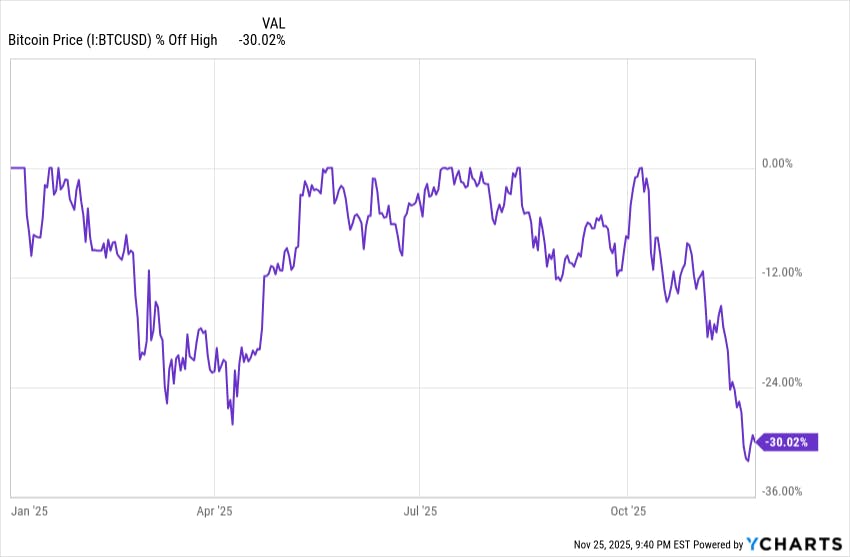
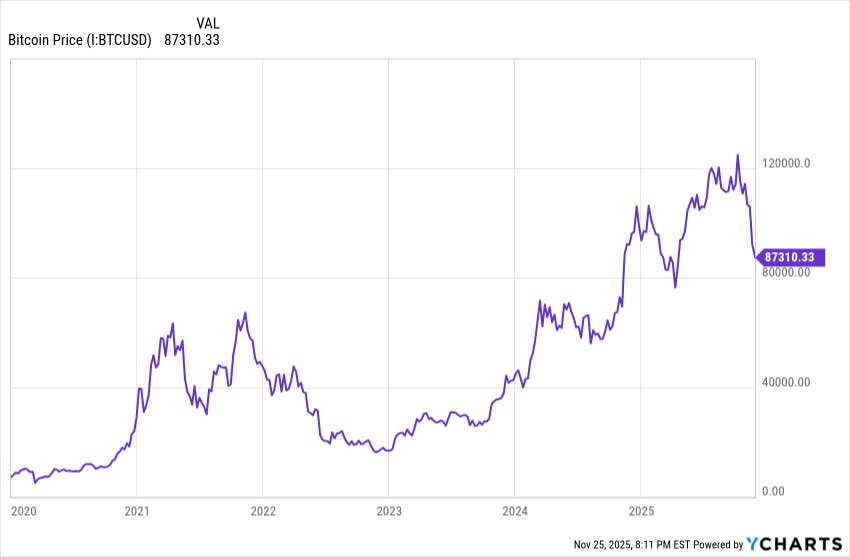
For individuals casually following the cryptocurrency markets, the current drawdown in Bitcoin may have caught your attention. After exceeding $120,000 in October, the popular cryptocurrency fell by approximately 30%. While most investors understand that drawdowns are part of the investment experience, the observable magnitude of bitcoin (and other cryptocurrency) drawdowns over the years may be a hindrance for some considering adding the asset class to their portfolio, despite its strong performance.
Allocating to Cryptocurrency
While access to cryptocurrencies has become relatively easy through exchange-traded funds, determining how much to allocate to these assets within a portfolio remains a lingering question. A recent whitepaper by Morgan Stanley Wealth Management sought to provide an answer.
In their capital market assumption framework calculated in March 2025, they projected the following for cryptocurrency over a strategic seven-year period: geometric and arithmetic returns of 6.0% and 17.2%, respectively; an annualized volatility of 55.3%; and a correlation of about 0.50 with US large-cap equities. These quantitative traits suggest that cryptocurrency shares similarities with US large-cap growth equity holdings.
Although bitcoin is increasingly traded like a high beta, large-cap growth stock, it remains a “zero-carry” asset—similar to certain commodities but unlike equities—lacking income-generating features such as dividends or interest to support its value. Importantly, this implies that bitcoin frequently trades based on technical factors or in relation to other assets that are fundamentally supported by cash flows.
Ultimately, since cryptocurrencies have a volatile investment profile, the whitepaper recommends an allocation of 2%-4% for moderate-to-aggressive growth portfolios and no exposure for more conservative portfolios.
Looking at the current Canadian multi-asset portfolio landscape, solutions like Fidelity’s All-in-One ETFs offer investors increasing exposure to cryptocurrencies as they progress along the risk spectrum.
Stand-Alone Offerings
For individuals who wish to add exposure to their portfolios at their discretion, there are several standalone ETFs they can consider. For those seeking pure-play exposure to bitcoin, the iShares Bitcoin ETF (Tickers: IBIT/IBIT.U) can facilitate said need. If an investor has an interest in an alternative cryptocurrency, such as Ethereum, the Purpose Ether Staking Corp. ETF (Ticker: ETHC.B) can provide this exposure.
More comprehensively, if an investor wants broad-based exposure to all cryptocurrency offerings, solutions such as CI Galaxy Multi-Crypto Navigator ETF (Tickers: CMCX.B/CMCX.U/CMCX) and CI Galaxy Core Multi-Crypto ETF (Tickers: CCCX.B/CCCX.U/CCCX) provide turnkey exposure via a single ticket. Regarding these solutions, the former uses a rules-based, momentum signalling strategy in its cryptocurrency allocation, whereas the latter is weighting-based on a modified market capitalization model.
Takeaway
Cryptocurrencies have become a table-stakes offering of the investment opportunity set, one that investors are interested in gaining exposure to. Despite the growing interest, the risky nature of this asset class still needs to be top-of-mind; as such, understanding where one resides on the risk spectrum and how a cryptocurrency allocation will help you achieve your investment goals is important to consider before taking any action.
Please note this article is for information purposes only and does not in any way constitute investment advice. It is essential that you seek advice from a registered financial professional prior to making any investment decision.