How Trump’s Policy Will Affect Crypto ETFs
A look at ETFs that are poised to benefit from the change in the U.S. Presidential Administration.


Though the performance of U.S. Equities and Gold was stellar for 2024, the performance of Bitcoin was exceptional. A strong reason for that was the election of President-elect Trump and what it could ultimately mean for the crypto industry.
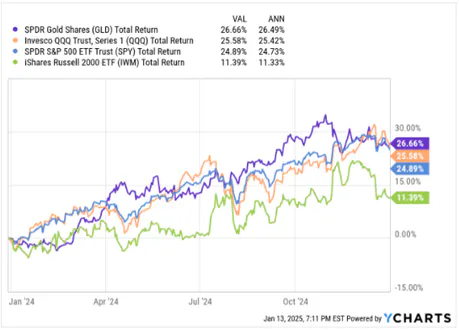
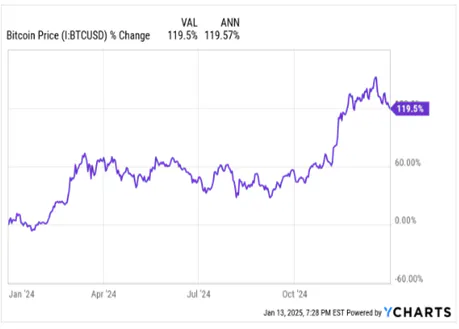
As the previous chart shows, Bitcoin’s performance rallied following the U.S. Presidential Election. The cryptocurrency landscape under President-elect Trump is poised to change in some material ways, namely, the passing of two important bills, the FIT21 Act and the Bitcoin Strategic Reserve Act.
The FIT21 Act seeks to establish a clear legal framework for token issuance and trading by classifying tokens as digital assets or commodities. It shifts regulatory oversight from the Securities and Exchange Commission (SEC) to the Commodity Futures Trading Commission (CFTC) and introduces a safe harbor mechanism, aiming to standardize and support the industry’s growth.
The Bitcoin Strategic Reserve Act, tied to Trump’s campaign promises, would elevate Bitcoin from a niche asset to a national reserve asset, boosting its legitimacy and global recognition. If passed, it could encourage other nations to adopt similar policies. Submitted to Congress on August 4, 2024, and currently under Senate Banking Committee review, Trump is well-positioned to advance this bill. Several U.S. states have also proposed Bitcoin reserve legislation, signaling that Bitcoin as a strategic reserve may become a reality in 2025.
Under Trump’s presidency, the SAB121 Act is likely to be repealed, enabling traditional financial institutions to hold cryptocurrencies on their balance sheets. This move would accelerate crypto’s institutionalization and market maturity. Additionally, a relaxed application of the Howey Test by the SEC could increase approvals for spot crypto ETFs and public listings of crypto companies.
Capitalizing on a changing landscape
For Canadian investors seeking exposure to Bitcoin, there are several ETFs to choose from.
The recently launched iShares Bitcoin ETF (Tickers: IBIT/IBIT.U) seeks to reflect the general performance of Bitcoin’s price. The fund’s exposure leverages a multi-year technology integration developed with Coinbase Prime, the world’s largest institutional digital asset custodian.
The Purpose Bitcoin ETF (Tickers: BTCC/BTCC.B/BTCC.U) is a physically settled Bitcoin solution, a differentiating characteristic relative to other ETF offerings on the market.
The CI Galaxy Bitcoin ETF (Ticker: BTCX.B/BTCX.U) tracks the Bloomberg Galaxy Bitcoin Index. The fund invests directly in Bitcoin and will utilize high-quality service providers in the digital assets sector (e.g., digital asset custodians, trading platforms, and trading counterparties) to manage the assets of the fund.
The Fidelity Advantage Bitcoin ETF (Ticker: FBTC) invests directly in Bitcoin, with the security of Fidelity’s in-house storage services.
The Evolve Bitcoin ETF (Ticker: EBIT) provides investors with exposure to the daily price movements of the U.S. dollar price of bitcoin while experiencing minimal tracking error by utilizing the benefits of the creation and redemption processes offered by the ETF structure. EBIT offers investors exposure to bitcoin by investing directly in bitcoin, with EBIT’s holdings of bitcoin priced based on the CME CF Bitcoin Reference Rate, a once-a-day benchmark index price for bitcoin denominated in U.S. dollar.
Please note this article is for information purposes only and does not in any way constitute investment advice. It is essential that you seek advice from a registered financial professional prior to making any investment decision.