International ETFs To Reduce U.S. Market Exposure
A look at International Equity ETFs worthy of consideration in a changing global landscape.


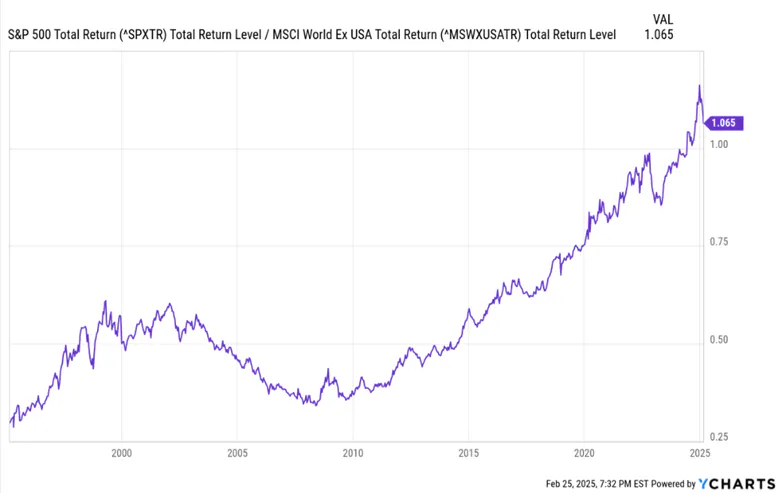
The outperformance of U.S. equities relative to international equities has a well-established track record. As illustrated in the following chart, the relative performance of the S&P 500 Index to the MSCI World ex-USA exemplifies the degree of outperformance over the years.
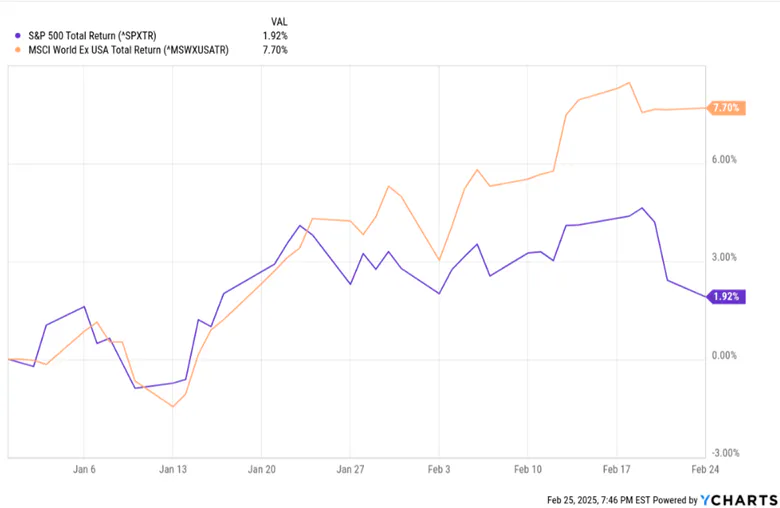
Thus far in 2025, the performance of international equities has outpaced that of U.S. equities. In looking at the performance of the MSCI World ex-USA Index versus the S&P 500 Index, the former has exhibited a materially stronger performance thus far.
Rising U.S. Uncertainty
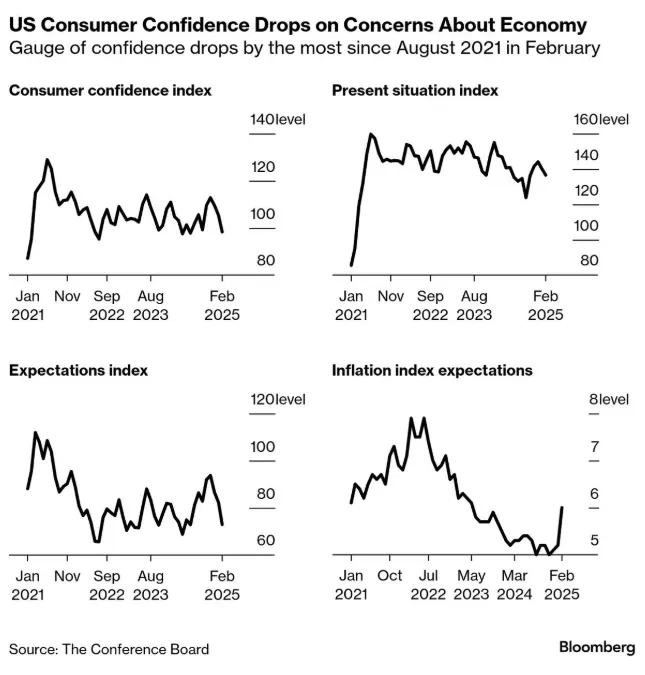
With growing uncertainty about U.S. economic policy, concerns about the possibility of a U.S. recession are rising. As noted in a recent Bloomberg article, U.S. consumer confidence fell this month by the most since August 2021 due to concerns about the outlook for the broader economy. U.S. consumers were more pessimistic about current and future labor-market conditions and the outlook for incomes and business conditions. The current economic anxiety of American citizens is contextualized in a recent Wells Fargo study that details that more than half of consumers are delaying major life plans due to uncertainty over the economy and the consequences of Trump’s tariff threats. Of those, about a third said they were putting off buying a home, while one in six have postponed education plans—and one in eight have pushed back retirement.
Investing Beyond the U.S.
Given the growing uncertainty regarding the economic policy actions being implemented under the Trump administration, investors seeking to limit their exposure to U.S. equities can consider international equity ETFs. These solutions provide comprehensive exposure to other equity markets.
For Canadian investors, several ETFs offer access to international equities while also providing a distinct investment focus. The following is a selection of international ETFs that are worthy of consideration:
The iShares International Fundamental Index ETF (Ticker: CIE) seeks to replicate the performance of the FTSE RAFI Developed ex US 1000 Index, which reflects companies based on fundamental factors, including dividends, free cash flow, sales, and book value. The index’s methodology seeks to avoid overweighting overvalued stocks and underweighting undervalued stocks. Notable companies held within the fund include Shell, Toyota, and Nestle.
The Dynamic Active International ETF (Ticker: DXIF) is an actively managed solution providing access to companies outside North America (i.e., U.S. and Canada). The fund has a high active share; as such, it has a low correlation with any benchmark index. Notable holdings within the fund include the London Stock Exchange Group PLC, Airbus SE, and Adidas AG.
For investors seeking single-factor, international equity mandates, Fidelity’s International Momentum ETF (Ticker: FCIM) and International High-Quality ETF (Ticker: FCIQ) are turnkey solutions. FCIM provides exposure to companies that exhibit positive momentum signals, while FCIQ focuses on companies with strong balance sheets and more stable cash flows than the broader international equity market.
Regarding notable holdings, FCIM includes HSBC Holdings PLC and Softbank Group; while FCIQ includes ASML Holdings NV and SAP SE.
For investors exploring international equities ETFs, the Cboe ETF Market Canada Screener is a valuable resource. Additional options include the TD International Equity Index ETF (Ticker: TPE), Mackenzie International Equity Index ETF (Ticker: QDX), and Franklin International Equity Index ETF (Ticker: FLUR), among others.
Please note this article is for information purposes only and does not in any way constitute investment advice. It is essential that you seek advice from a registered financial professional prior to making any investment decision.