Investing in Canadian Equity Pillars via ETF
A look at how Canadian bank and energy ETFs let investors capture the two sectors driving over half of the TSX Composite in 2026.


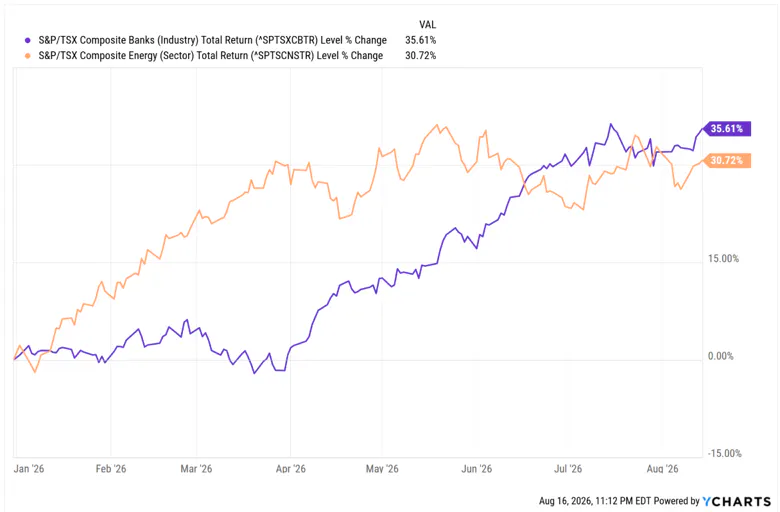
Within the Canadian equities asset class, both the Financials (specifically Banks) and Energy sectors are foundational pillars, collectively representing over 50% of the S&P/TSX Composite Index as of July 2025. Canadian Banks and the Canadian Energy sector have been particularly noteworthy, as shown by the S&P/TSX Composite Banks Total Return Index and S&P/TSX Composite Energy Total Return Index, which have returned 35.61% and 30.72%, respectively, year to date (as of August 14th, 2026).
Looking Below the Surface
Consistent earnings beats and strong earnings-per-share momentum have propelled Canadian banks' performance so far this year. Given the precariousness of the Canadian economy, concerns about the health of Canadian households, and the need for banks to increase their loan loss provisions were leading considerations for analysts. However, as noted in the Bank of Canada’s 2026 Financial Stability report, Canadian households have shown a high level of resilience. More specifically, though debt levels remain high – they are below their 2022 peak – and the share of borrowers falling behind on debt payments stabilized over the past year.
Beyond no increases in impairments, several banks noted revenue increases in their wealth management and capital markets business segments. Furthermore, five of the six Big Six banks — TD Bank Group, Royal Bank of Canada, Bank of Nova Scotia, BMO Financial Group and National Bank of Canada — each hiked their quarterly dividend following Q2 results. Dividend hikes of this nature are a strong management signal that earnings are not only beating in the near term, but are expected to be sustained.
The single biggest driver of Canadian energy stocks this year has been the geopolitical shock from the Middle East. With continued uncertainty about the progress of negotiations and when the conflict could end, elevated oil prices are likely to persist. From a strategic development standpoint, Enbridge started construction on its C$4 billion Sunrise Expansion Program, a natural gas pipeline project in British Columbia that received federal approval in April. The expansion will increase the province's gas transmission capacity by 300 million cubic feet per day, helping supply LNG export terminals on Canada's West Coast.
Investing in Canadian Banks and Energy via ETF
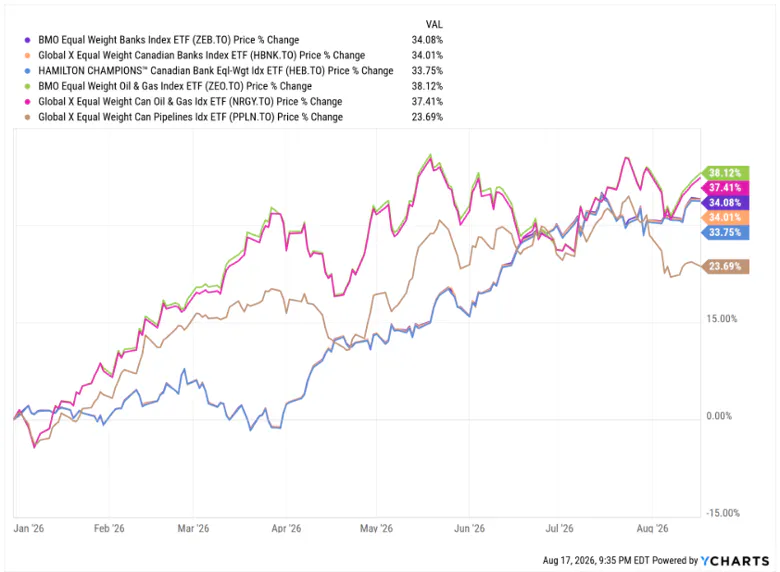
For Canadian investors seeking turnkey exposure to Canadian banks and energy firms, several equal-weight ETFs offer exposure to many of the leading firms in each industry. For individuals seeking banking exposure, the BMO Equal Weight Banks Index ETF (Ticker: ZEB), Hamilton Canadian Bank Equal-Weight Index ETF (Ticker: HEB), and Global X Equal Weight Canadian Banks Index ETF (Ticker: HBNK) all seek to replicate the Solactive Equal Weight Canada Banks Index.
Regarding Energy, the BMO Equal Weight Oil & Gas Index ETF (Ticker: ZEO) and Global X Equal Weight Canadian Oil & Gas Index ETF (Ticker: NRGY) are options worth considering, as they both provide exposure to the largest and most liquid Canadian companies in Oil & Gas. ZEO replicates the performance of the Solactive Equal Weight Canada Oil & Gas Index, while NRGY replicates the performance of the Mirae Asset Equal Weight Canadian Oil & Gas Index. Global X also offers the Global X Equal Weight Canadian Pipeline Index ETF (Ticker: PPLN), which focuses exclusively on midstream Canadian oil and gas companies, allowing investors to participate in the transportation and distribution aspects of the oil and gas industry. PPLN seeks to replicate the performance of the Mirae Asset Equal Weight Canadian Pipeline Index.
This article was written on August 17th, 2026. Please note this article is for information purposes only and does not in any way constitute investment advice. It is essential that you seek advice from a registered financial professional prior to making any investment decision.