Low-Volatility ETFs: A Buffer Against Trade Tensions
As Canada-U.S. trade tensions escalate, diversification and low-volatility ETFs offer investors a proven path through market uncertainty.


Risk is part of the investing experience. Yet while current market uncertainty feels heightened, particularly on the geopolitical front, market volatility has not materially risen. Amid renewed trade tensions between Canada and the U.S., the potential implications are far-reaching, with the U.S. imposing 50% tariffs on Canadian products accounting for some $27.6 billion in annual trade. In turn, Canadian Prime Minister Mark Carney announced dollar-for-dollar counter-tariffs of $27.6 billion on U.S. imports and will focus on sectors such as steel, dairy, appliances, agricultural equipment, pulp and paper, and electronics. Details on Canada’s tariffs are available here.
While the pace of trade-war rhetoric and announcements has been rapid, context is needed to understand the scale of their impact. As contextualized by a research memo published by National Bank of Canada’s Capital Markets Group, the 50% tariff the U.S. will impose will apply to roughly 5% of imports from Canada that had previously qualified for duty-free treatment under the Canada-United States-Mexico Agreement (CUSMA). As a result, the average tariff rate on Canadian goods would nearly double to about 6%, leaving Canada only slightly better positioned than the average U.S. trading partner. As shown in the following images, Canada is still better positioned than other U.S. trading partners, but that could change if the Trump administration decides to add more tariffs.
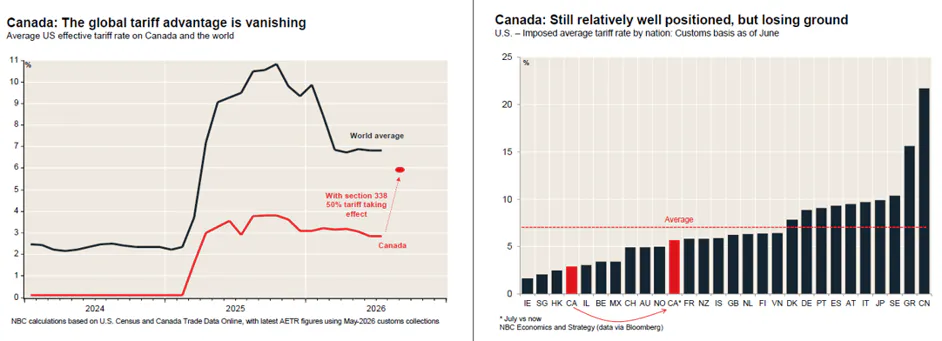
Given that trade policy uncertainty has persisted throughout President Trump’s first and current administration, its impact on the Canadian business landscape has been material, ranging from heightened business uncertainty for operators to products becoming uncompetitive in the U.S. market, resulting in declining exports, lost market share, and factory closures. Against the current U.S.-Canada trade backdrop, the Canadian government announced a $7.5 billion support package to aid affected Canadian workers and businesses at this precarious time.
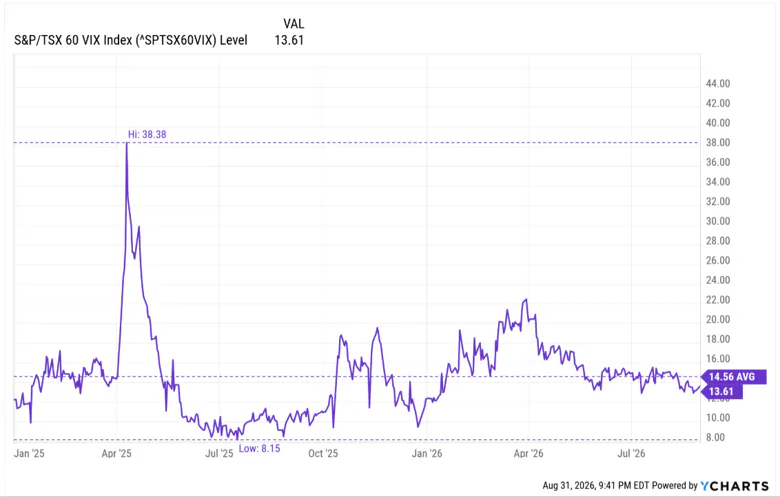
But the current tariff situation is not truly reminiscent of what occurred in 2025 (i.e., Liberation Day), as Canadian equity volatility, as illustrated by the S&P/TSX60 VIX index, has not shifted noticeably since each nation's tariff announcements. This suggests market participants are being measured in their response this go-round. Nonetheless, some investors may still be considering the impact on Canadian equity markets if this tariff environment persists or escalates.
Benefitting from Diversification & Low Volatility
For individuals examining the current geopolitical developments between the U.S. and Canada from an investment perspective, understanding the degree of their portfolio's exposure to Canada’s economy is a natural first step. Within the global equity landscape, Canada’s contribution is noteworthy, as shown in the respective factsheets of the MSCI All Country World Index and MSCI World Index, but it is not large enough to concern an investor that has a global perspective. Alternatively, the international equities asset class (MSCI EAFE Index) has no exposure to Canada. As such, investors with diversified geographic equity exposure already have a measure of risk mitigation in place. Furthermore, investors who utilize factor-based strategies within their portfolios also have an advantage, particularly those familiar with low-volatility investing. Low-volatility investing lets investors benefit from a proven strategy that provides innate risk mitigation and selects equities best suited to thrive through the ups and downs of an economic cycle. Specifically for ETFs, low-volatility ETFs are composed of stocks that are less volatile than their peers, which means that, on a risk-adjusted basis, they should exhibit superior performance and provide exceptional returns relative to other portfolios.
Attaining Diversification & Utilizing Low Volatility via ETF
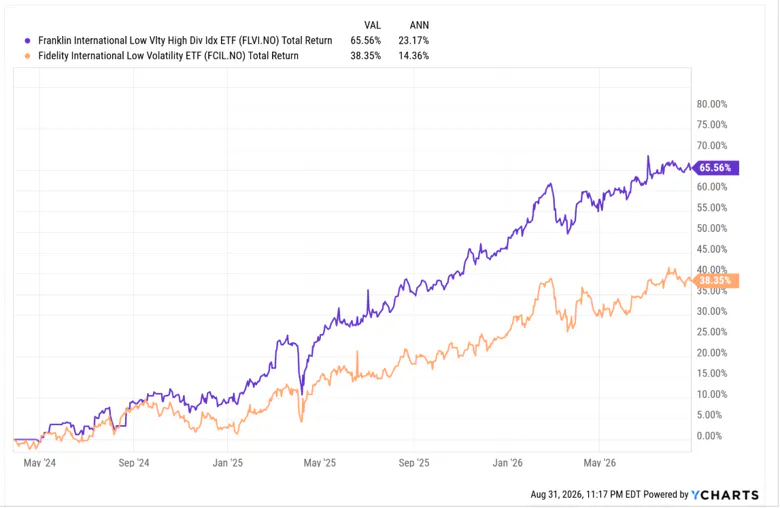
For investors looking to remain invested amid current trade uncertainty, solutions that are inherently diversified and/or reflect a low-volatility investment style may be a preferred course of action, as they allow investors to stay invested regardless of the prevailing market environment. As such, international equity-focused solutions, such as the Fidelity International Low Volatility ETF (Ticker: FCIL) and the Franklin International Low Volatility High Dividend Index ETF (Ticker: FLVI), may be worth considering.
FCIL provides investors with single-factor exposure to companies with lower volatility than the broader international equity market. As an asset class, international equities provide broad exposure to a broadly diversified group of companies across different regions and sectors. Similarly, FLVI is also international and low-volatility oriented, but has a high-dividend focus. The dividend aspect of the strategy favours stocks with yields supported by earnings and relatively low price and earnings volatility. This combination results in a portfolio that offers both income generation and stability.
Takeaway
Although trade relations between the U.S. and Canada are currently strained, this has not translated into higher market volatility, as shown by the S&P/TSX VIX Index. However, for investors seeking to manage market uncertainty, a diversified and low-volatility approach has proven effective over the long term.
This article was written on August 31st, 2026. Please note this article is for information purposes only and does not in any way constitute investment advice. It is essential that you seek advice from a registered financial professional prior to making any investment decision.