Low-Volatility ETFs: A Smarter Play for Market Uncertainty
Defensive investing outperforms in 2025. Low-volatility ETFs offer stability, reducing risk while maintaining returns. Explore top Canadian low-volatility ETF options.


In investing, as in sports, sometimes the best offense is a strong defense. To quote famed soccer coach Sir Alex Ferguson, "Attack wins you games, defense wins you titles." In the current market environment, a defensive investment mindset has proven fruitful against the backdrop of elevated market uncertainty.
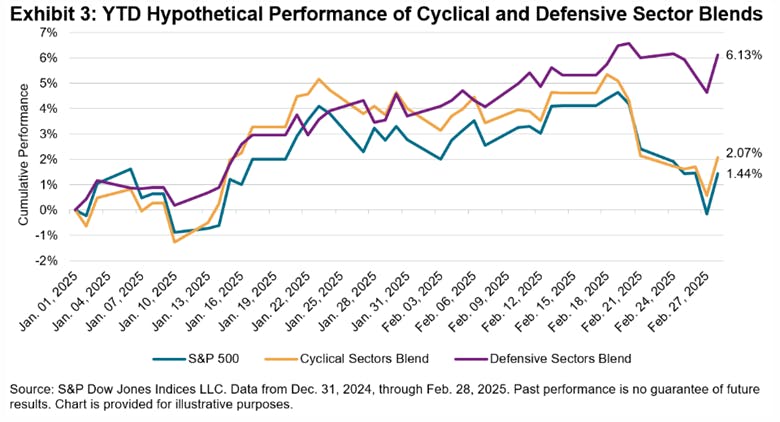
A recent S&P Global memo examined the performance of defensive investing by contrasting the performance of equally weighted blended indices comprised of traditionally cyclical and defensive sectors. The cyclical blended index included the Information Technology, Financials, Materials, Consumer Discretionary, and Industrials sectors. In contrast, the defensive blended index included the Utilities, Energy, Consumer Staples, Health Care, and Communication Services sectors. Both indexes were rebalanced monthly.
Year-to-date, through February 2025, the hypothetical defensive sector index has outperformed the cyclical and S&P 500 indexes.
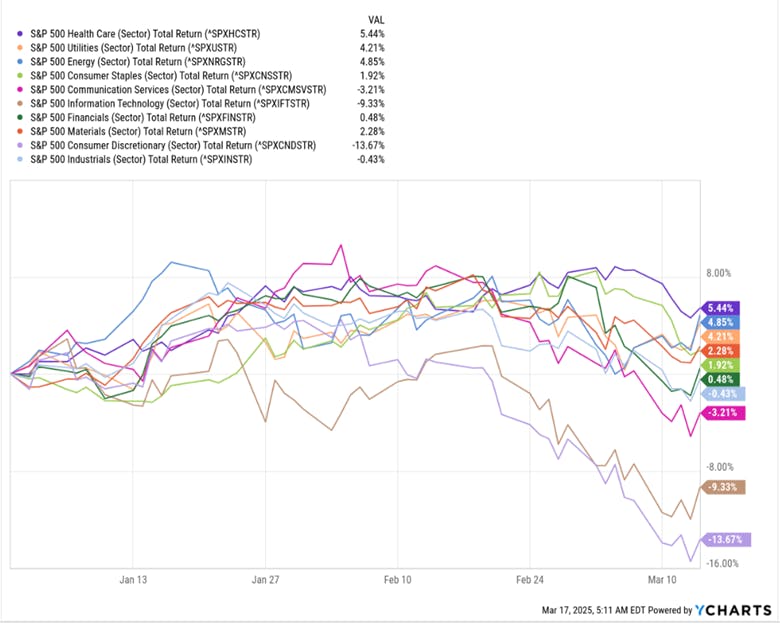
Looking at each sector's recent performance, as of March 14th, 2025, the defensive sectors have exhibited more compelling year-to-date returns than their cyclical counterparts.
Low Volatility As A Defensive Strategy
For investors seeking a defensive investment approach, low-volatility investing can be a turnkey solution worth exploring. Low-volatility portfolios are comprised of stocks that are less volatile than their peers, which means that on a risk-adjusted basis, they should exhibit superior performance and provide exceptional returns relative to other portfolios. Low volatility can be measured in two ways. The first is the standard deviation, which measures the volatility of each stock on a standalone basis, and the second is beta, which measures a stock's volatility and correlation relative to the overall market. The market has a beta of 1.0, so a stock with a beta below one is considered less volatile than the market and vice versa for a stock with a beta above 1.0.
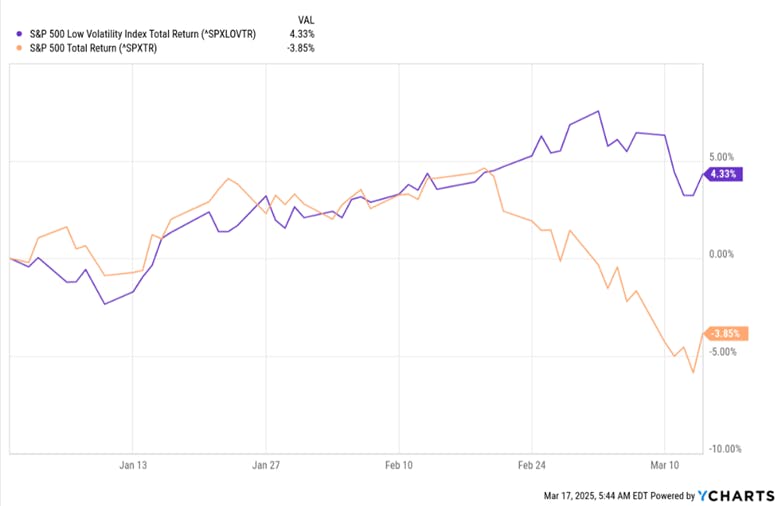
It should be noted that low-volatility portfolios are not impervious to market drawdowns; however, when market shocks occur, low-volatility portfolios generally outperform (i.e., lose less) than the broader market.
Low Volatility ETFs For Canadian
For Canadian investors looking for low-volatility solutions focused on the U.S. equity market, there are several ETF offerings available for consideration, namely:
The CIBC Qx U.S. Low Volatility Dividend ETF (Ticker: CQLU) seeks current income and long-term capital growth by investing primarily in U.S. equity securities that are expected to provide regular income from dividends while seeking to reduce volatility. As of January 31, 2025, the fund's most significant sector allocations have been Consumer Staples (19.9%) and Utilities (17%), with Kinder Morgan Inc., Altria Group Inc., and Philip Morris International Inc. being among the top holdings.
Alternatively, the Franklin U.S. Low Volatility High Dividend Index ETF (Ticker: FLVU) is another option for investors seeking high dividends and low volatility. Tracking the Franklin Low Volatility High Dividend CAD Index NTR, FLVU selects stocks based on strong earnings and balanced risk management, aiming for stable returns and income. As of March 13, 2025, the fund's 110 holdings are heavily weighted towards consumer staples (25%), utilities (24%), real estate (14%), and financials (8%).
The BMO Low Volatility U.S. Equity ETF (Tickers: ZLU/ZLU.U/ZLH) is designed to provide exposure to a low beta-weighted portfolio of U.S. stocks. In executing this investment strategy, the fund employs a rules-based methodology to select the 100 least market-sensitive stocks from a universe of U.S. large-cap stocks. As of March 14, 20205, the fund's most significant sector allocations are Utilities (20.2%), Health Care (17.7%), and Consumer Staples (15.69%), with International Business Machines Corp, Gen Digital Inc, and Johnson & Johnson being among the top holdings. There is both a USD and hedged version of the investment solution.
Finally, the TD Q U.S. Low Volatility ETF (Ticker: TULV) seeks to optimize the portfolio by overweighting stocks expected to deliver less volatile returns and underweighting or excluding stocks expected to provide more volatile returns. The portfolio manager currently uses historical standard deviation as a tool in selecting the stocks, looking at individual stocks and the correlation between stocks to reduce volatility. As of February 28, 2025, the fund's most significant sector allocations are Financial Services (23.3%), Consumer Goods (22.2%) and Health Care (22.1%), with Johnson & Johnson, Boston Scientific Corp, and CME Group Inc being among the top holdings.
Please note this article is for information purposes only and does not in any way constitute investment advice. It is essential that you seek advice from a registered financial professional prior to making any investment decision.