Low Volatility Investing Using ETFs: Here's How It Works
Exploring how low volatility investing works and how we can implement it using some low-cost BMO ETFs.


One of the first things I learned at Columbia University while studying for my master's degree in risk management was that "without risk, there is no return." The trick is interpreting this right. A lot of investors tend to interpret this as "more risk = more returns." This is true up to a point. Ideally, we want to take on smart risks with an asymmetrical payoff – where the return is commensurately higher.
The research suggests that taking on certain empirically validated and compensated risks (like the Fama-French factors of market, size, value, profitability, and investment) can lead to excess returns over the index (the elusive "alpha"). You might recognize some of these terms from various "smart beta" ETFs out there, which attempt to isolate and target specific risk factors with their investment strategy.
There is one exception, though, and it's called the low-volatility anomaly (or paradox). To put it simply, research has shown that investing in low-volatility stocks has historically outperformed over multiple rolling time periods with statistical significance. This is a direct contradiction of what the Capital Asset Pricing Model (CAPM) tells us - that there should be a positive relationship between the systematic risk exposure of a stock and its expected future returns.
Let's see how the strategy works and how we can implement it using some low-cost BMO ETFs.
What is Volatility Anyways?
When it comes to individual equity-like securities (stocks, ETFs), volatility is primarily measured by two concepts:
- Standard deviation: measures how much investment has historically fluctuated from its expected return. The smaller the standard deviation, the less an investment's return has dispersed around its average. A high standard deviation makes it difficult for investors to develop reliable profit expectations.
- Beta: measures how sensitive investment is relative to a market index, such as the S&P 500. A beta of greater than 1 means an investment is more volatile than the market, whereas a beta of between 0 and 1 means the investment is less volatile. A negative beta means the investment moves inversely to the market.
Low volatility investments are, therefore, stocks or ETFs with a lower-than-average standard deviation and beta compared to a benchmark, such as sector peers for the former and a broad market index for the latter. While past performance can't predict future returns, it turns out that past volatility is a fairly good predictor of future volatility.
Explanations for Low Volatility Investing
There are many schools of thought as to why low volatility investing strategies outperform. For your reading convenience, I've summarized a few of the more credible ones below:
- Low-volatility stocks tend to be mature, stable companies with excellent balance sheets, strong revenues, consistent earnings, and good cash flows. Thus, they provide excellent exposure to the profitability and investment risk factors, which explains their out-performance.
- Low-volatility stocks take advantage of the relationship between geometric and arithmetic returns by minimizing the negative effects of large compounding losses. For example, losing 33% in a year requires a 50% return in the following year to break even due to this relationship. For that reason, avoiding large losses should be more important than chasing high returns, and low-volatility stocks do that better.
- Low-volatility stocks are often overlooked by investors in favour of high-beta growth stocks (think about all the tech sector bubbles we've had). Thus, they tend to be underpriced relative to their fundamentals and, according to the value risk factor, can provide a higher return.
What's the real truth? Honestly, I'm not sure yet. I'm still in the midst of sifting through a few hundred pages of academic research to figure this out. At the time, these are some of the more understandable and reasonable explanations for the phenomenon.
Low Volatility Investing Using ETFs
Investors can use a stock screener to pick a portfolio of low-volatility companies, but this approach is time-consuming, difficult to rebalance, and may incur substantial trading commissions and bid-ask slippage. A better way is via ETFs, and BMO has conveniently released a lineup of three actively managed funds targeting Canadian, U.S., and international low volatility stocks:
- BMO Low Volatility Canadian Equity ETF (ZLB): 0.39% expense ratio.
- BMO Low Volatility US Equity ETF (ZLU): 0.33% expense ratio.
- BMO Low Volatility International Equity ETF (ZLI): 0.45% expense ratio.
In terms of historical performance since inception, ZLB has beaten the S&P/TSX Capped Composite Index, while ZLU has beaten the S&P 500, but ZLI has failed to beat the FTSE All-World Ex-US Index.
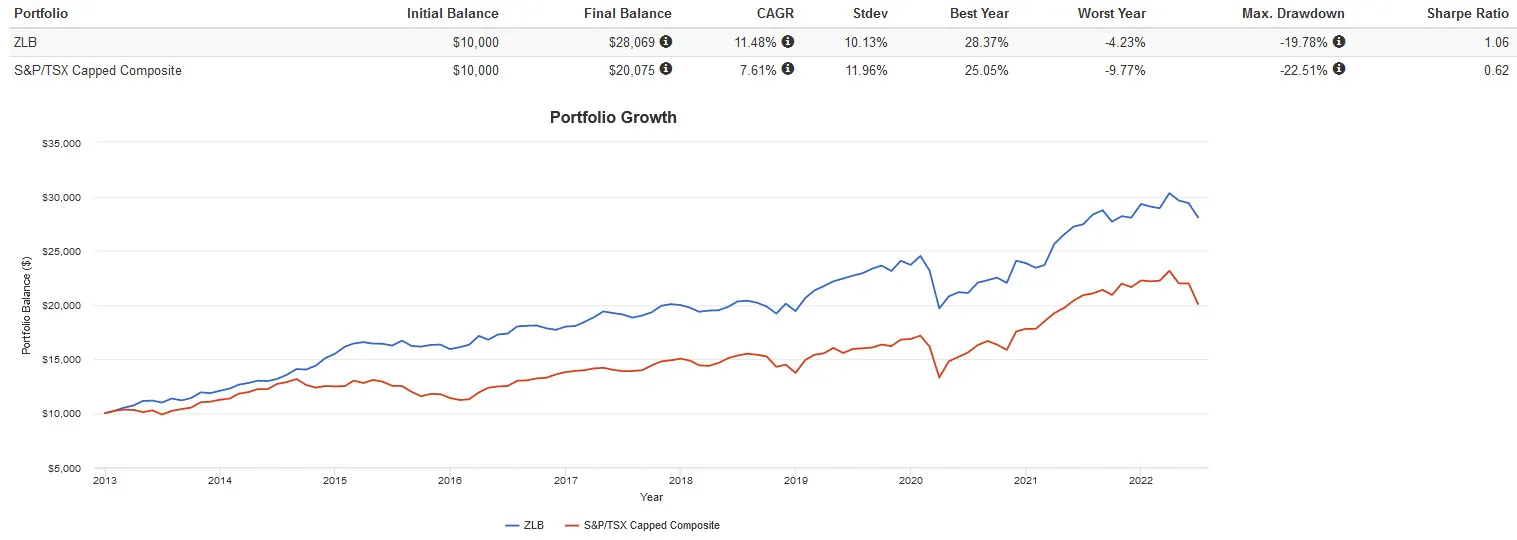
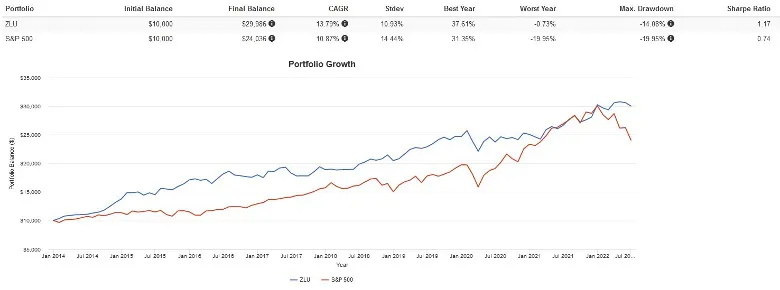
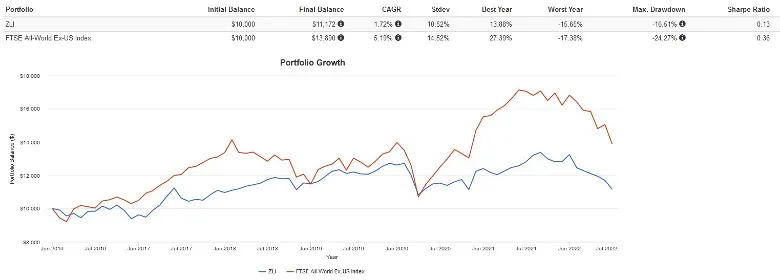
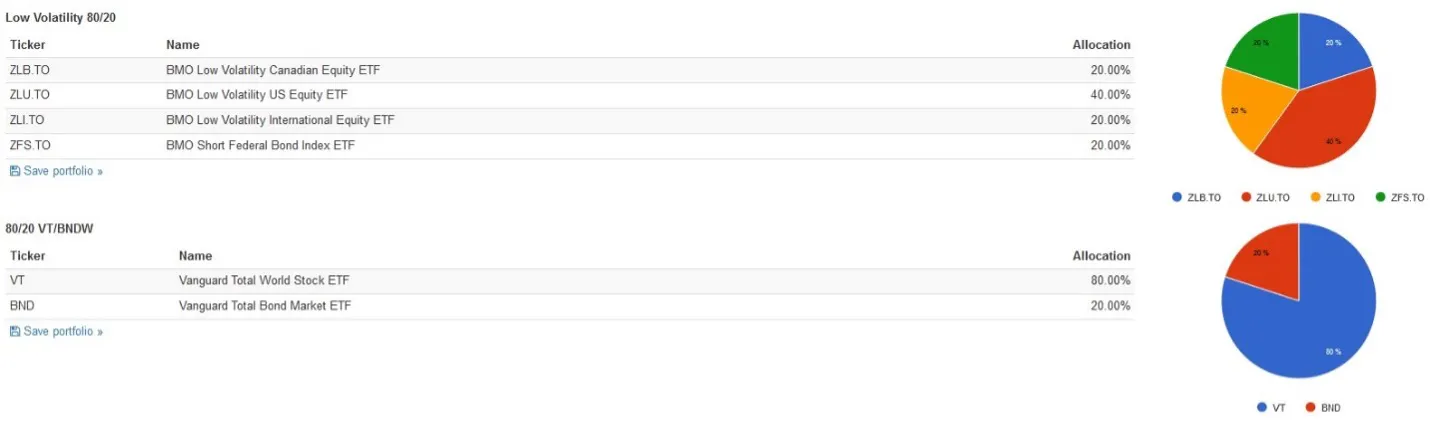
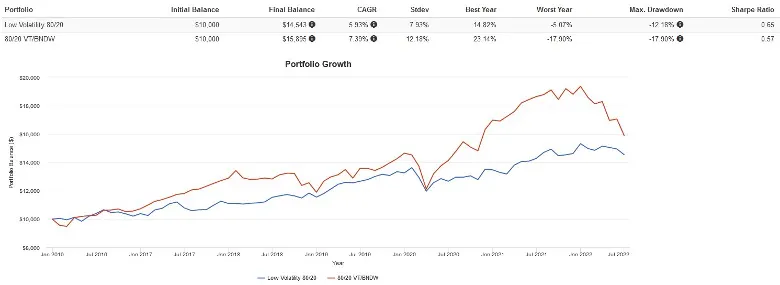
Throw a short-term Canadian government bond index ETF like the BMO Short Federal Bond Index ETF (ZFS) in there at a 20% allocation, and you get a very low-volatility, globally diversified portfolio with much lower standard deviation (worst year and max drawdowns) and a better overall risk-adjusted return (Sharpe ratio) compared to an 80/20 stocks / bonds portfolio:
Disclaimer: This article is limited to the dissemination of general information pertaining to investment strategies and financial planning and does not constitute an offer to issue or sell, or a solicitation of an offer to subscribe, buy, or acquire an interest in, any securities, financial instruments or other services, nor does it constitute a financial promotion, investment advice or an inducement or incitement to participate in any product, offering or investment.