Recent Troubles in Bank Equities Present an Opportunity for Investors
Despite recent underperformance, Canadian banks are worth reconsidering due to high dividends, temporary provisions, and potential for mean reversion in the long term.


Banks are an integral part of Canadian investor portfolios and warrant a second chance following 6 months of relative underperformance. Loan loss provisions and market jitters are by nature temporary and are unlikely to affect the long-term fundamentals of Canadian banks.
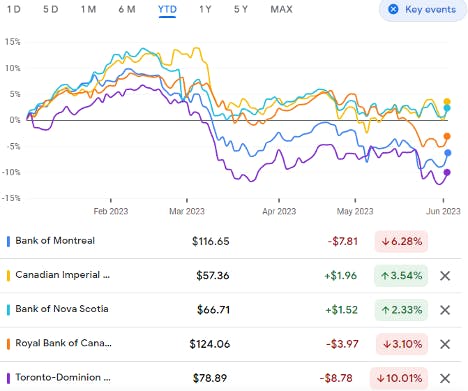
At the time of writing (June 4, 2023), the equal-weighted Canadian bank index is flat for the year, with a downtrend beginning in March after Silicon Valley Bank (SVB) kicked off the latest U.S. banking crisis. Despite the relative safety and the vastly different regulatory environment of Canadian banks, they are not immune to market sentiment and have been sold off, along with their peers south of the border.
The burden of this selloff, however, was not shared equally, as banks with a heavier U.S. presence decreased more than those with global or Canadian-only operations. Looking at the performance of the Big 5 Banks, we see the 3 banks with negative performance for the year also have the highest exposure to U.S. banking, while CIBC has the best performance:
Profits down, loan provision up
With the Q2 earnings season ending, a pattern has emerged in the banks’ earnings that sheds light on the environment in which they are operating. In a signal of uncertainty over the ability of borrowers to pay back their loans, the Big 5 increased their loan loss provisions across the board over this period. Listed as an Expense on the Income Statement, these provisions lower the profits in the quarter in which they are recorded.
Despite being treated as an Expense for accounting reasons, these provisions do not necessarily mean the loans are bad. The provisions are money banks set aside in the event of loan underperformance – it does not necessarily predict the event. Bank of Montreal (BMO), for example, saw the largest increase in loan provisions, topping $1B in Q2.
There is, however, an important caveat here, namely that roughly 70% of these provisions were inherited through the acquisition of Bank of the West and were not BMO’s own. This is an important distinction, in that it does not reflect BMO’s main market (which is still Canada), and only represents the loans inherited through its recent acquisition.
On the topic of acquisitions, Toronto-Dominion Bank (TD) pulled out of its deal to acquire First Horizons Bank in early May, in light of U.S. banking troubles, and chose instead to pay the roughly $ 250 million in penalties. Analysts welcomed the decision, seeing it as more favorable to pay the penalty than commit to the deal at a much higher valuation than the current market value.
Despite the relatively ugly results, most Canadian banks have raised their dividends in Q2, showing some confidence in their ability to return cash to shareholders in the future and making them great value and income plays.
Taking advantage of the opportunity
With the banking index relatively flat for the year, it would be easy to overlook financials as a place to park some cash. After all, the high-flying tech sector has clearly been an investor-favorite this year. There are a few reasons to consider increasing your allocation to Canadian Banks, or to initiate a new position, including:
1. High Dividend Yields: Canadian banks have not only managed to maintain their dividends, but most have opted to increase them despite the recent bout of bad news from the U.S. The banks are now yielding between 4%-6.5%, making them an excellent cash-flow play.
2. Provisions are temporary and can be released: The above-mentioned increase in loan loss provisions is a normal part of prudent capital management, a trait Canadian banks are well known and respected for. Increasing provisions does not necessarily indicate a rise in loan defaults. Loan provisions remained high throughout the COVID pandemic, and were subsequently written down, freeing up cash for dividends and buybacks.
3. Mean reversion: Canadian banks tend to perform similarly over the long term, which means short-term deviations are usually followed by “close the gap” events which see the laggard catch up with their peers. Certain ETFs, such as those listed below, can take advantage of this dynamic.
ETFs to consider
For income:
- Hamilton Enhanced Canadian Banks – HCAL
- BMO Covered Call Canadian Banks ETF – ZWB
- CI Canadian Banks Covered Call ETF – CIC
For mean reversion:
Please note this article is for information purposes only and does not in any way constitute investment advice. It is essential that you seek advice from a registered financial professional prior to making any investment decision.