This New S&P/TSX Rule Could Change What Canadian ETFs Hold
The Canadian Nexus Exception opens the door to foreign issuers with deep ties to Canada, potentially changing the makeup of major benchmarks and the ETFs that track them.


Index rules rarely make headlines. But when they change, billions of dollars can end up moving with them.
That is what makes S&P Dow Jones Indices’ latest methodology update worth a read.
Under the new rules, certain foreign companies will be eligible for inclusion in the S&P/TSX Canadian Indices if they have a sufficiently strong connection to Canada.
The change, known as the Canadian Nexus Exception, means a company no longer necessarily has to be incorporated or domiciled in Canada to qualify for a Canadian equity benchmark.
Index methodology has already drawn attention this year, after Nasdaq changed its rules to accommodate SpaceX’s IPO.
Now, S&P is making its own notable change to how Canadian index eligibility is defined.
What Is the Canadian Nexus Exception?
Under S&P Dow Jones Indices’ new methodology update, companies listed on the Toronto Stock Exchange that are not domiciled or incorporated in Canada may now qualify for inclusion as foreign issuers if they have an outsized connection to Canada relative to the size of the Canadian economy or to peer companies in the market.
Importantly, Canada does not have to represent the company’s primary source of economic exposure.
Instead, an eligible foreign issuer must demonstrate a material and substantial Canadian connection.
That could include significant physical assets in the country, a major executive presence, or a long-established historical presence.
S&P has also outlined the eligibility criteria used to determine which foreign issuers can qualify under the new framework.
In other words, where a company is legally based may no longer tell the whole story.
Why S&P Is Changing the Rules
The update comes as major corporate transactions increasingly blur the lines between domestic and international companies.
Recent activity in the Canadian equity market includes the proposed combination of Anglo American and Teck Resources, as well as Shell PLC’s acquisition of ARC Resources Ltd.
The Anglo American and Teck Resources transaction offers a useful example of the type of situation the new methodology is designed to address.
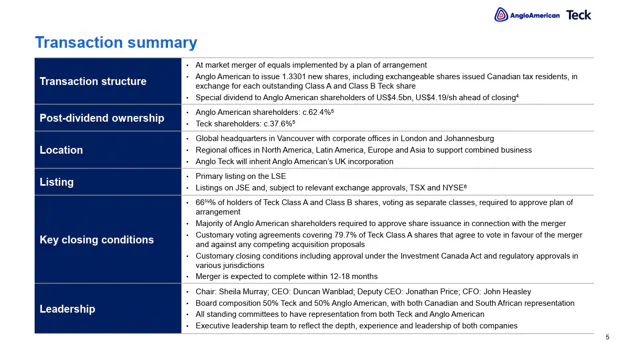
The new entity is expected to become one of the world’s largest copper producers.
Its primary listing will be on the London Stock Exchange, yet its global headquarters will remain in Vancouver, alongside meaningful Canadian executive leadership.
Under a strict domicile-based framework, a company with that structure could sit outside the Canadian indices despite maintaining deep ties to the country.
The Canadian Nexus Exception gives S&P Dow Jones Indices more flexibility to include companies with that kind of profile.
Why This Matters for Canadian ETF Investors
The ETF impact starts when index composition changes.
Foreign issuers that meet the new criteria could begin entering the S&P/TSX Canadian Indices during the December 2026 rebalance.
S&P will then review foreign issuer eligibility annually in September and when relevant corporate actions require another assessment.
For passive ETFs, any additions or deletions will need to be reflected in the portfolio.
If a foreign issuer enters the benchmark, index-tracking funds will need to buy it to stay aligned with the index.
Other positions may need to be reduced depending on how benchmark weights change.
Active managers benchmarked against the S&P/TSX Composite Index will also need to account for the new constituents. Choosing not to own a newly added company could increase tracking error relative to the benchmark.
This article was written on September 28, 2026. Please note this article is for informational purposes only and does not constitute investment advice. Investors should seek advice from a registered financial professional before making any investment decision.