Why Autocallable ETFs Are Turning Heads Among Income Investors
Canada's newest income ETF strategy opens another avenue beyond traditional bonds and dividends.


Income-focused investors face a persistent challenge: generating strong yield without overexposing themselves to equity risk or traditional bond limits.
Autocallable ETFs bridge this gap by linking coupon payouts to stock market performance—delivering regular income even during sideways or modestly declining markets.
Yet, higher yield carries inherent risks. Payouts can stop if markets fall, and severe declines can erode principal. As these strategies expand across the U.S. and Canada, weighing their upside against downside risks is key.
Derivative Income ETFs Are Gaining Ground
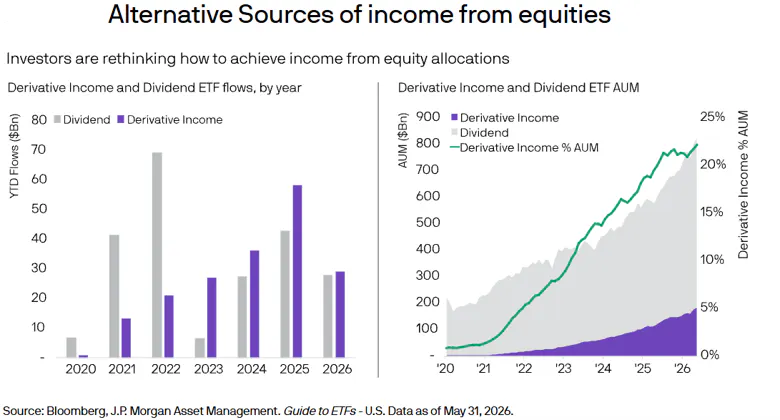
Investors have increasingly looked beyond traditional bonds and dividend-paying stocks for alternative sources of income. Derivative-based strategies have emerged as one way to meet that demand.
According to J.P. Morgan research, the U.S. derivative income ETF market has grown from approximately $6 billion to more than $175 billion over the past five years. Issuers have also launched 174 new equity derivative income ETFs in just two years.
Autocallable ETFs are part of this broader shift.
Rather than relying on bond interest or stock dividends, they generate income by accepting a defined level of exposure to equity market downside.
The appeal is straightforward: investors can potentially collect attractive coupons without needing stocks to deliver strong gains.
The catch? How much income investors receive, and whether their principal is returned in full, depends on how the underlying investments perform.
How Do Autocallable Notes Work?
To understand autocallable ETFs, it helps to start with their building blocks: autocallable notes.
These market-linked investments offer conditional coupon payments tied to the performance of an underlying equity index or stock. Unlike conventional bonds, the payments are not guaranteed, and the principal may be at risk if markets fall sharply.
Each note is issued with a specific set of terms:
- Maturity Term: The length of the investment, often five years, unless the note is called earlier.
- Coupon Barrier: The market level below which coupon payments may stop, such as a 40% decline from the initial reference level.
- Maturity Barrier: The level used to determine whether the investor receives their full principal back at maturity. For example, a barrier set 40% below the initial level.
- Reference Asset: The underlying index or stock whose performance determines the note's payments and repayment outcome.
- Autocall Trigger: A predetermined level that can cause the note to be redeemed early, returning the investor's principal.
The coupon and maturity barriers are particularly important. They help determine how much market weakness the strategy can tolerate before income payments or principal repayment are affected.
Three Market Scenarios, Three Different Outcomes
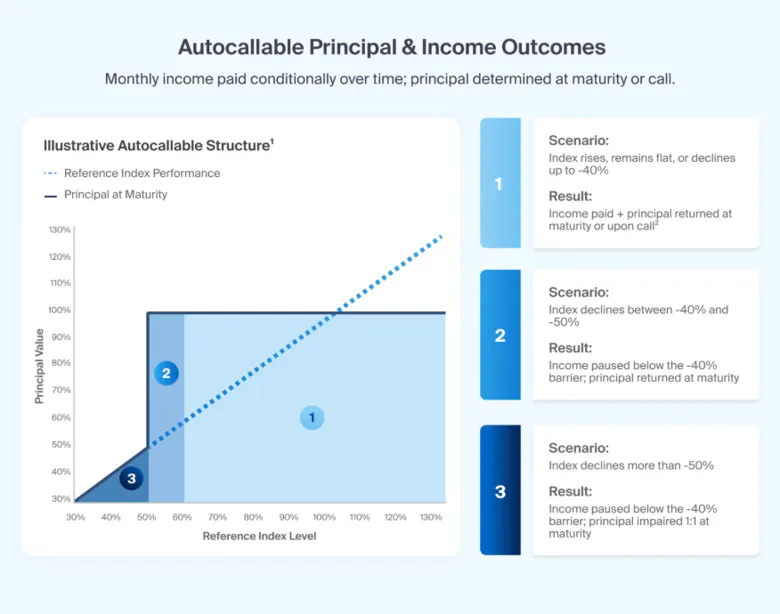
Consider an autocallable note with a five-year maturity and coupon and maturity barriers set 40% below the reference index's starting level.
Depending on market performance, investors could face three very different outcomes.
Scenario 1: Markets Rise or Remain Stable
If the reference index rises or remains relatively stable, the investor continues receiving monthly coupons, provided the coupon conditions are met.
If the index reaches the note's autocall trigger on a scheduled observation date, the note is redeemed early and the principal is returned.
Scenario 2: Markets Decline Moderately
Suppose the index falls by 20% but remains above the 40% downside barrier.
The note can continue paying coupons despite the market decline. If the index remains above the maturity barrier at the end of five years, the investor receives their original principal back.
In other words, the strategy can generate income even when the underlying market delivers negative returns.
Scenario 3: Markets Fall Sharply
Now consider a market decline of 45%, pushing the index below the 40% coupon barrier.
Coupon payments may stop. If the index subsequently recovers above the coupon barrier on a future observation date, payments may resume.
The more significant risk comes at maturity.
If the reference index remains below the maturity barrier, investors can lose principal in proportion to the underlying market decline. In this example, a 45% decline could translate into a 45% principal loss.
The critical distinction is that the 40% barrier is not necessarily a deductible against losses. Once breached at maturity, the investor may absorb the full decline rather than only the portion exceeding 40%.
These scenarios are illustrative. Actual outcomes depend on each note's contractual terms, including its observation dates and coupon conditions.
Why Package Autocallable Strategies Into an ETF?
While individual autocallable notes can provide access to conditional income, building a diversified portfolio of them is not straightforward.
Each note has its own maturity date, underlying investment, coupon conditions and downside barriers. Managing multiple positions requires ongoing monitoring and reinvestment decisions when notes mature or are redeemed early.
Investors must also consider issuer credit risk, liquidity constraints and the possibility of having too much exposure to a single note.
Autocallable ETFs aim to simplify that process.
Rather than purchasing and managing individual notes, investors can access a professionally managed portfolio through a single exchange-traded fund.
The ETF structure can help spread exposure across multiple positions while making the strategy more accessible and easier to trade.
However, diversification and professional management do not eliminate the underlying risks. Coupon payments can still fluctuate, market declines can affect the fund's value, and investors are not guaranteed the return of their initial investment.
Autocallable ETFs Arrive in Canada
Although autocallable ETFs have already gained a foothold in the U.S., the Canadian market is only beginning to develop.
In September 2026, BMO Global Asset Management launched the BMO Strategic Autocallable Income US Large Cap ETF, Canada's first dedicated autocallable ETF.
The fund trades on the Toronto Stock Exchange under three tickers:
Rather than linking its strategy to a broad market index, the ETF invests in an actively managed portfolio of autocallable derivatives tied to individual U.S. large-cap stocks.
The launch gives Canadian investors an exchange-traded route into a strategy that previously required more involvement in the structured-note market.
For additional information, investors can consult BMO's Autocallable ETF Brochure.
This article was written on October 20, 2026, for informational purposes only and does not constitute investment advice. Investors should consult a registered financial professional before making investment decisions.