A Fixed Income Solution in a Rising Rate Environment
Investors entered uncharted territory in 2022. Read the Canadian market in review by Alex Lee, ETF Strategist with Franklin Templeton in Toronto, and where he sees opportunity in 2023.


This year has been challenging for investors as markets grappled with persistent and elevated inflation, hawkish monetary policies by many central banks, and geopolitical tension between Russia and Ukraine, along with supply chain issues related to COVID-19.
The rise in interest rates this year has been especially challenging for fixed income investors as the broad Canadian fixed income market, represented by the FTSE Canada Universe Bond Index, had the worst eleven-month start in 40+ years, with a loss of 11.8% year to date (YTD).
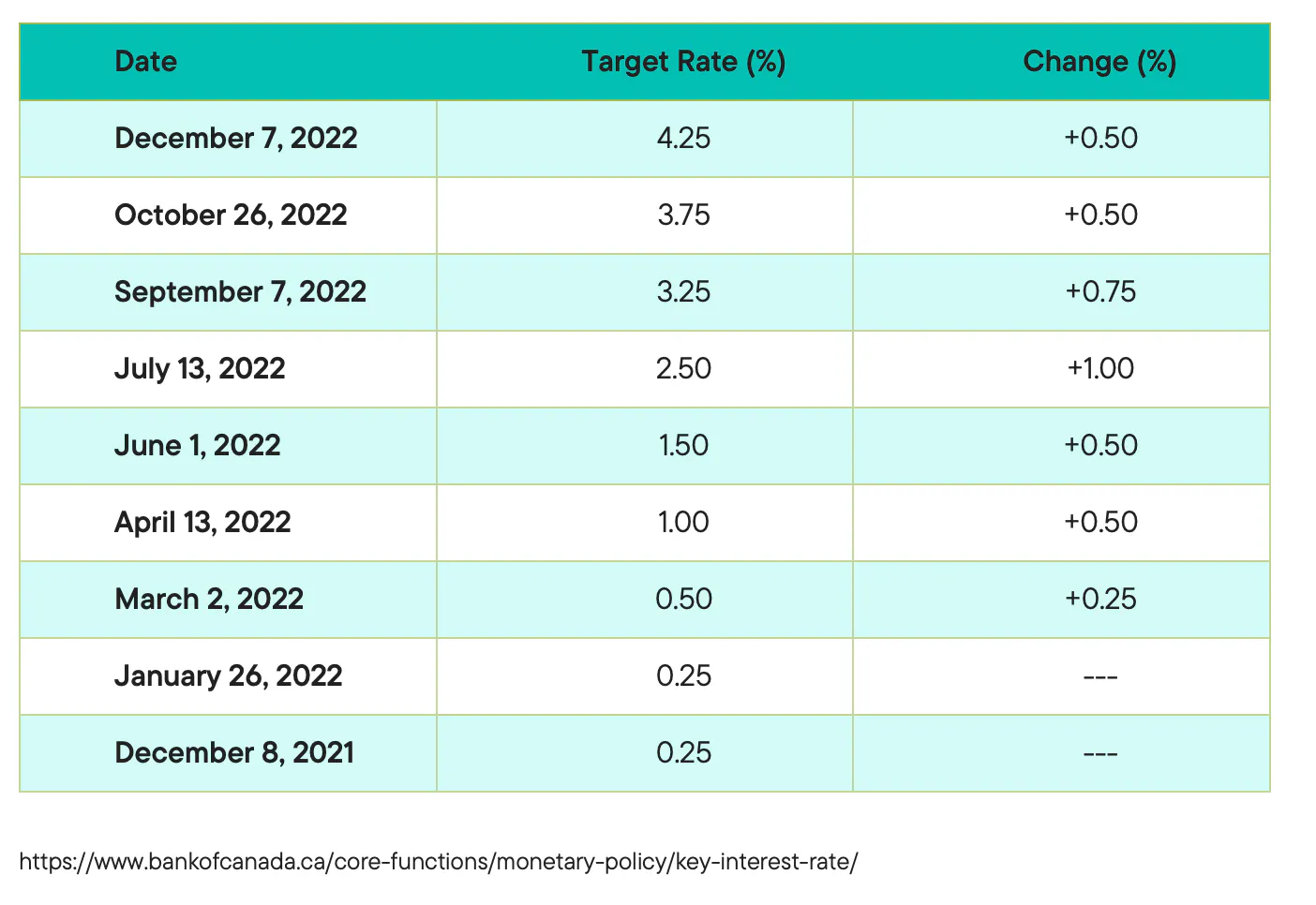
The overnight rate in Canada surged from 0.25% at the beginning of 2022 to 4.25% with the recent 50-basis-point hike at the December 7th meeting:
Most of the drawdown YTD in the Canadian fixed income market has been duration related; the longer the duration, the higher the drawdown with yields rising across the yield curve. The chart below shows that YTD, the ultra-low duration government bond index has been much more defensive, minimizing drawdown during times of volatility compared to other government bonds with higher duration in Canada.

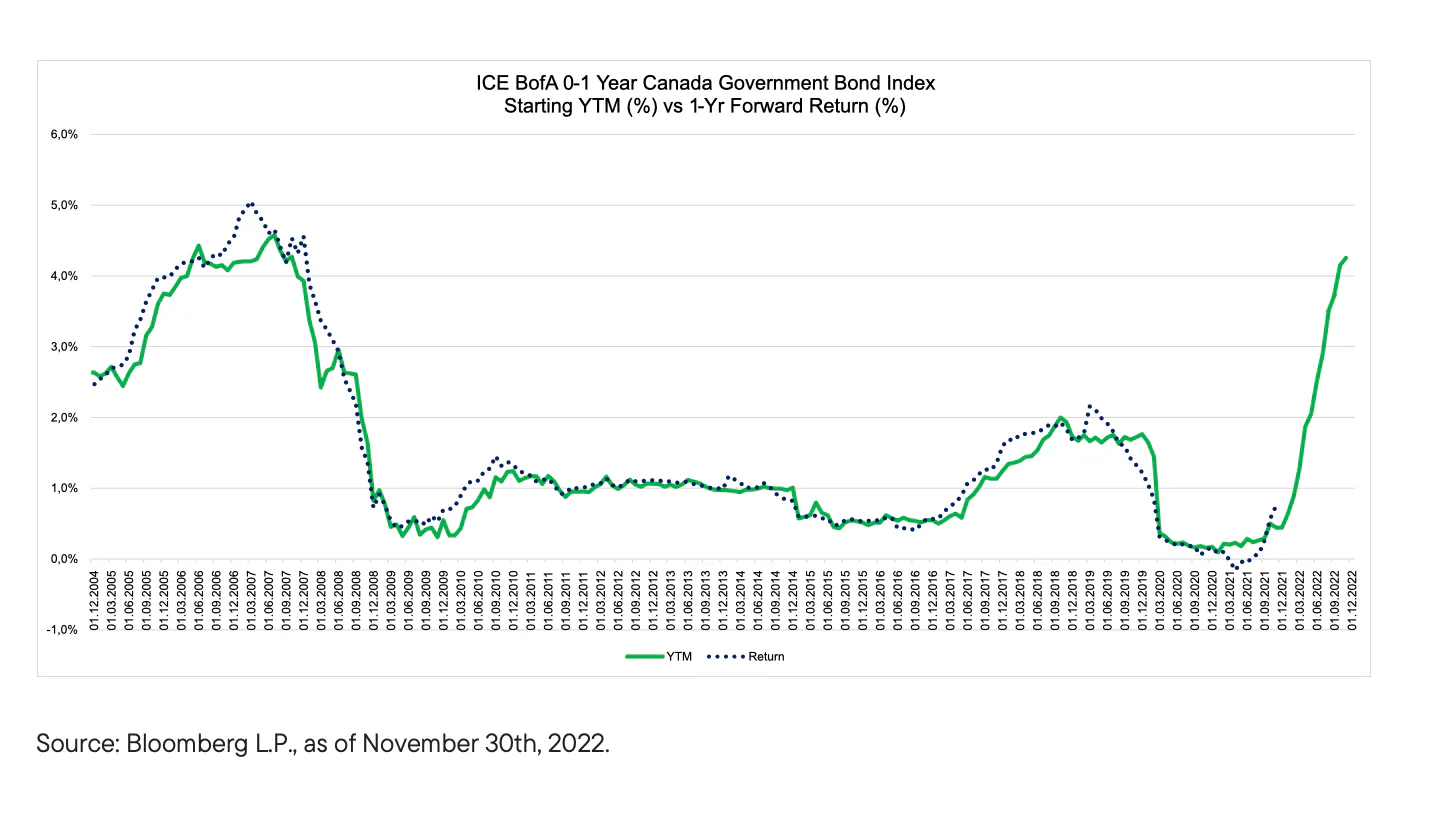
We have also seen a close relationship between the Yield-To-Maturity and one-year forward return for ultra-short-term bonds based on the ICE BofA 0-1 Year Canada Government Bond Index. This is important for investors who want to capture higher yield without increasing too much volatility in a portfolio.
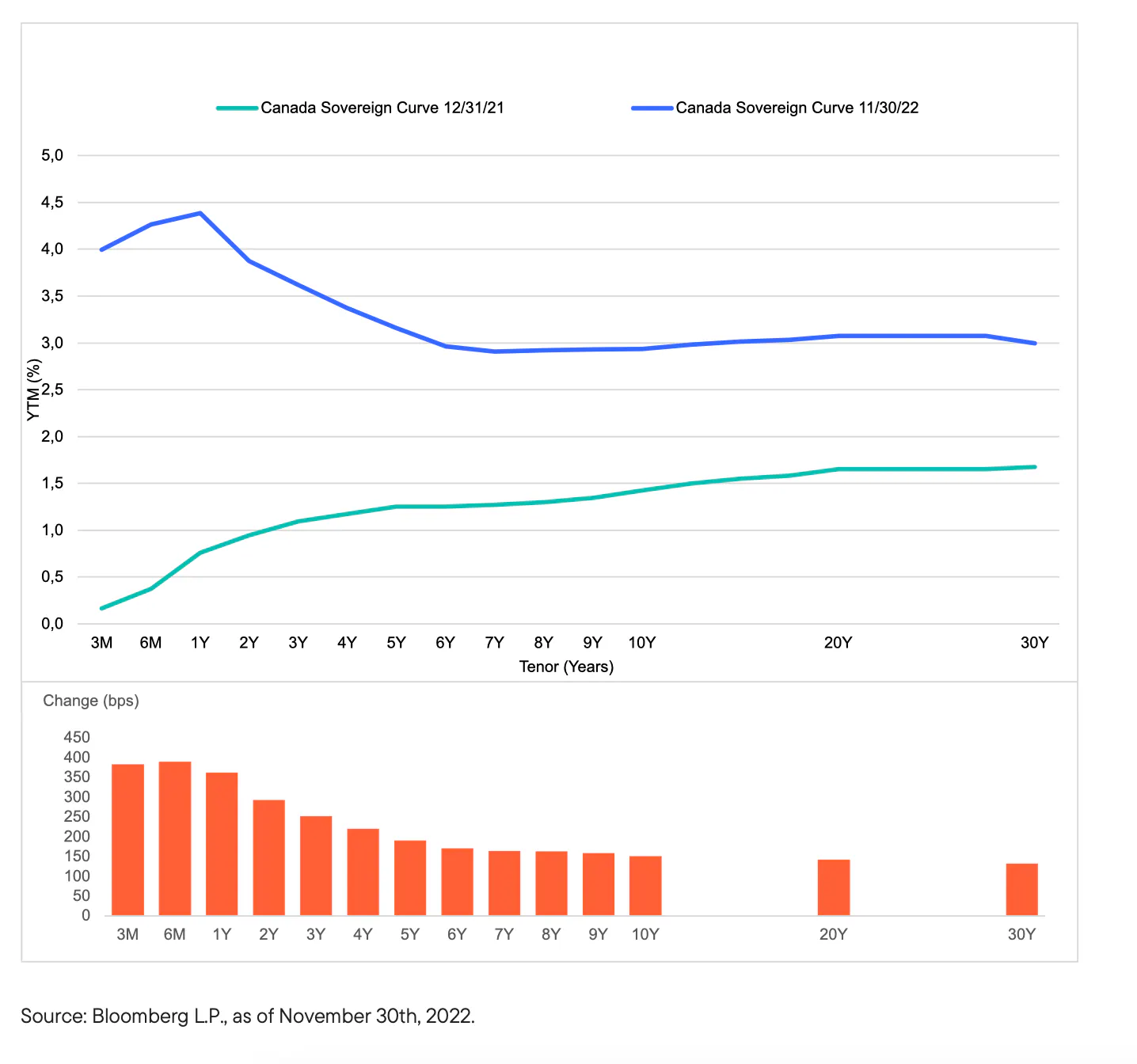
The following chart shows the shape of the Canadian yield curve as of November 30, 2022, compared to the end of 2021. With an inverted curve, yields are now much higher at the front of the curve than in the belly and at the long end. Hence, investors are not rewarded with the term premium to extend maturity, which provides opportunity on the short end of the curve for yield seekers in the current environment.
Canadian Yield Curve – 12/31/21 versus 11/30/22
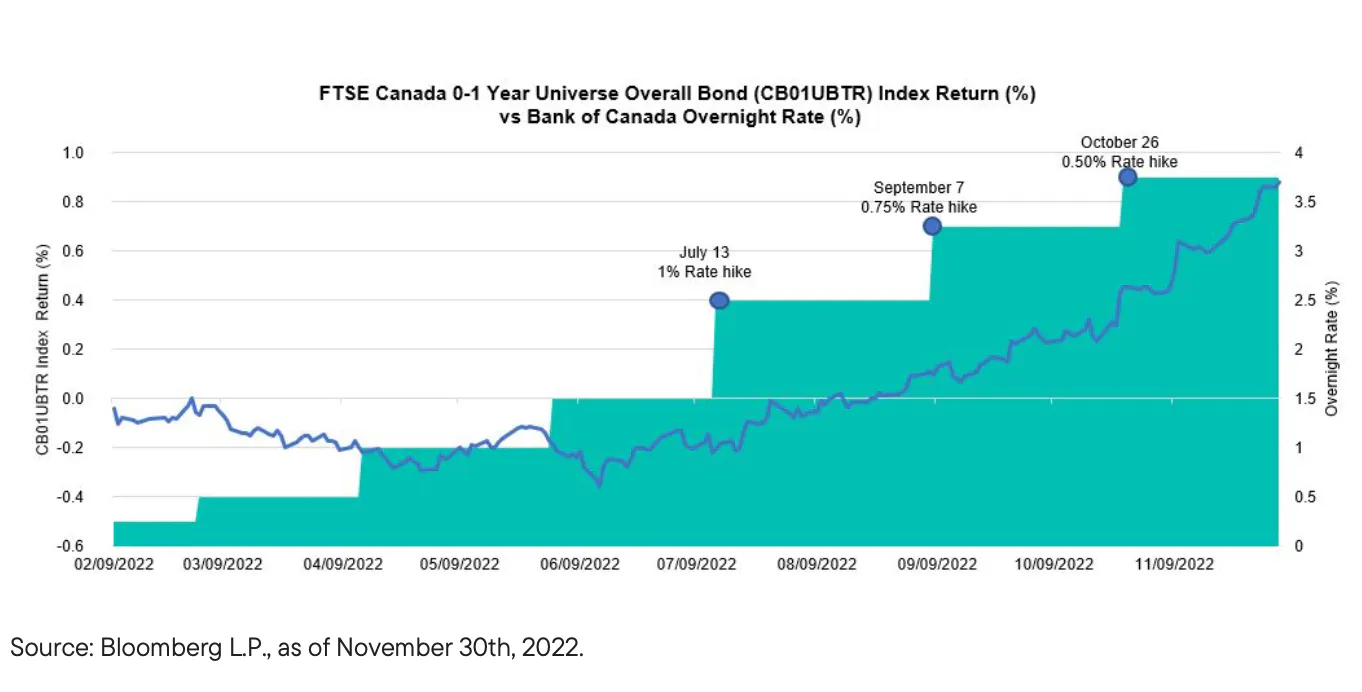
The value of the FTSE Canada 0-1 Year Universe Overall Bond Index, which includes both investment grade corporate and government bonds, has been moving higher since mid-June despite a number of rate hikes because, first, markets have already priced in most of the near-term rate hikes and, secondly, the Index was able to reinvest in higher yield opportunities as bonds came due since they had short maturities:
The rise in yields now provides attractive income opportunities for investors which we did not see at the beginning of the year. The Franklin Bissett Ultra Short Bond Active ETF (FHIS) is appropriate for investors seeking an attractive yield with limited interest rate risk and low volatility within the fixed income portion of their portfolios. FHIS has a duration of 0.58 years, YTM of 4.98%, and a credit rating of A, as of November 30.
As an actively-managed strategy, FHIS has the ability to incorporate core and non-core sectors to seize opportunities arising in the bond market. We believe its management fee of 15 basis points is attractive for investors seeking an active, ultra-low duration strategy co-managed by three Franklin Bissett portfolio managers with 15 years of industry experience.
This article was originally published by Franklin Templeton on 12/12/2022. View the original post here.