A look at Japanese equities and the developments driving the market
Important structural changes are occurring in the Japanese economy that are propelling it forward.


Change is occurring in Japan and its implications are reverberating across varying aspects of the economy, particularly capital markets. On March 14th, at the Senior Leadership Forum in Tokyo, Japan’s Prime Minister, Fumio Kishida, shared Japan’s vision to develop a set of “Asset Owner Principles” and pursue reform through dialogue with global investors. The Government of Japan aims to transform the nation into a vibrant economy, and positive signs of growth are already seen across the board in areas such as wage increases, capital investment, and high stock prices.
This article will expound on the structural changes being implemented in the Japanese economy and how they will affect the Japanese equity landscape. The article will also highlight ETFs that provide investors with exposure to Japanese equities.
Japan’s resurgent market and structural changes
Japan’s Nikkei 225 has been hitting new highs recently, closing out the 2023 fiscal year, which ended in March, gaining over 40 per cent from a year ago. The benchmark stock index ended at 40,369 on Friday, March 29th, rising 43.9 per cent from the previous year's ending figure of 28,041.
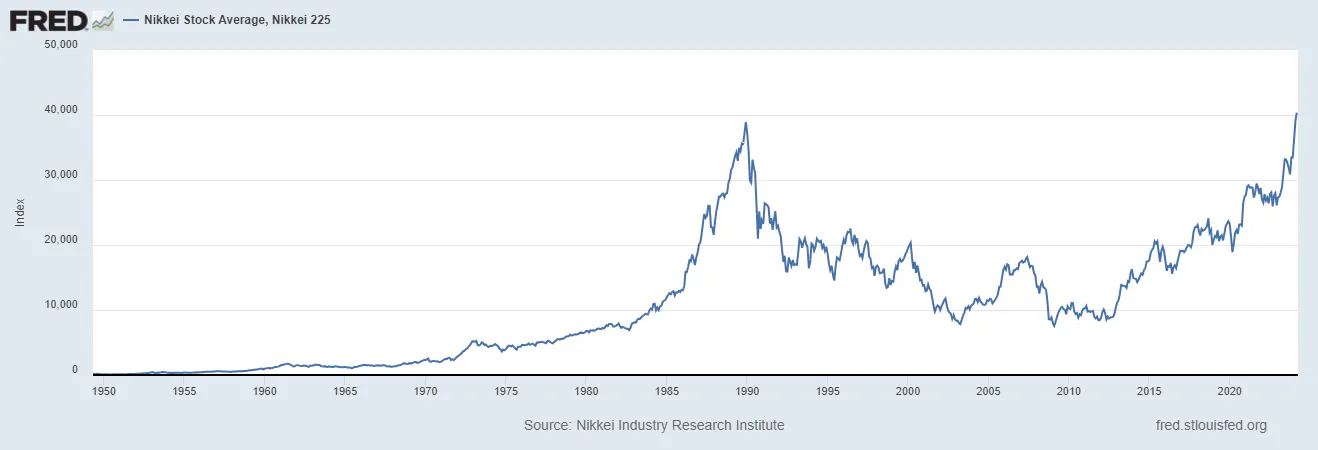
The convincing performance of the Nikkei 225 is reflective of structural changes being implemented in Japan’s economy, namely the country is shifting to an inflationary economy after years of deflation, and corporate governance reforms are taking root.
Japan’s new form of capitalism
From Deflation to Growth
The Government of Japan is promoting a new form of capitalism that seeks to transform social issues into growth engines in close coordination with the private sector. Given that Japan’s quarter-century deflationary environment has adversely impacted its economy, the recent uptick in inflation is a hopeful indication of economic change. In December 2023, at the Meeting of Councillors of Keidanren (Japan Business Federation) in Tokyo, Bank of Japan Governor Kazuo Ueda said years of low to negative inflation led to a “status quo in wage- and price-setting behavior,” so many prices and wages didn’t change. “The know-how for raising prices was thus lost,” he said. The absence of this price-discovery function, Ueda contended, sapped productivity and dynamism for the Japanese economy.
Now Japan can completely overcome low economic growth and a deflationary environment that has persisted for decades. To seize this opportunity and transition to a new economy with a virtuous cycle of growth and distribution, Japan will strive to strengthen the earning capacities of companies by promoting domestic investment in strategic sectors such as semiconductors. Furthermore, major Japanese companies have promised to raise wages to help workers cope with inflation. The announcements by companies such as Hitachi Ltd. and Honda Motor Co. add pressure on smaller companies to follow suit.
Japan’s improved corporate governance
Another change being enacted by the Japanese government pertains to corporate governance. In January 2024, the Tokyo Stock Exchange (TSE) launched an initiative to disclose the listed companies that are making efforts towards corporate management that is conscious of market valuations, such as the Price-to-Book Value Ratio (PBR) and the cost of capital. The government is also working with the TSE to ensure that as many listed companies as possible make such efforts and engage in active dialogue with investors. Another change occurring is the ending of the decades-old practice of ‘cross-shareholdings’, often called strategic holdings by companies, which are widely used in Japan to cement business ties. The holdings have long been criticized by investors as an inefficient use of capital because they can cloud companies’ financial positions and shareholder structures.
Empowering Japanese Investors with NISA
Finally, to spur personal investment in capital markets, the government of Japan launched the Nippon Individual Savings Account (NISA). This account is meant to help residents in Japan save money with tax-exempt benefits. By promoting a shift of household financial assets from savings to investment, the government expects Japan’s household financial assets to be utilized fully to increase national income and improve companies’ earnings capacities.
How to gain exposure to Japanese equities
For investors looking to gain exposure to Japanese equities, the following ETF solutions can provide comprehensive exposure:
- The Franklin FTSE Japan ETF (Ticker: FLJA), seeks to replicate the performance of the FTSE Japan Index It invests, directly or indirectly, primarily in equity securities of large- and mid-capitalization Japanese issuers. FLJA is not currency hedged.
- The CI Wisdom Tree Japan Equity ETF (Tickers: JAPN/JAPN.B) seeks to track the price and yield performance of the WisdomTree Japan Equity Index CAD. The Index consists of dividend-paying companies incorporated in Japan and traded on the Tokyo Stock Exchange that derive less than 80% of their revenue from sources in Japan. By excluding companies that derive 80% or more of their revenue from Japan, the index is tilted toward companies with a more significant global revenue base. JAPN is the currency-hedged version of the ETF, while JAPN.N is the unhedged version.
- The BMO Japan Index (Tickers: ZJPN/ ZJPN.F) has been designed to replicate the performance of the Solactive GBS Japan Large & Mid Cap Index. The ETF invests in large and mid-cap Japanese companies. The ETF invests in and holds the constituent securities of the index in the same proportion as they are reflected in the index. ZJPN.F is the currency-hedged version of the ETF, while ZJPN is the unhedged version.
- The iShares Japan Fundamental Index ETF (Ticker: CJP) has been designed to replicate the performance of the FTSE RAFI Japan Canadian Dollar Hedged Index Under normal market conditions, CJP will primarily invest in securities of one or more iShares ETFs and/or Japanese equity securities. CJP is a currency hedged.
In looking at the performance of each solution over the past year, all have provided compelling returns. However, there is a clear distinction for the trailing 1-year performance. As is evident, the currency-hedged version of these mandates has performed exceedingly well. A currency-hedged ETF offers reduced risk compared to the added possibility of currency value volatility that comes with an unhedged ETF. So, investors who don’t want to be worried about the currency risk associated with exposure to attractive foreign investments via an ETF may be more inclined to target a hedged ETF.
With the Government of Japan making moves to enhance the attractiveness and economic prosperity of their nation, investors looking to add Japanese equities to their portfolio can utilize these solutions as an avenue to gain broad-based exposure.
Please note this article is for information purposes only and does not in any way constitute investment advice. It is essential that you seek advice from a registered financial professional prior to making any investment decision.