Building a Robust Canadian Fixed-Income Portfolio: An Exploration of Franklin Templeton's Bond ETF Lineup
Franklin Templeton's bond ETF lineup offers great versatility. Here's all you need to know.

Bonds may seem boring compared to equities, but they form a crucial component of a properly diversified portfolio. They're the quiet workhorses, diligently helping to manage volatility and drawdowns, offering a steadying presence amid the roller-coaster ride that can sometimes characterize equity markets.
For Canadians, the world of fixed income is far from limited to the familiar territory of the aggregate bond index ETFs. From government to corporate bonds, short-term to long-term maturities, the choices can be both intriguing and, at times, overwhelming.
This comprehensive guide seeks to illuminate the path for investors navigating the fixed-income terrain. Whether you're a newbie dipping your toes into the bond market or a seasoned investor looking for nuanced diversification strategies, we'll delve deep.
And at the forefront of our exploration is Franklin Templeton's bond ETF lineup – a suite of offerings that brings versatility, innovation, and a depth of expertise to the Canadian fixed-income landscape.
Quick recap: Bond ETFs 101
A bond ETF is an investment vehicle that tracks a basket of different bonds and trades on stock exchanges, much like individual stocks. They offer a convenient way for investors to gain exposure to a diversified portfolio of bonds without purchasing each individual security.
Compared to investing in equity ETFs, bond ETFs can be somewhat confusing for the layperson investor. To help get you oriented and up-to-speed, we've provided a mini-guide on their basic mechanics and things to watch out for. The three main mechanics to know are:
- Duration: Duration measures the sensitivity of a bond's price to changes in interest rates. A bond ETF with a longer average duration is more sensitive to interest rate changes. For instance, if a bond ETF has an average duration of 5 years, a 1% increase in interest rates might lead to a roughly 5% decline in the ETF's price.
- Yield to Maturity (YTM): YTM gives an idea of the total return an investor can expect if they hold the bond until it matures. For a bond ETF, it's an average YTM of all the bonds in the portfolio. If an ETF has a YTM of 3%, it means, on average, investors can expect a 3% return annually until the bonds within the ETF mature.
- Credit Quality: Bonds are rated based on the creditworthiness of the issuer. For example, a bond ETF might hold AAA-rated bonds (high credit quality) or BB-rated bonds (lower credit quality). The credit quality gives an idea of the risk of default. A bond ETF with higher-rated bonds is typically less risky but may also offer lower yields.
One important thing to remember: While the YTM provides an insightful glimpse into the potential returns of the bonds within the ETF, it's pivotal for investors to recognize a key distinction: bond ETFs do not mature in the traditional sense like individual bonds do.
Whereas holding an individual bond to maturity guarantees the return of principal (assuming no default), a bond ETF operates differently. It continuously reinvests in bonds, often aiming to maintain a target maturity range.
This means that the principal invested in a bond ETF is not returned to the investor at a specific date, as would be the case with an individual bond. Instead, the ETF keeps rolling its holdings to maintain its target portfolio composition.
As a result, the actual returns an investor receives from a bond ETF can vary based on both interest rate movements and the ETF's ongoing bond selections. This distinction underscores the importance of understanding the mechanics of bond ETFs and setting expectations accordingly.
Finally, investors need to understand how bond ETFs distribute, or payout their income. Unlike individual bonds, which typically distribute interest payments semi-annually, bond ETFs often distribute their payments on a monthly basis.
This difference can be advantageous for investors who prefer a more frequent income stream. So, while an individual bond might pay you twice a year, a bond ETF can provide you with steady monthly income, reflecting the aggregated interest from its diversified bond holdings.
Putting the mechanics into practice
One of the distinct advantages of bond ETFs lies in the vast array of choices they present, empowering investors to tailor their portfolios precisely to their individual needs.
By mixing and matching bond ETFs, investors can fine-tune the duration, YTM, and credit quality, striking the right balance that aligns with their risk tolerance, financial objectives, and investment horizon.
Take, for instance, an investor who is highly risk-averse and has a short-term financial goal, such as accumulating funds for a down payment on a home in a year or two. This investor might lean towards an ultra-short duration bond ETF with less sensitivity to interest rate movements.
Conversely, consider an investor with a high-risk tolerance, perhaps someone with a diversified portfolio and a more extended investment horizon. Such an individual might be drawn to a high-yield bond ETF focusing on non-investment grade credit quality. While these bonds come with higher default risks, they also offer a tantalizingly high YTM, appealing to those seeking returns significantly above average. It's a classic risk-reward scenario, where the investor is willing to take on increased credit risk in pursuit of potentially higher income.
In essence, bond ETFs provide a flexible toolkit, allowing investors to sculpt their fixed-income exposure. By understanding the nuances of each fund, investors can assemble a bond portfolio that is both resilient and aligned with their financial aspirations.
Selecting the right geographical exposure
Beyond the levers of credit quality, YTM, and duration, another vital dimension awaits bond investors: geographical exposure. The origin country of the bonds you invest in can significantly influence your returns, risk profile, and overall experience.
By looking beyond Canada's borders, investors can tap into opportunities that might not be available domestically:
- Different Interest Rate Regimes: Different countries have their own monetary policies, which allows investors to benefit from varied interest rate environments.
- Reduced Foreign Exchange Risk: While investing internationally introduces currency risk, diversifying across multiple currencies can mitigate the potential downside of any single currency's depreciation.
- Possible Higher Yields: Certain global markets, especially emerging markets, might offer bonds with higher yields compared to developed markets like Canada.
While global bonds open doors to diverse opportunities, they also introduce currency risk, which can lead to increased volatility. This is where currency hedging comes into play.
By employing derivatives that offset potential losses from currency movements, ETF managers can reduce the impact of exchange rate fluctuations on returns. This makes international bonds more attractive to investors.
Customizing your portfolio with Franklin Templeton's Bond ETFs
Franklin Templeton offers a range of bond ETFs designed for investors looking to diversify their fixed income portfolio. Whether you're focused on geography, duration, or issuer specifics, their lineup has options tailored to fit diverse investment needs.
Below is a table outlining some of the current bond ETF options from Franklin Templeton, complete with key metrics for easy comparison:
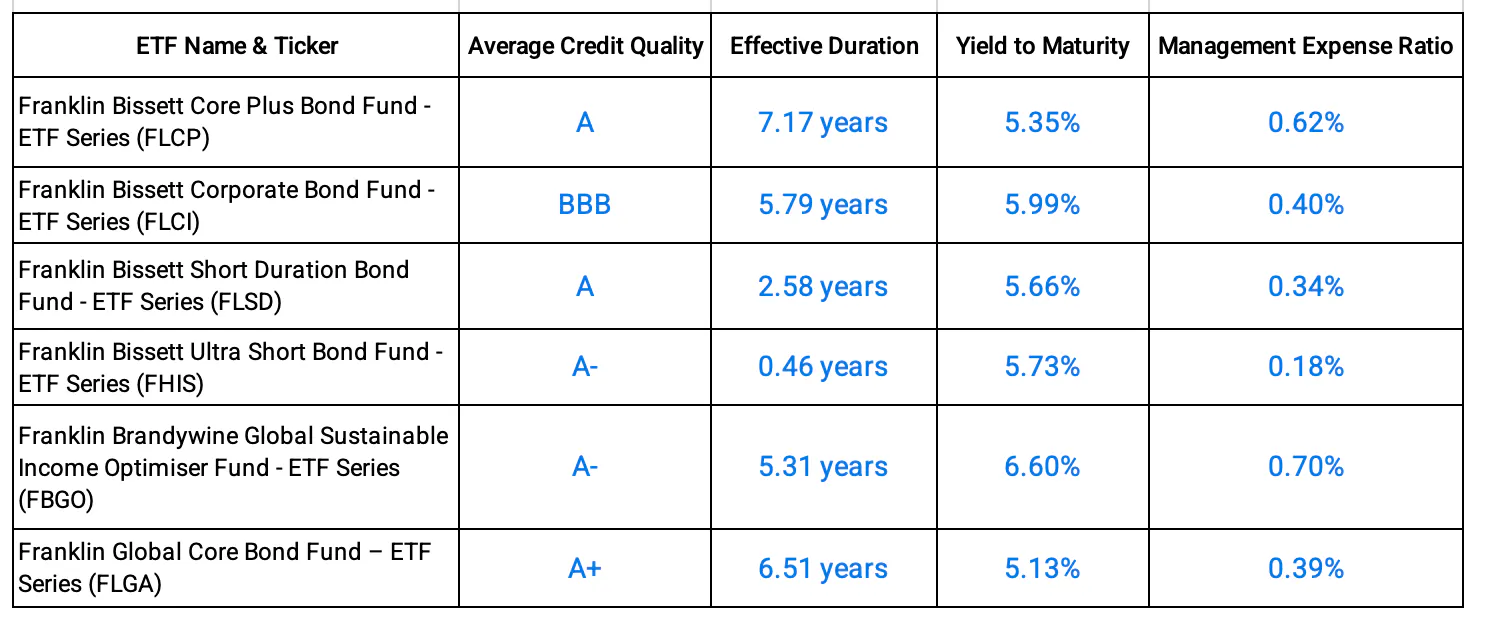
Source: Franklin Templeton as of July 31st, 2023.
One way to employ Franklin Templeton's bond ETF lineup is via the "core-satellite" approach. This strategy entails having the majority of the investment (the "core") dedicated to securing broad, stable returns, while the remainder (the "satellite") seeks higher, potentially more volatile returns to enhance overall performance.
Possible Core Options:
- Franklin Bissett Core Plus Bond Fund - ETF Series (FLCP): With an average credit quality of 'A', an effective duration of 7.17 years, and a YTM of 5.35%, FLCP can serve as the backbone for many investors looking for a balanced risk-reward profile. Its slightly longer duration offers stability and consistent yields.
- Franklin Bissett Corporate Bond Fund - ETF Series (FLCI): Holding an average credit quality of 'BBB' and a YTM of 5.99%, FLCI can also be considered as a core option, especially for those wanting corporate exposure with a mid-range duration of 5.79 years.
- Franklin Global Core Bond Fund – ETF Series (FLGA): With a high average credit quality of A+ and competitive YTM of 5.13%, FLGA offers global bond diversification in a single-ticker solution.
Possible Satellite Options:
- Franklin Bissett Short Duration Bond Fund - ETF Series (FLSD): With its shorter duration of 2.58 years, FLSD can be a suitable satellite for investors who wish to enhance portfolio liquidity while still achieving a good YTM of 5.66%.
- Franklin Bissett Ultra Short Bond Fund - ETF Series (FHIS): The most liquid of the bunch with a mere 0.46 years of effective duration and a 5.73% YTM, FHIS can be an excellent choice for those looking to park short-term funds with potential yield or for those who wish to mitigate interest rate risk.
- Franklin Brandywine Global Sustainable Income Optimiser Fund - ETF Series (FBGO): For those looking to integrate global exposure and sustainability considerations into their satellite portfolio, FBGO offers an intriguing mix with a YTM of 6.60%.
Through combinations of these ETFs, investors can craft portfolios that align with their specific goals, be it income generation, capital preservation, or a blend of both, all while leveraging the benefits of a core-satellite approach. Here are some hypothetical examples:
- Conservative Investor: 70% in FLCP as the core for its balanced profile and 30% in FHIS as a satellite for liquidity and shorter-term opportunities.
- Income Seeker: 50% in FLCI for its corporate bond yields and 50% in FBGO to exploit the higher YTM from global sustainable bonds.
- Diversified Builder: 60% in FLCP for core stability, 20% in FLSD for short-term yield, and 20% in FBGO for global diversification and sustainable investment.
As you explore Franklin Templeton's bond ETF lineup, it's essential to remember that investing is a personal journey, and every individual has unique financial goals, risk thresholds, and time horizons. By evaluating your own objectives and comfort levels, you can better leverage the diverse offerings within this lineup to craft a bond portfolio that resonates with your aspirations.
IMPORTANT INFORMATION
Commissions, trailing commissions, management fees, brokerage fees and expenses may be associated with investments in mutual funds and ETFs. Please read the prospectus and fund fact/ETF facts document before investing. ETFs trade like stocks, fluctuate in market value and may trade at prices above or below the ETF’s net asset value. Brokerage commissions and ETF expenses will reduce returns. Performance of an ETF may vary significantly from the performance of an index, as a result of transaction costs, expenses, and other factors. Indicated rates of return are historical annual compounded total returns for the period indicated, including changes in unit value and reinvestment distributions, and do not take into account any charges or income taxes payable by any security holder that would have reduced returns. Mutual funds and ETFs are not guaranteed. Their values change frequently. Past performance may not be repeated.
ETF units may be bought or sold throughout the day at their market price on the exchange on which they are listed. However, there can be no guarantee that an active trading market for ETF units will develop or be maintained, or that their listing will continue or remain unchanged. While the units of ETFs are tradable on secondary markets, they may not readily trade in all market conditions and may trade at significant discounts in periods of market stress.
Foreign Investment Risk. The value of foreign securities may be influenced by the policies of foreign governments and by political, economic, or social instability. There may be less information about foreign companies than North American firms and there may be lower standards of government supervision and regulation in foreign financial markets. The legal systems of some foreign countries may not adequately protect Unitholders’ rights. Some or all of these factors could make a foreign investment more or less volatile than a North American investment. If a Franklin ETF or the underlying fund in which a Franklin ETF invests holds these securities, the Franklin ETF may have difficulty enforcing legal rights in jurisdictions outside Canada.