Building Around the Core: How Franklin’s Systematic Equity ETFs Help Allocate Risk and Fees
Franklin Templeton’s Michael Greenberg explains how a risk-controlled, multi-factor equity core can free up fee and risk budget for higher-conviction positions elsewhere in a portfolio.

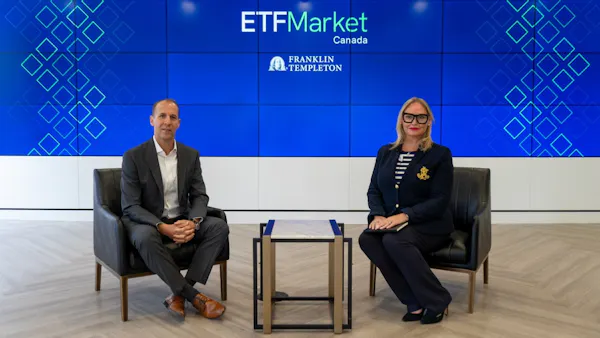
ETF investors manage two budgets at once: active risk and fees. In a recent episode of Issuer Insights from ETF Market Canada, Michael Greenberg, Senior Vice President and Head of Americas Portfolio Management at Franklin Templeton Investment Solutions, returned to explain how the Franklin Core Equity ETFs are designed to address both.
A core that directs active risk where it is intended
Greenberg describes the funds as “a core building block” that investors can build around. Their objective is to seek consistent incremental alpha above the benchmark with low to moderate tracking error. To get there, the strategy neutralizes unintended exposures to sectors, size, style and countries, so that active risk is concentrated in five factors: quality, value, sentiment, alternative, and a conviction factor drawn from Franklin Templeton’s active managers.
Each factor has historically added value over a full cycle, though at different points within it. Because their correlations to one another are low or negative, Greenberg argues the combination can deliver “smoother and more predictable returns” than any single factor.
Canadian, U.S. and international exposures are available as ETF series — Franklin Canadian Core Equity Fund (FCRC), Franklin U.S. Core Equity Fund (FCRU) and Franklin International Core Equity Fund (FCRI).
Spending fees where they count
Fee pressure has been building for years, and active fees are expected to demonstrate value. Greenberg positions the core funds between two familiar options: priced somewhat above passive equity ETFs, with the potential to add value beyond market exposure, yet “a fair bit less” than traditional active managers. Management fees on the ETF series are 0.13% for FCRC, 0.17% for FCRU and 0.22% for FCRI, plus a 0.05% administration fee, reflecting a partial waiver in place until December 31, 2026.
That middle ground can lower a portfolio’s overall fee budget and redirect active spending where it may matter more: less efficient segments such as emerging markets and small caps, low-volatility, high-dividend strategies, or newer evergreen private market funds offering diversified income or inflation protection.
As an illustration, he outlines a portfolio with 10% to 30% in passive vehicles, 30% to 60% in core systematic equity funds, and 10% to 40% in higher active share, outcome-oriented or private market allocations. These ranges are illustrative and do not represent a recommended allocation.
Turning manager conviction into a signal
The conviction factor is the element Greenberg calls “quite unique to Franklin Templeton.” The process identifies fundamental managers believed to have stock-picking skill, then isolates their active bets through portfolio holdings and position-level risk. A quantitative framework converts this information into a score for every stock in the universe, as with the other four factors.
What happens when conviction falls out of favour? By design, Greenberg says, not every factor works at the same time, and the others are generally expected to support the portfolio during those periods. No single factor is meant to dominate the risk budget or the return profile.
Weighting factors by risk
Greenberg uses the traditional 60/40 portfolio as an analogy: while capital is split 60/40, equities typically account for 80% to 90% of total risk. Factors behave similarly. In his hypothetical example, a quality factor with 4% volatility and a sentiment factor with 12% volatility would not warrant equal weights, since the more volatile factor would quickly take over the risk budget.
The team therefore rebalances back to strategic risk targets, monthly or intramonth after large market moves. Greenberg is explicit that “we’re not trying to market time these factors.” Trading costs and market impact are weighed each time, with a tolerance band deciding whether a deviation justifies a trade.
Staying invested in narrow markets
With concentration and sector volatility elevated, some investors are tempted by cash. Greenberg cautions that this requires being right twice, on both the exit and the re-entry.
Concentrated markets also challenge stock pickers, as large sector moves can swamp individual stock bets. Greenberg points to Canadian equities in 2025, when gold was a major driver of a market that proved difficult for active managers to beat. In his view, systematic strategies that avoid sector and industry bets, including Franklin’s, were able to keep pace and outperform in that environment.
For a more defensive tilt, he suggests pairing a core fund with a low-volatility, high-dividend ETF, which may offer more downside protection but tends to lag in rising markets, while the core fund aims to preserve upside participation. Each holding plays a distinct role, and none should dominate the risk budget.
Anchoring the equity allocation
Launched in 2019 for Franklin Templeton’s multi-asset portfolios, the core equity strategies held approximately $2.4 billion in assets as of September 30, 2026, according to the firm. For investors weighing where to spend active fees and risk, the Franklin Core Equity ETFs offer one way to anchor the equity sleeve while leaving room for higher-conviction positions.
Important Legal Information
Please note this article is for information purposes only and does not in any way constitute investment advice. It is essential that you seek advice from a registered financial professional prior to making any investment decision.
This material is intended to be of general interest only and should not be construed as individual investment advice or a recommendation or solicitation to buy, sell, or hold any security or to adopt any investment strategy. It does not constitute legal or tax advice. The views expressed are those of the investment manager and may change without notice.
Commissions, trailing commissions, management fees, brokerage fees, and expenses may be associated with investments in mutual funds and ETFs. Please read the prospectus and fund facts before investing. Mutual funds and ETFs are not guaranteed. Their values change frequently, and past performance may not be repeated.
Franklin Templeton and Franklin Templeton Canada are business names used by Franklin Templeton Investments Corp.