Canadian Investors: FTSE Canada vs FTSE Canada All-Cap?
Here's how to decide between which domestic broad-market index to buy and hold.


Last week we compared and contrasted two popular Canadian index options out there: the S&P/TSX 60 vs the S&P/TSX Capped Composite. I noted that ETFs tracking these indexes (notably from iShares) were highly popular, with great liquidity and assets under management (AUM).
However, options for tracking domestic stock don’t just stop at the two S&P Global indices. Beyond that, organizations like FTSE have released a variety of indices tracking Canadian stocks. Notably, FTSE indices are heavily used by Vanguard in their fund construction. Let's take a look at two of the most popular options: The FTSE Canada index, and the FTSE Canada All-Cap index.
What are our two options?
The FTSE Canada Index is very similar to the S&P/TSX 60 in that it tracks the largest Canadian stocks. There are some differences though. While the S&P/TSX 60 holds around 60 stocks, the FTSE Canada only holds 51-53 stocks.
The reason behind the slightly lower number of stocks is FTSE's decision to allocate some Canadian stocks that are dual listed on U.S. exchanges to their U.S. indices instead, a notable example including Shopify (SHOP) and limited partnerships, which would include most of the Brookfield subsidiaries. For Canadian investors, this can either be desirable or not, depending on your outlook for certain stocks.
Nowadays, the FTSE Canada Index is fairly obsolete thanks to the development of the FTSE Canada All-Cap index. This index essentially adds around another 150 mid and small-cap stocks to the FTSE Canada index. In terms of tracking Canada's overall investable market, this index does a better job.
Conveniently, Vanguard offers two low-cost ETFs for tracking these indexes:
- Vanguard FTSE Canada Index ETF: 0.05% expense ratio.
- Vanguard FTSE Canada All-Cap Index ETF: 0.05% expense ratio.
What's the difference between the two?
Very little actually unless you want to get very technical and detailed. For the average retail investor, their performance is indistinguishable at first glance. Take a look at the following backtests from 2014 to the present day for the FTSE Canada vs S&P/TSX 60 and the FTSE Canada All-Cap vs the S&P/TSX Capped Composite:
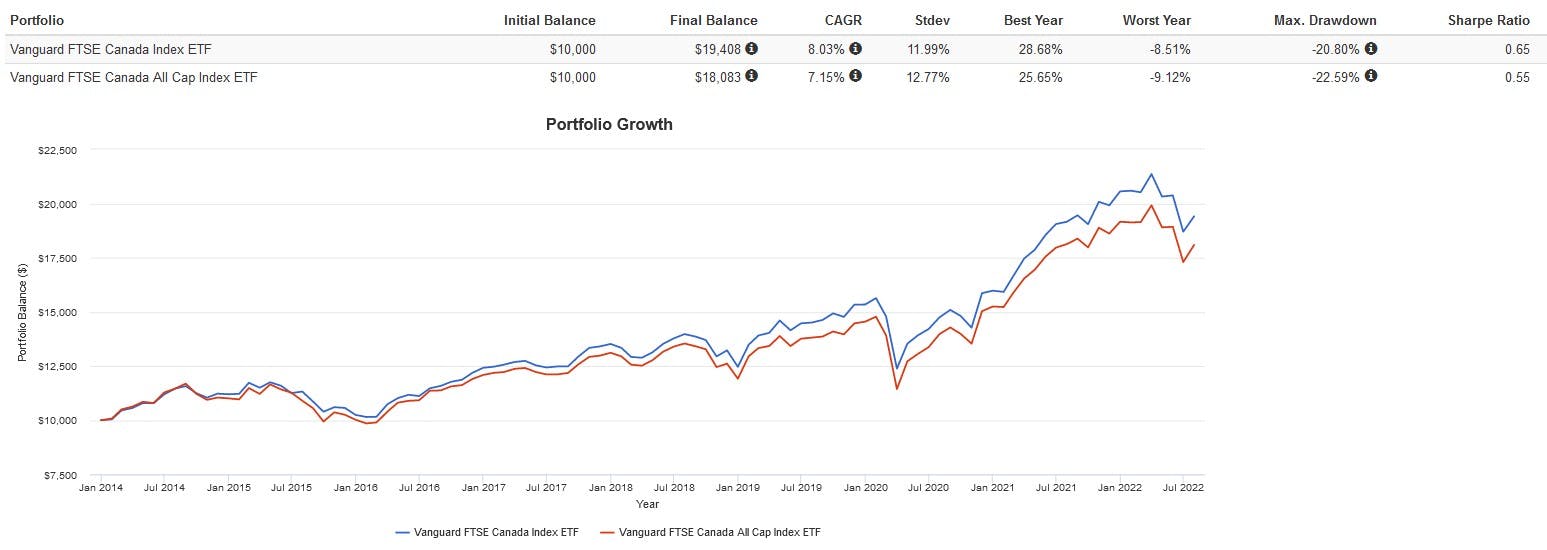
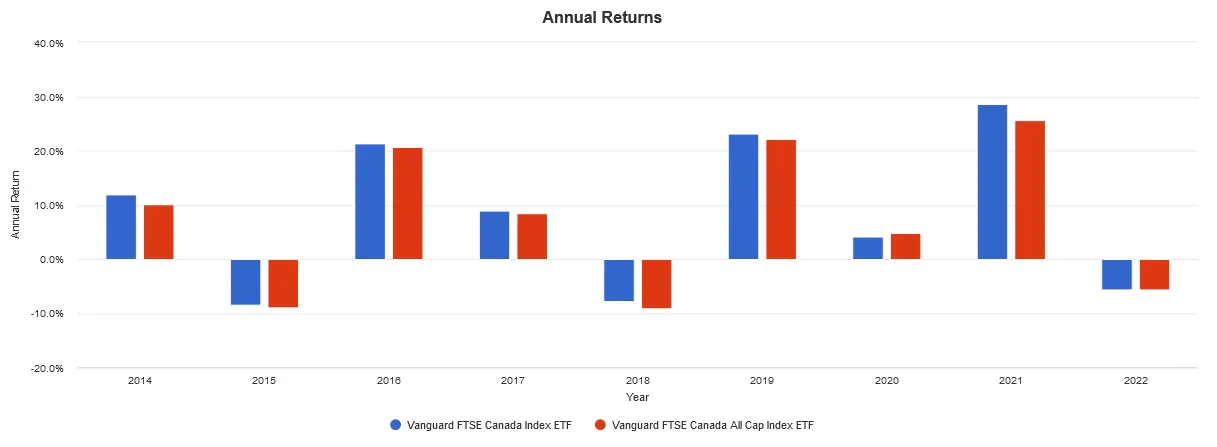
Because VCE holds 85% VCN, the two funds have a very high correlation. As of writing, it's around 0.99 measured monthly over various rolling 5-, 10-, and 20-year periods. The market conditions of the previous decade have been favourable for large-caps, and thus VCE has benefitted more.
That being said, the time period being back tested is too short (8 years) to really draw a solid conclusion. Given that both ETFs cost the same and have a high proportion of overlapping holdings, I expect their performance to narrow over time, especially if small-caps have a resurgence.
FTSE vs S&P
Now, let's assess how both FTSE indices stack up against the S&P ones. I've once again provided a backtest below:
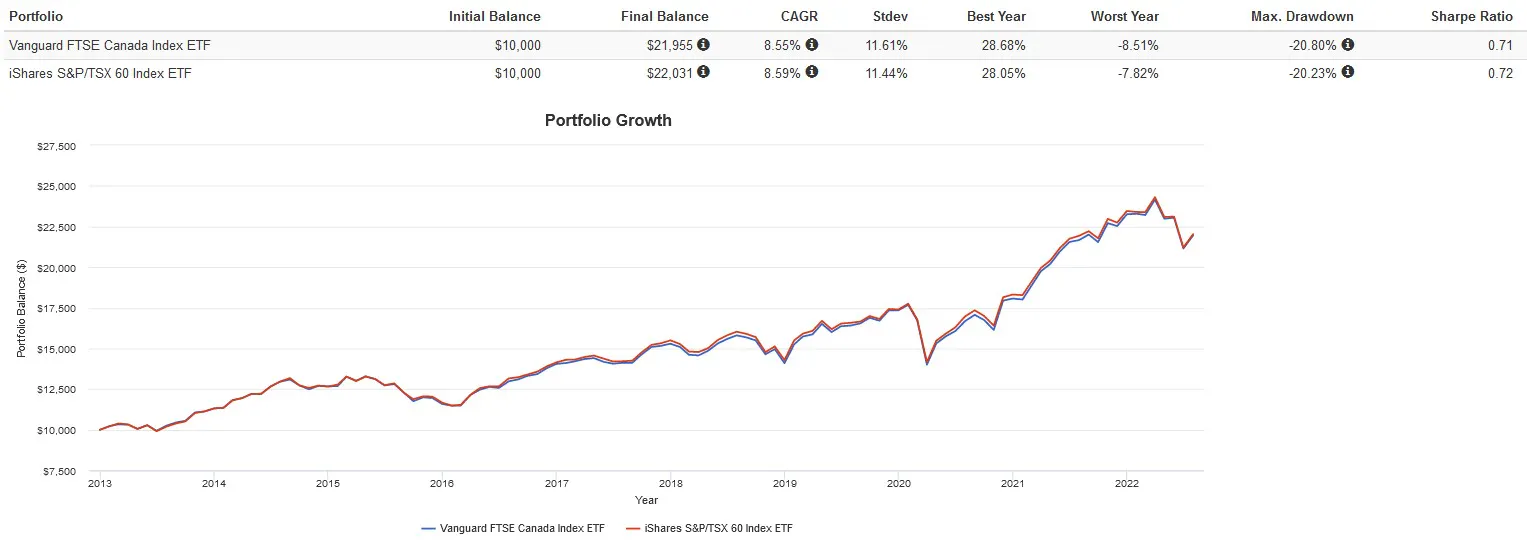
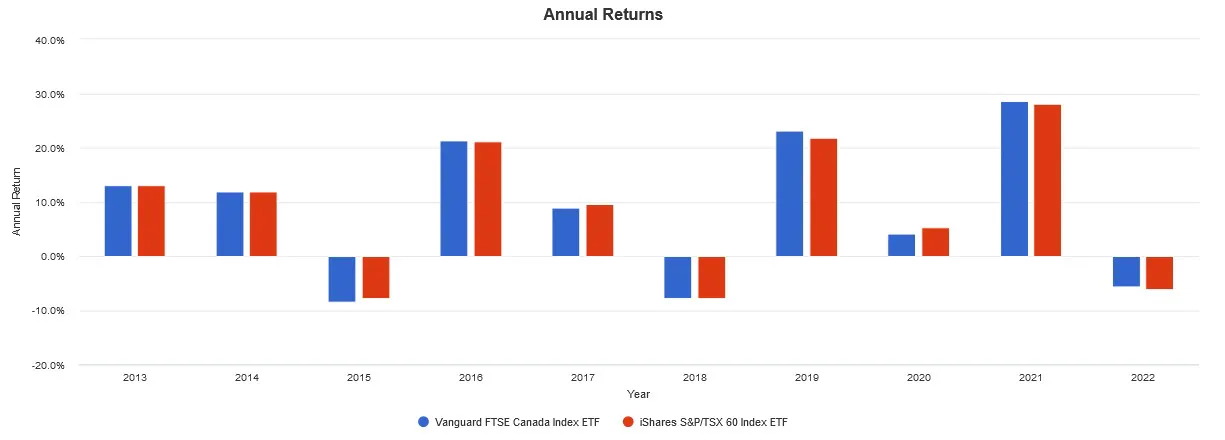
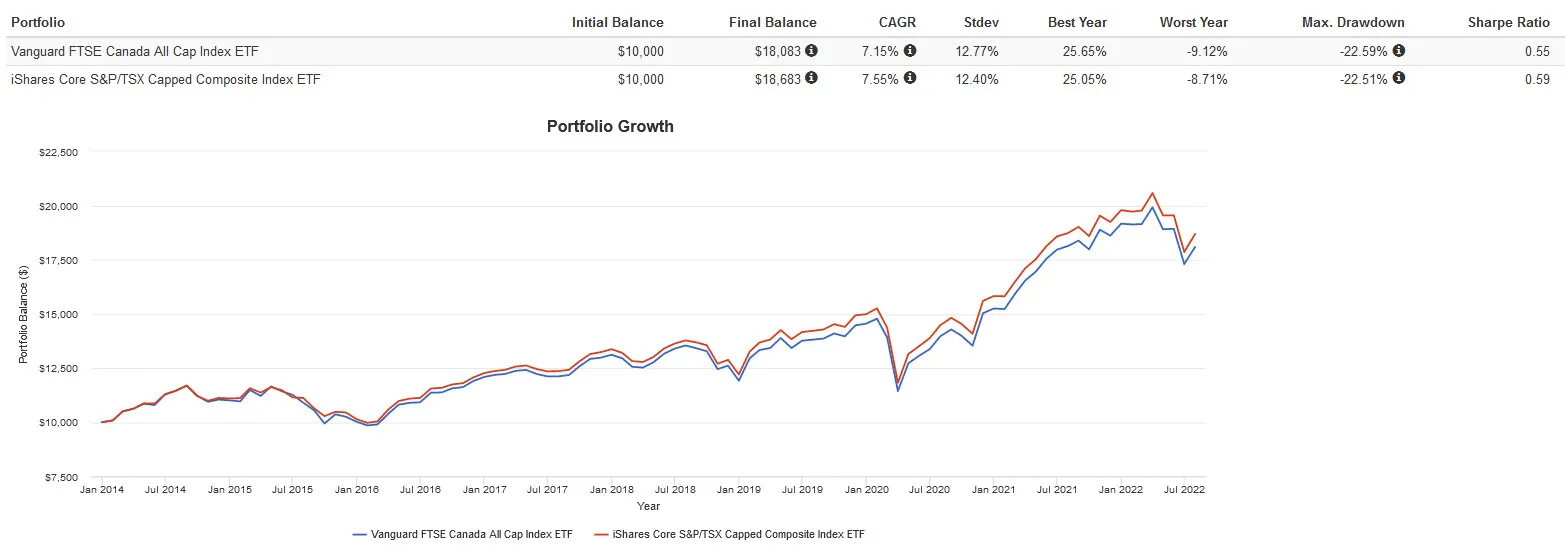
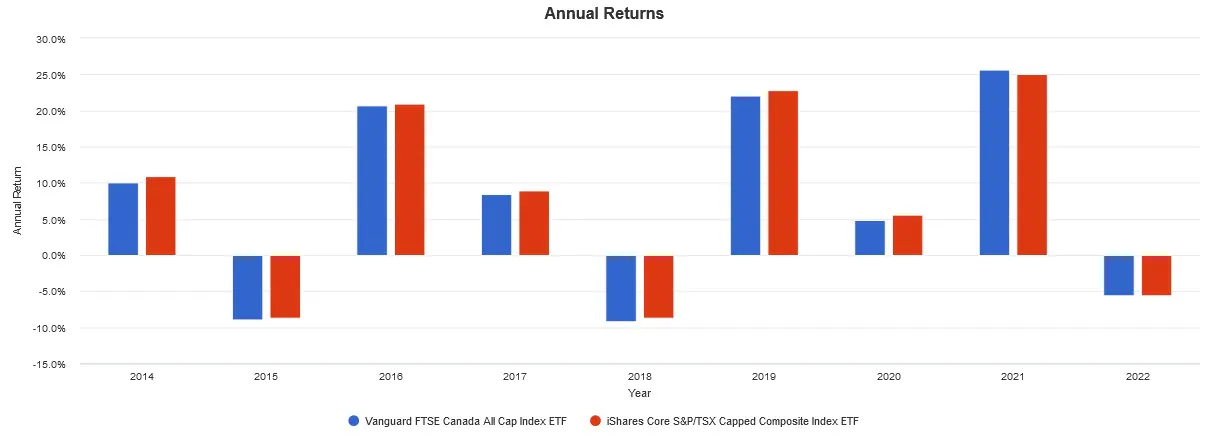
Both of the S&P indices outperformed slightly in the past. Does this mean they're a better choice moving forward? Not necessarily. Relying on backtests to predict future performance is highly risky and subject to the possible overfitting of data. That being said, I'm more in favour of the S&P indices, solely because they don't exclude certain Canadian stocks for being dual-listed or limited partnerships.
Which one is ideal?
The answer depends on your outlook for small vs large-cap stocks. If you want lower volatility and higher dividend yields, the 51 large-cap blue-chip stocks in VCE might suit your needs. If you're in favour of broad diversification and tracking the total Canadian market as closely as possible, VCN wins. From fees and liquidity perspective, they're both tied.
Over long periods of time, VCE and VCN will likely perform virtually identically, barring some small intra-year tracking error. The minimal amount of small and mid-caps in VCN is unlike to differentiate it much from VCE in the long run. From a strict diversification perspective, VCN is broader and holds more stocks, but takes on very slightly higher volatility for a tiny bit more potential return.
A great alternative is using both as tax-loss harvesting pairs given their high correlation and similar holdings, yet different underlying indexes. If you're not familiar with tax-loss harvesting, I suggest giving this article a read.
Disclaimer: This article is limited to the dissemination of general information pertaining to investment strategies and financial planning and does not constitute an offer to issue or sell, or a solicitation of an offer to subscribe, buy, or acquire an interest in, any securities, financial instruments or other services, nor does it constitute a financial promotion, investment advice or an inducement or incitement to participate in any product, offering or investment.