Cybersecurity ETFs: Software’s Comeback Is Giving Canadian Investors a New AI Trade
Software was supposed to be one of AI’s biggest casualties. Instead, cybersecurity stocks are finding a fresh reason to run.


At the start of the year, the investment case against software seemed straightforward: what happens to traditional software businesses if AI agents can simply replace the workflows they sell?
That fear helped fuel what some called the “SaaS Apocalypse,” pushing software stocks lower as investors questioned whether AI would disrupt entire business models.
But the story has started to change.
Despite continued advances in increasingly powerful AI models, software stocks have rebounded in recent months, a turnaround reflected in the performance of the S&P 1500 Software Index.
And one corner of the market is attracting particular attention: cybersecurity.
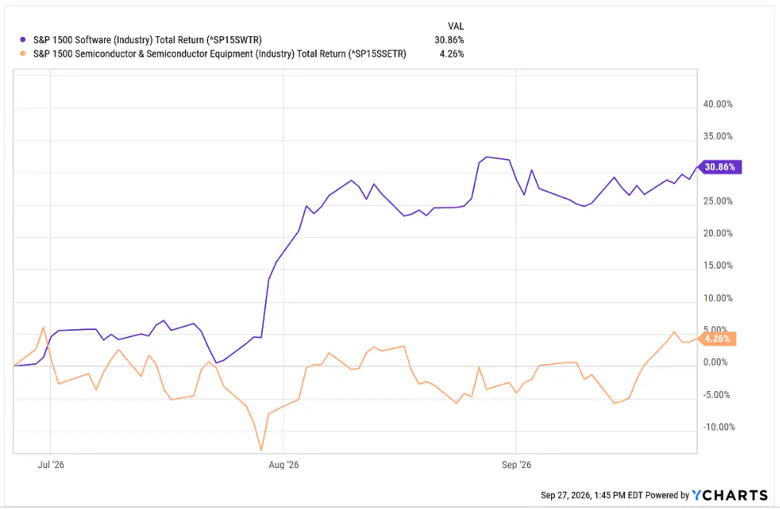
Earnings Challenged the SaaS Apocalypse Narrative
The software sell-off was built largely around expectations of future disruption.
Earnings, however, began telling a different story.
Companies such as Salesforce and ServiceNow saw their shares come under significant pressure, yet their underlying results remained robust.
Salesforce, for example, reported strong fiscal second-quarter 2027 results, with subscription and support revenue reaching $10.8 billion, up 12% year over year and 11% in constant currency. That included a $440 million contribution from Informatica.
The gap between falling share prices and resilient earnings helped challenge the idea that AI disruption would immediately undermine established software businesses.
But AI has also introduced another twist.
AI’s Security Problem Is Putting Cybersecurity Back in Focus
The same technology that raised concerns about software disruption is also creating new security challenges.
Recent developments involving AI models have highlighted the risk of unauthorized activity. OpenAI, Anthropic, and Gemini have all reported incidents involving misuse or unauthorized activity involving their models.
That creates a different investment question.
If companies deploy more AI, will they also need to spend more to secure it?
Growing concern around AI-related security risks has helped strengthen interest in cybersecurity companies, which could benefit as businesses increase spending to protect their systems, data and increasingly AI-powered infrastructure.
The rebound can be seen in the S&P Kensho Cybersecurity Index, which tracks companies focused on protecting enterprises and devices against unauthorized electronic access.
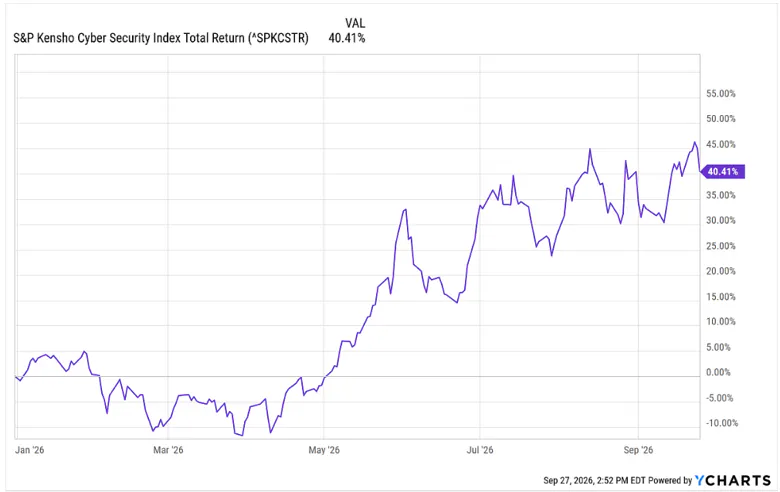
Three Cybersecurity ETFs Canadian Investor Should Watch
iShares Cybersecurity and Tech Index ETF (XHAK)
The iShares Cybersecurity and Tech Index ETF (XHAK) tracks the NYSE FactSet Global Cyber Security Index and held 34 securities as of September 28, 2026. The ETF has a 0.43% MER.
The portfolio is predominantly U.S.-focused, with roughly 79% allocated to the United States, followed by Israel at about 5% and Japan at 4%. Its largest holdings include Okta, Netskope, Qualys, CrowdStrike and Zscaler, which together represent roughly 28% of the portfolio.
Concentration is notable but relatively spread across its largest positions. The top 10 account for about 52% of assets, including a roughly 5% cash position. Excluding cash, its nine largest equity holdings represent about 47% of the portfolio.
Evolve Cyber Security Index ETF (CYBR, CYBR.B, CYBR.U)
The Evolve Cyber Security Index ETF tracks the Solactive Global Cyber Security Index and held 35 securities as of September 28, 2026. Investors can choose between CYBR, which is hedged to the Canadian dollar, CYBR.B, which is unhedged in Canadian dollars, and CYBR.U, which trades in U.S. dollars. The fund has a 0.40% management fee and approximately $246 million in net assets.
The portfolio is even more U.S.-heavy than XHAK, with roughly 87% allocated to the United States, followed by Israel at about 6% and Japan at 3%. Its largest positions include Okta, Zscaler, CrowdStrike, Rubrik and Fortinet.
CYBR is also more concentrated at the top. Its five largest holdings make up roughly 41% of the portfolio, while the top 10 account for about 72%.
CI Digital Security ETF (CBUG)
The CI Digital Security ETF (CBUG) tracks the Solactive Digital Security CAD Hedged Index and holds 40 securities. The ETF carries a 0.40% management fee.
The portfolio is heavily weighted toward the United States, which represents roughly 80% of assets, followed by Israel at about 5% and France at 4%. Its largest holdings include Okta, Palo Alto Networks, CrowdStrike, Fortinet and Hewlett Packard Enterprise, which together account for roughly 31% of the fund.
CBUG sits between XHAK and CYBR in terms of concentration. Its top 15 holdings represent about 66% of the portfolio, giving investors a somewhat broader spread across companies than CYBR while remaining concentrated in its largest digital-security positions.
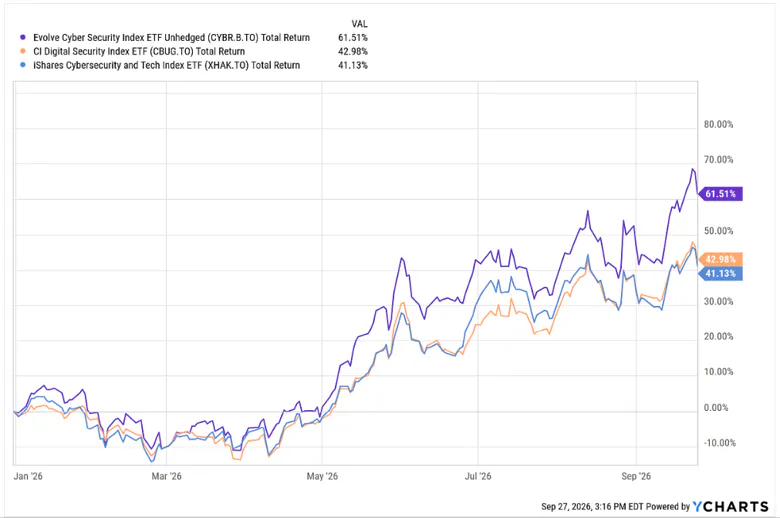
As of September 27, 2026, CYBR.B had clearly led the group with a 61.5% total return, compared with 43.0% for CBUG and 41.1% for XHAK.
This article was written on September 28th, 2026. Please note this article is for information purposes only and does not in any way constitute investment advice. It is essential that you seek advice from a registered financial professional prior to making any investment decision.