ETF Comparison: ZLB vs. FCCL
Two of Canada's largest low-volatility ETFs share a similar objective, but differences in methodology and sector exposure have led to notably different results.

Loss aversion is a powerful motivator for many investors, particularly during periods of elevated market volatility. For many investors, low-volatility strategies have become a popular choice for managing portfolio volatility and mitigating losses, allowing them to remain invested through market cycles. For investors seeking low-volatility Canadian equity ETFs, Cboe Canada’s ETF Screener tool is an ideal starting point for identifying the options available from different issuers.
ETF Comparison: ZLB vs. FCCL
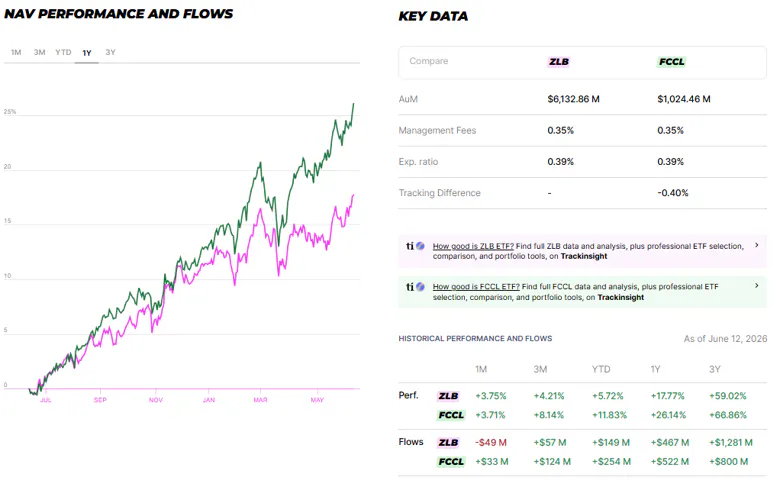
For Canadian investors interested in pure-play low-volatility ETF solutions, the BMO Low Volatility Canadian Equity ETF (Ticker: ZLB) and Fidelity Canadian Low Volatility Index ETF (Ticker: FCCL) will likely cross your radar, as they are among the largest low-volatility ETFs in Canada, with assets under management of $6,132.86 million and $1,024.46 M, respectively, as of June 12th, 2026. However, while both solutions share a similar focus, they differ in investment experience. Using Cboe Canada’s ETF Market comparison tool, investors can gain both qualitative and quantitative insights into how the funds differ.
The ETF Market comparison tool provides baseline information, including fund characteristics and a daily-updated Frequently Asked Questions section, allowing users to access foundational information for the funds in question. Although both solutions share a similar investment focus, management fees, and expense ratios, their long-run performance shows how different they truly are. FCCL has outperformed the ZLB across several time frames.
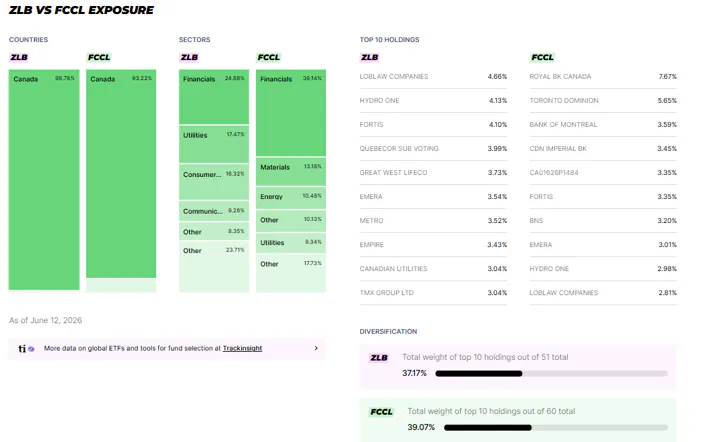
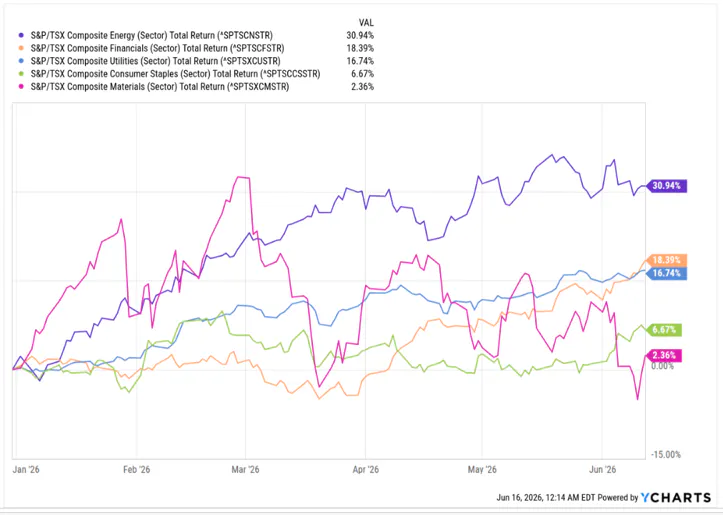
The difference in performance, particularly on a year-to-date basis, is likely attributable to differences in sector exposure between the solutions. As illustrated in the following image, FCCL allocates almost 40% to the Financial Services sector, with Materials (13.18%) and Energy (10.48%) being the next-largest sector exposures. Conversely, ZLB’s Financial Services allocation is approximately 25%, with Utilities (17.47%) and Consumer Staples (16.32%) being the next-largest sector exposures for the fund.
In looking at the year-to-date performance of the previously mentioned sectors, FCCL has benefited from the strong performance of the Energy and Financial sectors, which have performed well thus far in the year.
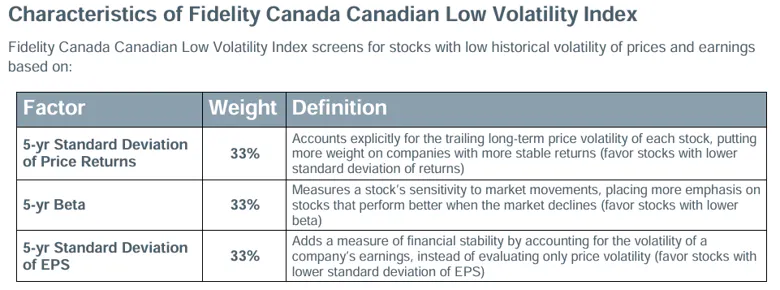
From a qualitative perspective, both solutions are factor ETFs with rules-based methodologies guiding their stock selection and portfolio composition. For FCCL, the Fidelity Canada Canadian Low Volatility Index starts with a universe of the largest 300 Canadian stocks by market cap, subject to liquidity and investability requirements, and then evaluates the remaining securities using a proprietary low-volatility factor score based on 5-yr Standard Deviation of Price Returns, 5-yr Beta, and 5-yr Standard Deviation of EPS.
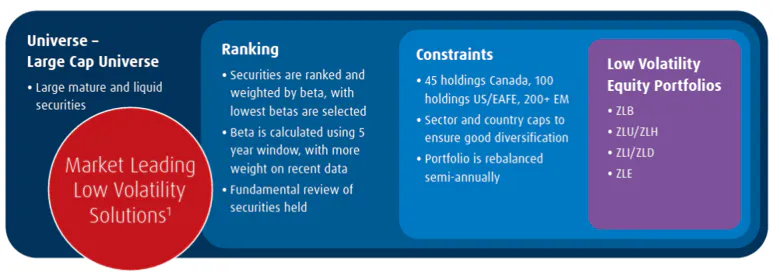
The methodology used by ZLB consists of selecting the largest and most liquid securities. Next, the remaining securities are ranked by beta, and those with the lowest betas are selected. The beta used for weighting is calculated from 5 years of market data, with 25% weight on the most recent year, 22.5%, 20%, 17.5%, and 15% on the prior successive years.
Takeaway
While both funds share the same objective, FCCL has delivered better long-term performance and demonstrated a stronger loss-mitigating profile during the most recent market drawdown. Although FCCL has significant financial-sector exposure, within the Canadian equity landscape, the sector is led by banks, which are regarded as stable institutions known for their consistent dividends.
This article was written on June 26th, 2026. Please note this article is for information purposes only and does not in any way constitute investment advice. It is essential that you seek advice from a registered financial professional prior to making any investment decision.