Investing in Space Beyond the SpaceX IPO
The space economy is growing far beyond rockets, creating new opportunities for investors seeking exposure through space-focused ETFs.


“Space, the final frontier” is a phrase popularized by William Shatner as Captain James T. Kirk in the Star Trek franchise. In reality, space is already a top-of-mind investment area, bringing innovations on both the commercial and consumer levels that can propel our modern economy forward. While the pending initial public offering of SpaceX (see S-1 filing) has captured the general public's attention, the investment thesis around the space economy has long been in place, though it has received increased attention in recent months. For investors looking to enter the burgeoning space economy, there are ETFs that provide exposure to turnkey exposure to firms within the industry.
The Space Economy
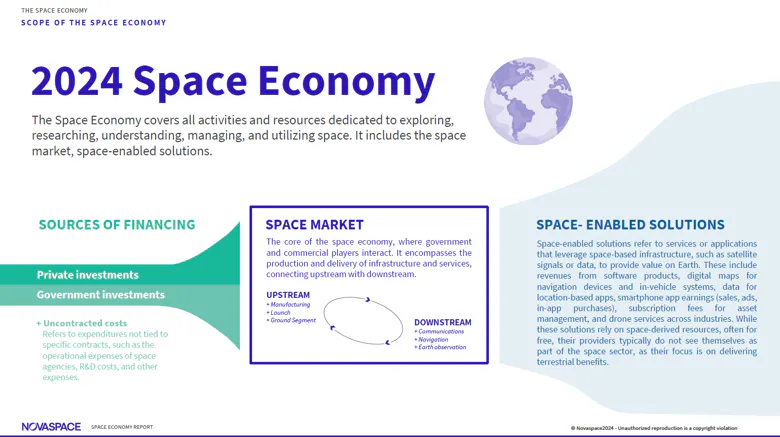
The space economy encompasses all activities and resources that advance human progress through the exploration, research, understanding, management, and use of space. The sector supports critical infrastructure on Earth (e.g., GPS and digital communications), provides fundamental scientific data for decision-making (e.g., weather tracking and natural disaster preparedness), and supports societal well-being (e.g., monitoring climate change and other environmental data). According to research by McKinsey & Company, the space economy is worth $1.8 trillion, up from $630 billion in 2023. The increase can be attributed to rising satellite launches, declining launch costs, increased defence spending by nations, and demand for AI-powered insights into space data and greater satellite-driven connectivity.
Space Economy Incumbents
Firms operating in the space economy may not be household names, but they are crucial stakeholders in the industry, each with a distinct value proposition that makes them economically viable and intriguing for long-term investment. Below are some notable firms within the space economy that play a crucial role.
Rocket Lab (RKLB) has established itself as the most credible competitor to SpaceX in the launch services sector. The company operates Electron, a small launch vehicle designed for frequent, dedicated missions, and is also developing Neutron, a larger, reusable rocket targeting the medium-lift market.
What sets Rocket Lab apart is its vertical integration. In addition to launches, the company produces satellite components, spacecraft systems, and mission software, making it a comprehensive provider of space infrastructure. As governments and commercial operators increasingly look for alternatives to SpaceX to diversify their options, Rocket Lab has become a key secondary choice.
OHB SE (OHB-DE) ranks among Europe’s leading manufacturers of space and satellite technology, playing a significant role in Earth observation, military reconnaissance, and national communications infrastructure. The company participates in advanced military satellite projects in Germany and in broader European defence programs that increasingly view space assets as vital to national security. It stands to benefit as Germany plans to triple its space defence budget by 2030. In a global context where geopolitical intelligence, missile detection, and secure communications are increasingly important, space is fundamentally linked to national defence.
AST SpaceMobile (ASTS) is attempting something transformative: Delivering broadband connectivity directly from space to standard, unmodified smartphones. Billions of people globally still lack reliable mobile connectivity, while even developed markets continue to experience coverage gaps. If satellite-to-phone connectivity becomes mainstream, AST SpaceMobile could emerge as an indispensable part of the new global communications infrastructure.
Investing in the Space Economy via ETFs
For Canadians interested in the space economy, there are investment solutions that provide exposure to the broad economy and to individual players, such as SpaceX .
Global X Space Tech Index ETF (Ticker: ORBX), which reflects companies driving the growth and commercialization of the global space economy, including space technologies and components, launch and orbital services, space exploration and tourism, and satellite-enabled communications and data services.
As an investment solution, ORBX includes companies directly tied to launch systems, satellites, space-enabled data and communications, and the components and software that make those systems work. These companies comprise four segments:
- Rocket Launch and Reusable Rockets: companies providing launch systems and reusability technologies that can reduce the cost of access to space
- Space Tech & Components: companies supplying mission-critical hardware, propulsion, software, analytics, and specialized components that support modern space operations
- Satellite Telecommunications & Data Services: companies enabling connectivity, navigation, imaging, and secure communications through satellite systems and related infrastructure
- Space Transportation, Tourism, and Exploration: companies commercializing human spaceflight, orbital access, and related exploration services
For Canadian investors seeking specific exposure to SpaceX, Harvest ETFs recently announced the listing of the Harvest SpaceX Enhanced High Income Shares ETF (Ticker: SPXE) on TSX, while Purpose Investments has already launched the Purpose SpaceX Yield Shares ETF (Ticker: SPXY) on Cboe Canada.
SPXE is a new offering within Harvest’s High Income Shares suite, providing access to the growth of SpaceX and overlaying an active covered call-writing strategy on up to 50% of the portfolio. It applies modest leverage of around 25% to enhance exposure, income, and growth potential.
SPCX is a new entrant in Purpose’s Yield Share product suite, generating enhanced income from SpaceX through a covered call strategy on 50% of the portfolio and a moderate leverage of 25%.
Takeaway
As a recently launched solution, ORBX has a short track record; however, the investment thesis and mandate focus are poised to develop over the long term. The space economy is still early in its development; as such, the progress of the companies held in the fund will reflect the net new developments and innovations that come to market as the space economy grows.
This article was written on June 8th, 2026. Please note this article is for information purposes only and does not in any way constitute investment advice. It is essential that you seek advice from a registered financial professional prior to making any investment decision.