Protecting your Portfolio Against Market Downturns with Buffer ETFs
Sudden fears of a recession and a shift in the macroeconomic landscape-initiated panic but highlighted the benefit of buffer ETFs.


As the saying goes, it only takes a spark to get the fire going. Only mere days after the Federal Open Markets Committee (FOMC) issued its policy decision statement to hold rates due to recent indicators suggesting that economic activity has continued to expand at a solid pace, the release of the July 2024 jobs report upended market sentiment, as U.S. employers added just 114,000 jobs in July — 35% fewer than expected — and unemployment, now at 4.3%, is the highest since October 2021.
With unemployment rising, the belief that a recession was impending became the dominant narrative - with many market commentators referencing the Sahm rule as their basis for recession concerns. Ironically, Claudia Sahm, the economist for whom the rule was named, wrote in a recent post that "A recession is not imminent, but the risks of a recession have risen.”
The ripple effect stemming from the Bank of Japan
While the jobs report shifted market sentiment on Friday, the Bank of Japan's recent action to raise its benchmark rate from 0.10% to 0.25% was the impetus for the drawdown in U.S. equity markets on Monday. How was this possible? Because of the yen carry trade.
Macroeconomic conditions between Japan and the United States have shifted. Since early 2023, the Federal Reserve has increased interest rates, while the Bank of Japan has kept its rates close to zero. This difference made the yen less attractive, allowing investors to borrow cheaply in yen and invest in higher-yield assets, such as U.S. equities, specifically Magnificent Seven companies.
This practice, known as the carry trade, pushed the yen's value down further. A weaker yen boosted the earnings of Japan's export-driven companies as their foreign earnings became more valuable in yen.
With the Bank of Japan enacting tighter monetary policy, traders are forced to close their positions due to the appreciation of the yen; causing a sharp market decline. Japan's stock market, led by export-oriented companies, has been particularly affected, as these companies benefited from a weaker yen both through competitive pricing and higher reported earnings from abroad. On Monday, the Nikkei 225 shed much of its value, after hitting a multi-decade high of 42,426 on July 10th.
Drawdowns occur, but their impact can be managed
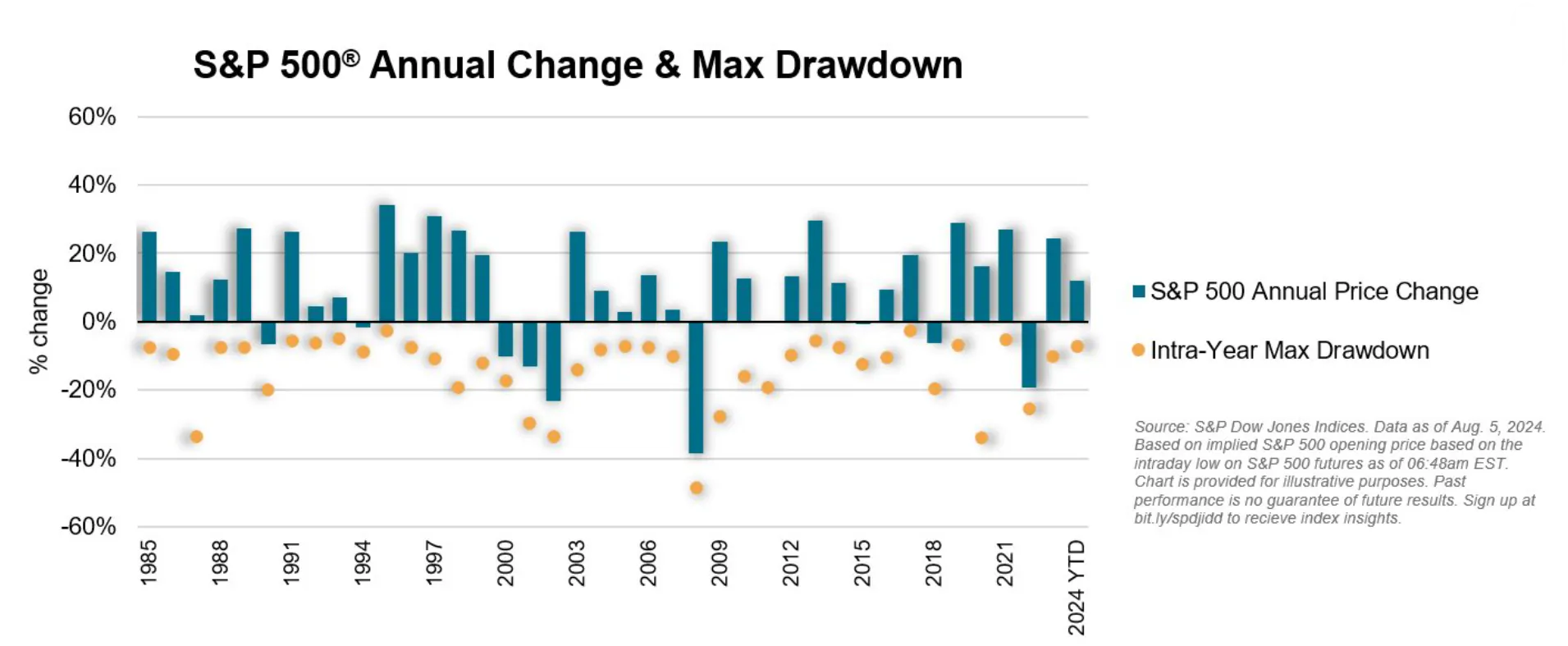
The market activity on August 2nd and August 5th exemplified a simple investment fact: market drawdowns occur. While the impetus for this drawdown stemmed from the collective belief of a recession and a policy change by the Bank of Japan, the occurrence (i.e. a market drawdown) is part of the normal equity market cycle. This is illustrated by the following chart that diagrams the historical drawdowns with the S&P 500 Index since 1989.
Buffer ETFs: A Risk-managed approach to investing
For individuals seeking to manage volatility and protect their investments from significant market downturns, Buffer ETFs offer a more predictable return by limiting downside losses and capping upside potential over a specific period (typically one year).
These funds are especially attractive to more risk-averse investors, as they may not want to take on additional risk in their portfolios. The investment efficacy of buffer ETFs, utilizing the BMO U.S. Equity Buffer Hedged to CAD ETF – October (Ticker: ZOCT) as a reference, was demonstrated during the latest drawdown.
Investors should note that Buffer ETFs' performance depends on factors such as the timing of your investment, with entering at the start of the buffer period being optimal, the size of the buffer, which offers more protection but can limit returns.
Takeaway
Market drawdowns are a natural occurrence in investing and are to be expected. However, buffer ETFs can be utilized as a means of mitigation for investors who seek to manage their loss exposure during such events.
For investors interested in buffer ETFs, BMO ETFs launched their first buffer ETF and has gradually grown their investment offerings in this product category in mere months, recently launching the BMO U.S. Equity Buffer Hedged to CAD ETF – July (Ticker: ZJUL).
BMO's Buffer ETF suite provides investors with exposure to the large-cap segment of the U.S. equity market, namely the S&P 500 Hedged to Canadian Dollars Index while providing a buffer against the first 15% of a decrease in the index's market price over a period of approximately one year.
Read more: How BMO's Buffer ETFs Can Protect Your Portfolio in Volatile Markets
Please note this article is for information purposes only and does not in any way constitute investment advice. It is essential that you seek advice from a registered financial professional prior to making any investment decision.