Sustainable ETF Comparison: FCSW vs. NSGE
FCSW and NSGE both bring sustainability into global equity investing, but their different approaches reveal why investors need to look beyond the label.

The buzz around environmental, social and governance (ESG) investing has faded since the pandemic, but the underlying question remains relevant: can investors align their portfolios with their values while pursuing competitive returns?
Answering that takes more than a sustainability label.
Investors need to understand what a fund owns, how it selects companies and whether its approach delivers the balance of performance, risk and sustainability they expect.
Two ETFs with similar objectives can build very different portfolios, with meaningful implications for diversification and returns.
In this edition of the Canadian ETF Comparison, we take a look at two approaches to sustainable global equity investing: the Fidelity Sustainable World ETF (FCSW) and the NBI Sustainable Global Equity ETF (NSGE).
Both pair global stock exposure with a sustainability focus, but how do their investment processes and portfolios compare?
Using Cboe Canada’s ETF Market Comparison tool, we explore their investment philosophies, holdings, fees and performance to understand what sets them apart and what those differences mean for investors.
FCSW Starts With ESG Leaders, Then Looks for Attractive Stocks
The Fidelity Sustainable World ETF (FCSW) selects companies from the MSCI ACWI ESG Leaders Index.
The index identifies companies considered best-in-class within their industries based on their exposure to ESG risks and how effectively they manage those risks relative to peers.
From there, FCSW’s manager applies a quantitative multi-factor model to assess companies in the index.
The goal is to identify reasonably valued, profitable businesses with high-quality earnings, positive price momentum, and other distinguishing characteristics.
In other words, sustainability determines the starting universe, while traditional investment factors help shape the final portfolio.
NSGE Builds Around the UN Sustainable Development Goals
The NBI Sustainable Global Equity ETF (NSGE) takes a different route.
Its investable universe is derived from the UN Sustainable Development Goals, which cover economic prosperity, environmental sustainability, and social inclusion.
Rather than beginning with a broad ESG-screened index, NSGE invests exclusively in themes directly aligned with the UN Sustainable Development Goals.
Its portfolio is organized around three investment themes: climate, health, and empowerment.
That gives the fund a more explicitly thematic framework for defining sustainability.
NSGE’s manager uses both top-down and bottom-up analysis when selecting companies.
The top-down process begins with the UN Sustainable Development Goals and is used to better understand long-term secular themes that could shape the outlook for different industries.
The bottom-up process then focuses on individual companies, including prospective earnings growth, valuation, management quality, and exposure to ESG factors.
The result is a strategy that first identifies sustainability-related themes and then evaluates which companies within those areas may merit inclusion.
FCSW vs. NSGE: How Do Size and Costs Compare?
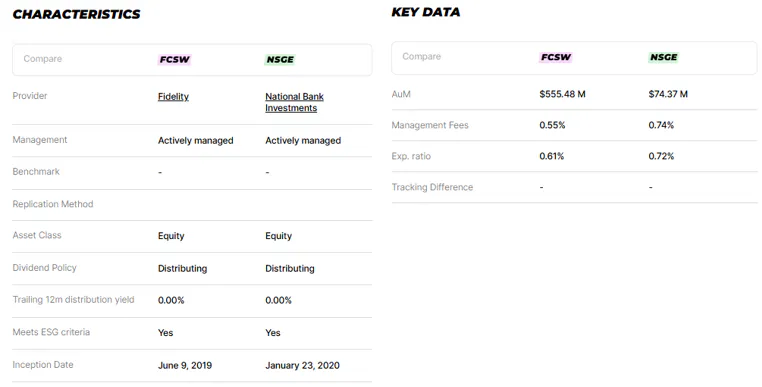
FCSW has significantly more assets under management and lower management fees and expenses than NSGE.
Alongside their different investment approaches, these are practical considerations for investors.
Fees directly affect net returns, while fund size provides useful context but does not, by itself, indicate better performance or liquidity.
FCSW vs. NSGE: Which ETF Performed Better?
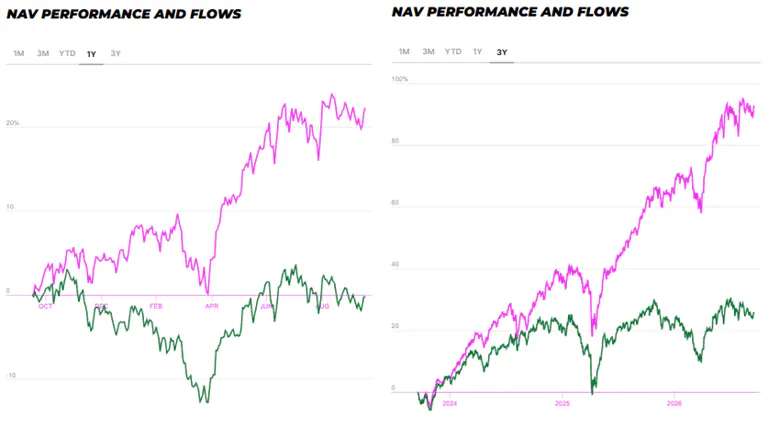
FCSW has led on performance, though neither fund has escaped market volatility.
Both experienced notable drawdowns in 2025 and early 2026, but FCSW came out ahead over the periods shown. Its lead is visible across the one-year and three-year growth charts and the trailing returns.
Final Takeaway
FCSW has demonstrated better performance and charges a lower fee than NSGE. The investment thesis of FCSW has proven effective, given its growth trajectory across various market cycles.
This article was written on September 21st, 2026. Please note that this article is for information purposes only and does not in any way constitute investment advice. It is essential that you seek advice from a registered financial professional prior to making any investment decision.