Why Tactical Asset Allocation ETFs Like RTA Are Gaining Attention
A look at how the Purpose Tactical Asset Allocation ETF (RTA) uses a quantitative model to dynamically shift between equities and bonds.


Asset allocation solutions have become the default choice for many Canadian investors because they offer turnkey, diversified portfolios aligned with an individual's risk profile. However, many asset allocation ETFs use a strategic asset mix that reflects historical performance and volatility trends. As a result, solutions based on a strategic mix tend not to focus on capitalizing on short-term opportunities arising from market sentiment or emerging developments across asset classes. Given the dynamism of markets, there is a cohort of investors interested in solutions that can tactically adjust to new developments as they arise; as such, solutions such as the Purpose Tactical Asset Allocation ETF (Ticker: RTA) may have strong appeal.
Purpose Tactical Asset Allocation ETF (Ticker: RTA) Explained
RTA's primary investment objective is long-term capital appreciation with lower volatility and lower correlation to equity markets, particularly those in North America. As the fund's name suggests, RTA employs a tactical approach; as such, holdings can range from 100% equity to 100% bonds/cash. To achieve its primary investment objective, the fund uses a proprietary, quantitatively driven investment process that minimizes human intervention, with a systematic multi-factor model determining 80% of the portfolio's asset allocation. Indicators within the model include technical market trends, with an emphasis on relative strength and momentum. Additional factors include monetary policy indicators, U.S., Canadian, and global economic indicators, and a fundamental assessment of valuation metrics. The remaining 20% is managed on a discretionary basis, guided by the portfolio manager’s fundamental view of asset allocation and security selection given market conditions.
In executing this strategy, RTA uses third-party (i.e., non-Purpose Investments) ETF issuers to gain exposure to equities, bonds, and cash. This is noteworthy, as the portfolio manager is conscientious about ensuring the ETF effectively tracks the desired underlying bond or equity index. Cost is also a key consideration, including the embedded management expense ratio and liquidity factors such as ETF size, bid/ask spread, volume, and market maker support. Finally, the fund is benchmarked against 40% S&P/TSX Composite Total Return Index, 20% S&P 500 Total Return Index, and 40% FTSE Canada Bond Universe Index.
RTA’s Appeal in a Changing Landscape
The ever-changing global landscape has heightened uncertainty but also created new opportunities. Tactically oriented solutions, such as RTA, aim to identify market inefficiencies and make judgments that create opportunities to outperform. The fund’s use of a proprietary model in executing its asset allocation is particularly noteworthy, as it distills copious amounts of data into a directional guide- a bullish or bearish approach – that can be actioned in a timely manner, eschewing human bias and errors in judgement.
As gleaned from the fund’s most recently published commentary (published September 9th), the fervour that was present in August has abated, given the backdrop of rising oil prices and persistent inflation. This has led the fund to reduce its equity allocation to 50% in September/October, to position for potential near-term volatility.
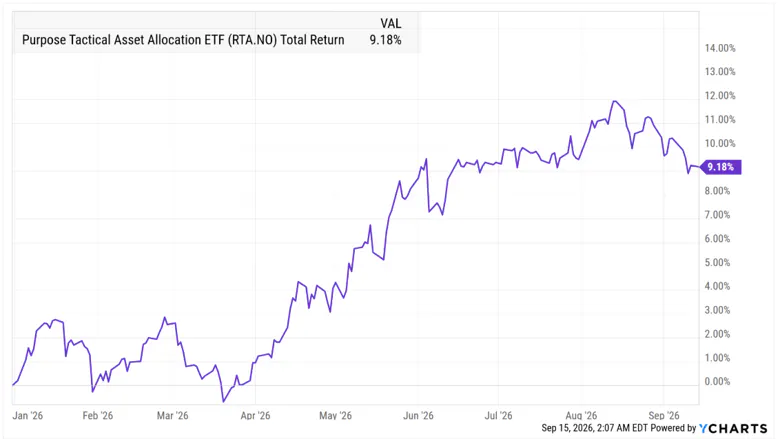
RTA’s year-to-date performance has modestly rewarded investors, given the market events that have shaped the global economy so far this year. The fund’s Canadian equity exposure, via the Mackenzie Canadian Equity Index ETF (Ticker: QCN) and the Global X S&P/TSX 60 Index ETF (Ticker: CNDX), contributed materially to the fund’s return, reflecting the energy sector's strong performance this year. Conversely, the bond holdings, Vanguard Canadian Short-Term Bond Index ETF (Ticker: VSB) and Vanguard Short-Term Bond Index Fund ETF (Ticker: BSV) — which represent nearly half the portfolio — were essentially flat YTD, acting as ballast rather than a return driver.
Takeaway
The Purpose Tactical Asset Allocation ETF provides investors with a solution that automatically responds to changing market conditions to generate absolute returns. For investors seeking a dynamic asset allocation solution that captures upside in rising markets and protects on the downside when markets turn, RTA offers this capability in a single-ticket offering.
This article was written on September 15th, 2026. Please note this article is for information purposes only and does not in any way constitute investment advice. It is essential that you seek advice from a registered financial professional prior to making any investment decision.