The Final ETF Play of 2026: Where Are the Market’s Biggest Opportunities?
A review of the themes and sectors that shaped 2026, and the ETFs offering global and sector exposure heading into year-end.

Markets have had plenty of reasons to stumble in 2026. AI spending is soaring, conflict in the Middle East has shaken energy markets, and central banks have turned more hawkish. Yet North American stocks have continued to deliver gains. With the year drawing to a close, the bigger question is not simply how markets have held up. It is which sectors have done the heavy lifting, and where ETF investors might look next.
Three Forces Driving Markets in 2026: AI, Oil and Interest Rates
Three forces have dominated the investment story this year: the race to build AI infrastructure, the prolonged conflict in the Middle East, and a shift toward higher interest rates. Start with AI. The biggest technology companies are committing extraordinary sums to expand computing capacity:
- Alphabet lifted its full-year capital expenditure forecast to $195 billion–$205 billion after second-quarter spending more than doubled year over year.
- Amazon raised its full-year capital spending plan by $20 billion to $220 billion, citing higher memory costs. AWS capacity for 2026 and 2027 is largely booked, with a significant share of 2028 capacity already committed, as demand continues to outpace expansion.
- Meta increased its 2026 capital expenditure outlook to $135 billion–$145 billion, raising the lower end of its guidance. Microsoft, meanwhile, lowered its guidance from $190 billion to $175 billion.
The spending boom creates a dilemma. AI infrastructure is delivering exceptional revenue growth for some companies, but building it is expensive. Heavy investment is squeezing free cash flow, while investors are still waiting for clearer evidence of returns on that capital. In a higher-for-longer interest rate environment, that tension is putting valuations under pressure.
Then there is oil. The prolonged war in the Middle East has sent shock waves through the global economy, with WTI and Brent crude reacting to developments on the ground. Fighting intensified in September and October, including attacks on Saudi energy infrastructure and the East-West Pipeline, raising fresh concerns about oil transportation.
Diplomatic discussions have offered some hope, but the timing of any resolution remains uncertain. So does the prospect of a return to normal conditions in energy markets.
That uncertainty has also reshaped monetary policy. With higher energy costs adding to inflation pressure, central banks have moved toward rate increases. The Federal Reserve raised rates in September for the first time in three years, followed by the European Central Bank's earlier move that month and the Bank of Canada's increase in late October. All three signaled that further hikes could follow before year-end.
North American Stocks Are Rising. Energy Is Leading the Charge
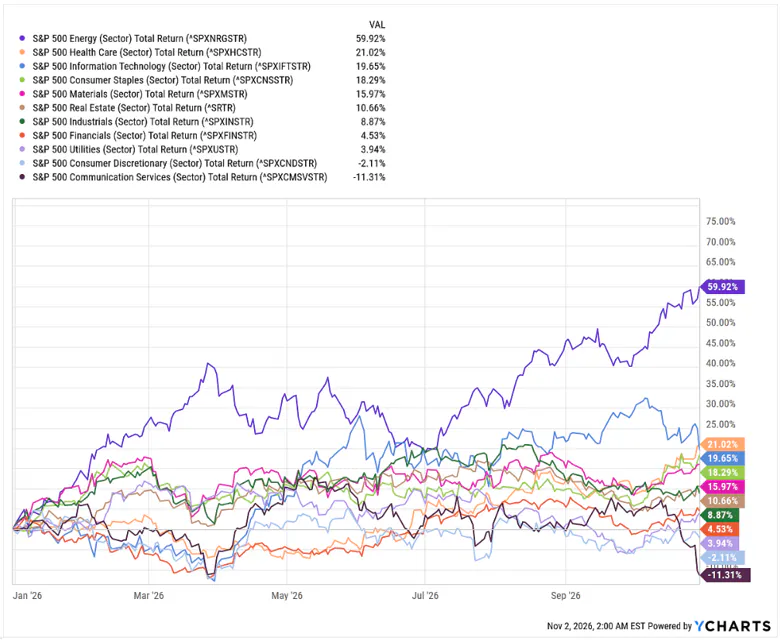
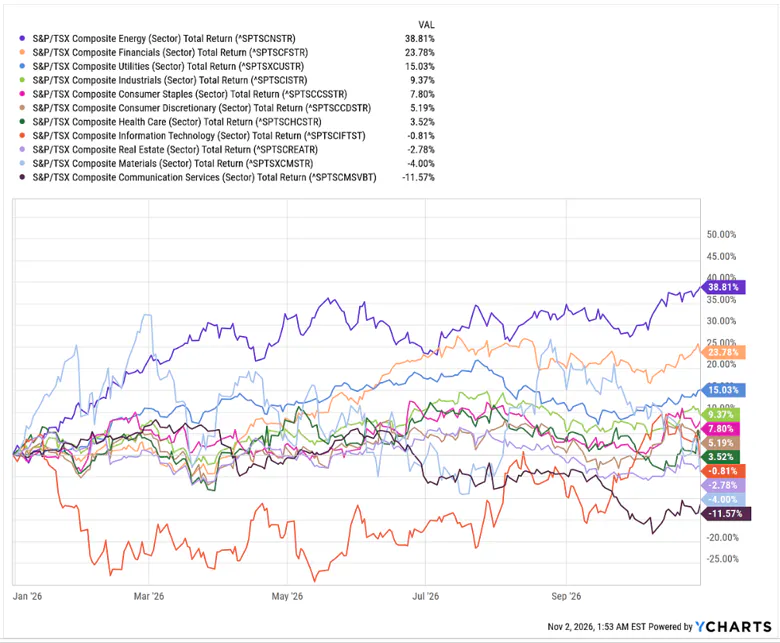
For all the uncertainty, both the S&P 500 and the S&P/TSX Composite have posted compelling returns in 2026. But headline index gains tell only part of the story. Look beneath the surface and one sector stands out: Energy. Its strength reflects the year's extraordinary backdrop of geopolitical risk and volatile oil markets.
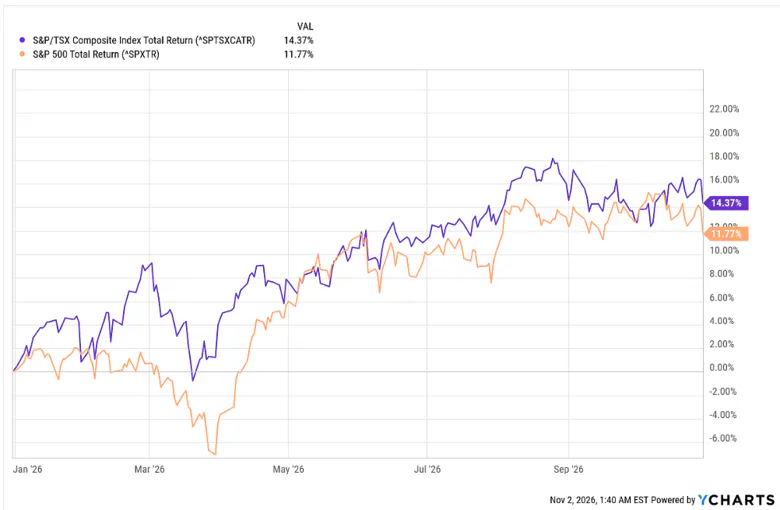
The U.S. market offers another revealing contrast. Health Care and Consumer Staples have performed well, suggesting investors are showing greater interest in defensive businesses. Information Technology has also remained a strong performer despite mounting questions about the cost of the AI buildout. In Canada, Financials have been another source of strength, supported by the country's major banks.
The ETF Playbook for Year-End: Diversify or Target the Leaders?
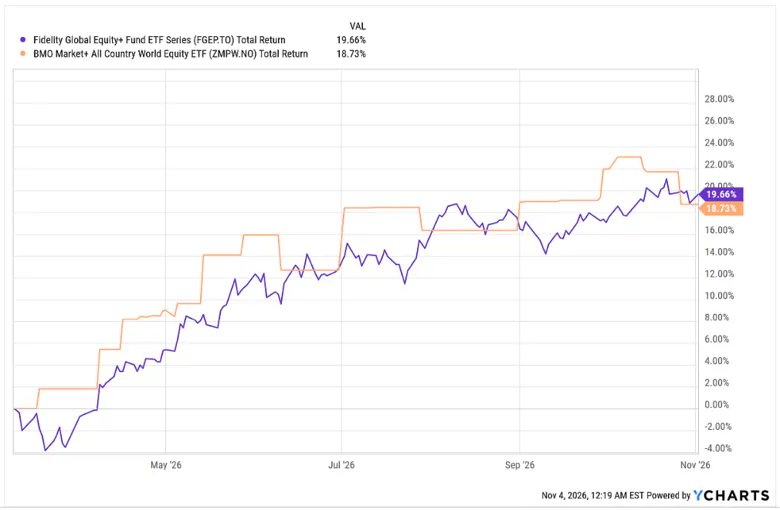
With uncertainty still hanging over markets, solutions that offer global diversification are one way to spread risk. For example, ETFs like the Fidelity Global Equity+ Fund (Ticker: FGEP/FGEP.U) or the recently launched BMO Market+ All Country World Equity ETF (Ticker: ZMPW) offer one-ticket access to global equities.
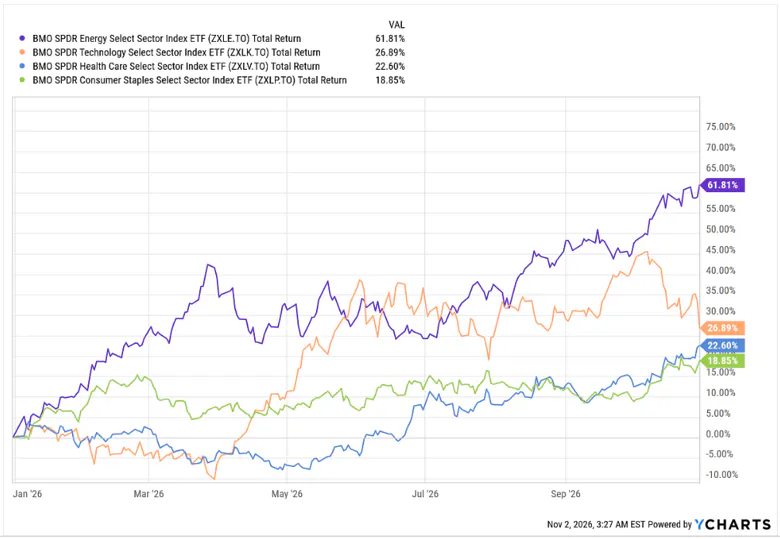
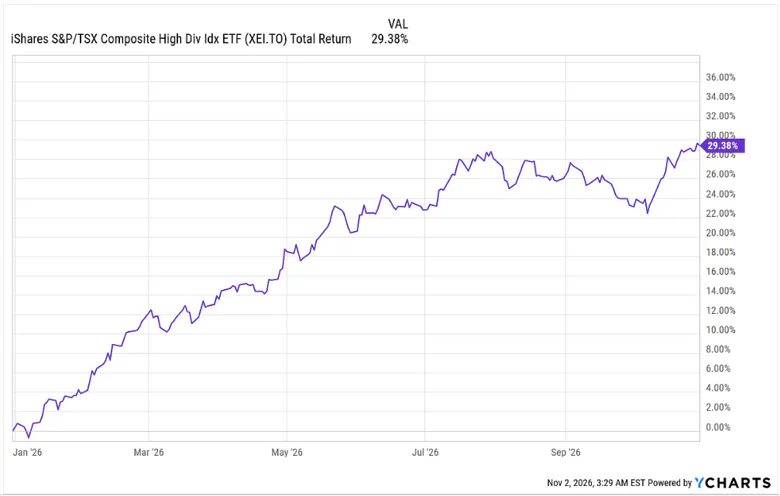
Investors who may want more targeted equity exposure, including those interested in leading U.S. sector exposure , ETFs such as the BMO SPDR Energy Select Sector Index ETF (Tickers: ZXLE/ZXLE.F), BMO SPDR Technology Select Sector Index ETF (Ticker: ZXLK/ZXLK.F), BMO SPDR Health Care Select Sector Index ETF (Tickers: ZXLV/ZXLV.F), and BMO SPDR Consumer Staples Select Sector Index ETF (Tickers: ZXLP/ZXLP.F) provide that exposure. For a single fund spanning Canadian Energy and Financials, the iShares S&P/TSX Composite High Div ETF (Ticker: XEI) held 31.2% and 30.1% in Canadian Energy and Financials, respectively, as of October 2026. Given the Canadian Energy and Financial sectors' reputation for consistent dividend payments, these firms have historically shown stable, predictable revenue and cash flow; as a result, they can maintain and grow dividends over time, benefiting investors.
Written November 2, 2026. This article is for informational purposes only and does not constitute investment advice. Consult a registered financial professional before making any investment decision.