What the SpaceX IPO Reveals About Index Methodology
How SpaceX's IPO exposed the diverging choices of index providers, and why methodology matters for ETF investors.


SpaceX’s (Ticker: SPCX) entry into the public markets has not only made investors aware of the burgeoning space economy but also provided an opportunity to educate many about the role of index providers and their importance in the investment ecosystem. With SpaceX’s initial public offering (IPO) having occurred on June 12th, the actions taken by the leading index providers, namely Nasdaq Inc., FTSE Russell, a subsidiary of London Stock Exchange Group plc, and S&P Dow Jones Indices, a part of S&P Global Inc., may have set a precedent for the upcoming IPOs of Anthropic and OpenAI.
Bifurcation among Index Providers
The previously mentioned index providers have made markedly different choices regarding the inclusion of SpaceX in their indices. As a baseline, newly public companies are not automatically included in an index, as each provider has its own eligibility rules for determining a company's suitability for inclusion. In addition to a minimum time a company must trade publicly (i.e., a seasoning period), other criteria, such as financial viability, trading volume, market capitalization, and post-IPO lock-up considerations, are factored in. Ultimately, these rules are designed to ensure that companies meet standards for liquidity, trading history, and investability before being added to major benchmarks.
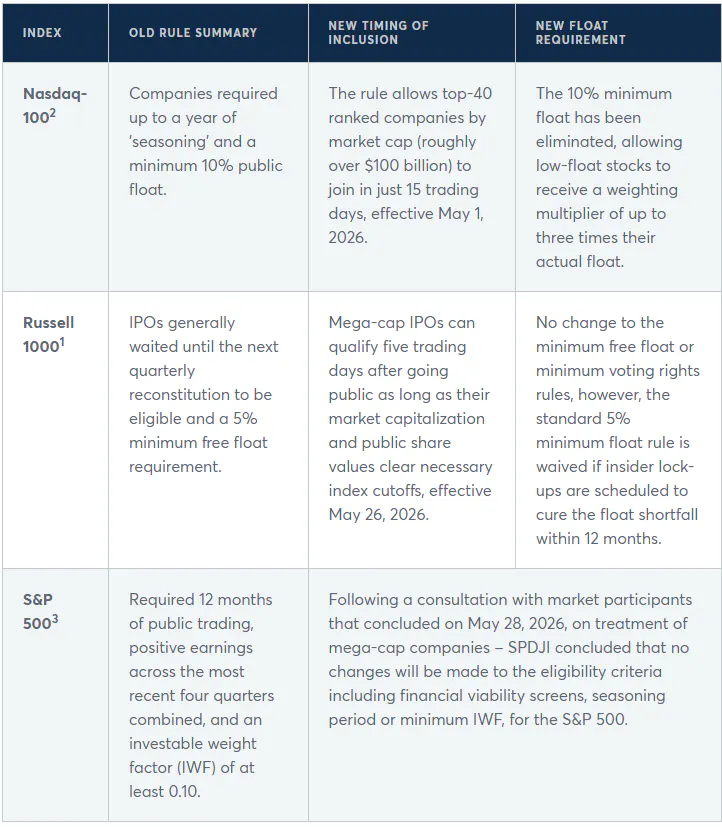
Regarding SpaceX, Nasdaq and FTSE Russell have opted to expedite its inclusion, whereas S&P Global has decided to maintain its existing methodology.
Gradual Share Unlock and Index Implications
At present, only a small fraction (approximately 4.3%) of SpaceX's total shares are available for trading, which limits supply and amplifies demand until lockups expire. SpaceX has implemented a tiered, rolling release schedule designed to facilitate sales by its longest-tenured shareholders. While the approach is mainly aimed at tempering stock price volatility, staggered lockups have not always kept a newly listed stock’s price high. As it pertains to the Nasdaq-100 Index and the new rules instituted, companies with a very low float will have their index weight capped at 3 times their free-floating shares. As more shares become available, the firm's weight in the index is expected to increase over time.
The actions taken by index providers have implications for passively managed strategies that track these indices, as they are required to buy shares to match the benchmark's weight. Given the stock's limited float and the need for passive strategies to mirror the index, there is potential for liquidity strain and increased volatility.
More broadly, SpaceX’s presence in both the Nasdaq and FTSE Russell Indices, but not in S&P Global’s, creates a forked investment experience for investors. Proponents of the expedited inclusion argue that indices should be representative of the market; given SpaceX’s seminal status and market cap, excluding it leaves investors underexposed. Conversely, opponents of fast-tracking the company into indices highlight incomplete price discovery and volatility in the stock due to the limited float and forced buying by passive investment solutions, regardless of valuation.
Another perspective is that, from a perception standpoint, Nasdaq’s decision to fast-track SpaceX into its index affirms the long-standing narrative that it is tech-innovation-focused and that its index reflects that ideology. The Nasdaq and S&P taking different approaches to mega-cap IPOs gives investors different options, depending on their investment styles and preferences.
Index Methodology Matters
SpaceX’s IPO has highlighted the importance of index methodology and its significance within the ETF ecosystem. With the increasing proliferation of index replication strategies, both investors and Advisors who utilize ETF solutions within their portfolio need to understand how index methodology can ultimately shape the outcome of their portfolio’s investment strategy.
Last year, Cerulli Associates, a market intelligence firm serving stakeholders in the asset management and financial services industry, published a research paper titled ‘Redefining the Role of Index Providers, ’ which details how index providers are increasingly differentiating themselves from their peers and elevating their value proposition for stakeholders.
This article was written on June 21st, 2026. Please note this article is for information purposes only and does not in any way constitute investment advice. It is essential that you seek advice from a registered financial professional prior to making any investment decision.