Addressing Home-Country Bias in ETF Investing
How much in Canadian equity ETFs should Canadians hold?


A common complaint about asset allocation ETFs that I see online is regarding their high allocation to domestic Canadian equities. For example, Vanguard's popular Vanguard All-Equity ETF Portfolio (VEQT) currently allocates around 30% to Canadian stocks.
More savvy investors might note that by market capitalization, Canadian equities only account for around 3% of the world. So why overweight them by nearly 10 times?
This practice is called a home-country bias, and it is a deliberate choice by Vanguard (and other fund managers with asset allocation ETFs). A certain degree of home-country bias provides numerous advantages. Let's get into it.
Lower currency volatility
Canadians who hold foreign equity ETFs denominated in CAD are at the mercy of exchange rate fluctuations. For example, a Canadian S&P 500 ETF could theoretically lose value even if the S&P 500 performed well, because during that same time period the CAD appreciated sharply. For a more detailed discussion on this, check out my article on currency hedged ETFs.
Having a larger portion of Canadian stocks helps lower this volatility and ensures more predictable returns. Vanguard deliberately replaced some of the allocations to the U.S., developed, and emerging markets with Canadian equity ETFs for this reason.
Better Tax-Efficiency
Asset allocation ETFs aren't the most tax efficient in terms of foreign withholding tax. For a recap, this is a 15% deduction on any non-Canadian dividends. This is unavoidable unless you hold U.S. denominated ETFs that contain U.S. equities in a Registered Retirement Savings Plan.
In contrast, there is no such deduction for Canadian equity ETFs. Moreover, dividends from Canadian equities are taxed much more favourably compared to foreign ones in a non-registered account. If VEQT only held 3% of Canadian stocks, the tax drag from foreign withholding tax would have been significantly higher.
Behavioural Advantages
Earlier, I wrote an article about the types of cognitive biases to avoid when investing in ETFs. One of them was recency bias and performance chasing, or our tendency to overweight past performance and use it to predict future returns.
The issue here is the decade-long bull run U.S. stocks have been on. With the recent outperformance of U.S. stocks, it’s no wonder why investors want to overweight them. In comparison, the Canadian stock market has been rather anemic, right?
Not quite. Take a look at this back test of the S&P/TSX 60 vs the S&P 500. Both indexes are currently neck-and-neck, despite the U.S. outperforming previously. This is a great example of reversion to the mean. The outperformance cannot last forever. The performance of different markets is cyclical in nature.

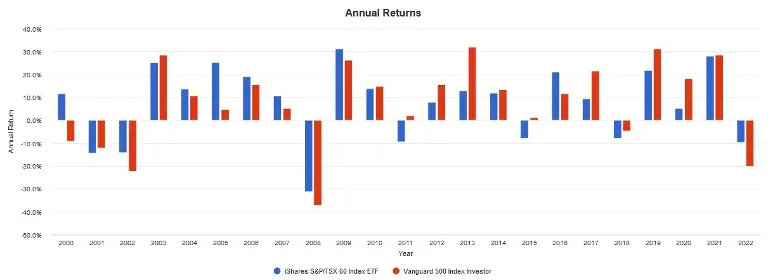
The Canadian stock market is not "mediocre". It is strongly tilted towards the financials, energy, and utility sectors, which are counter-cyclical and tend to perform well when U.S. heavy sectors like technology and communication services falter. Case in point, the TSX has strongly outperformed in 2022's high inflation and rising interest rate environment.
How Much Home-Country Bias is Too Much?
There is such a thing as holding too many Canadian stocks. Vanguard themselves recommend no more than 20-30%. According to their research, this range has historically been optimal for reducing currency risk, lowering portfolio volatility, and improving tax efficiency.
I'm in favour of a holistic approach to determining Canadian equity allocation. Personally, I would hold less in Canadian equities if I owned property in Canada, had a job tied to the Canadian economy or had a pension plan. In this case, I already have a significant stake in the Canadian market, and perhaps a lower holding of Canadian equities is appropriate.
Investors can also weight their allocation of Canadian equities to their heart's content by skipping VEQT and breaking it down into two ETFs: an all-cap world ex-Canada ETF and a Canadian equity ETF. By doing so, you're free to choose exactly how much in Canadian equities you want. I've provided an example below using Vanguard funds:
- Vanguard FTSE Global All-Cap ex Canada Index ETF (VXC): 0.21% MER
- Vanguard FTSE Canada All Cap Index ETF (VCN): 0.05% MER
Disclaimer: This article is limited to the dissemination of general information pertaining to investment strategies and financial planning and does not constitute an offer to issue or sell, or a solicitation of an offer to subscribe, buy, or acquire an interest in, any securities, financial instruments or other services, nor does it constitute a financial promotion, investment advice or an inducement or incitement to participate in any product, offering or investment.