Is it Time to Add Alternative ETFs to Your Portfolio?
Recent market conditions have given these funds a chance to shine. Here's what you need to know before buying one.


The term "alternative investments" can be confusing for the layperson to distinguish. Often, it's defined in terms of what they are not. A common definition of alternative investments is "anything other than stocks, bonds, and cash assets."
On the surface, this includes assets like currencies, commodities, and derivatives. However, it also includes more complex fund strategies like hedge funds and managed futures funds. The distinction is in the management process:
- A passive alternative commodities/currency fund attempts to track and replicate the returns of a benchmark or index, net of fees.
- An active alternatives fund is free to use a variety of strategies and asset classes to achieve a positive return regardless of how the market is performing.
The latter is what I'll be discussing today. Thanks to rising interest rates and persistently high inflation, investors are looking for additional sources of diversification for their portfolios outside of bonds. When these macroeconomic conditions ensue, bonds tend to become correlated to stocks while losing value, which negates their protective capabilities.
What are Alternative ETFs?
A good way to think about alternative ETFs is as a hedge fund in an ETF form. Contrary to what most people think, most hedge funds do not attempt to beat the market. Their goal is to:
- Deliver positive returns regardless of how the market is performing (absolute returns).
- Provide a low correlation with stocks and bonds.
- Incur lower than average volatility and drawdowns.
These funds are actively managed. The fund manager is at liberty to:
- Invest in a variety of asset classes, including equities, bonds, commodities, private equity, precious metals, currency pair, etc.
- Leverage up individual assets or the portfolio as a whole.
- Employ derivatives like futures, options, swaps, and forwards.
- Take long and or short positions.
- Use a variety of strategies like long/short equity, market neutral, event-driven, relative value, systematic trend-following, and global macro.
So, we see that alternative ETFs are very similar to hedge funds, albeit in an exchange-traded form. There are some crucial differences though, most of which are beneficial for retail investors:
- Alternative ETFs typically charge lower expense ratios than hedge funds. Hedge funds normally charge a "2% and 20%" fee structure, which refers to a 2% annual expense ratio plus a 20% performance fee of any returns net a benchmark or previous high-water mark.
- Alternative ETFs are more liquid thanks to the open-ended ETF creation/redemption process. Hedge funds are typically illiquid and subject investors to a lock-up period where they cannot sell and withdraw.
- Alternative ETFs are available to retail investors, while hedge funds are generally limited to high-net-worth or sophisticated institutional investors.
Why Invest in Alternative ETFs?
Alternative ETFs are a bet on active management and the methodology behind the fund manager's strategy. Contrary to what most people think, the fund manager is not actively trading willy-nilly at their discretion. Often, they have sophisticated quantitative models, screeners, and risk management guidelines to abide by.
The reason most people invest in alternative ETFs is for their ability to deliver positive expected returns in all market conditions with lower correlation with equities and bonds. In other words, alternative ETFs can make excellent diversifiers. This is especially so during volatile market conditions where conditions exist that impact stocks and bonds simultaneously (rising rates + high inflation).
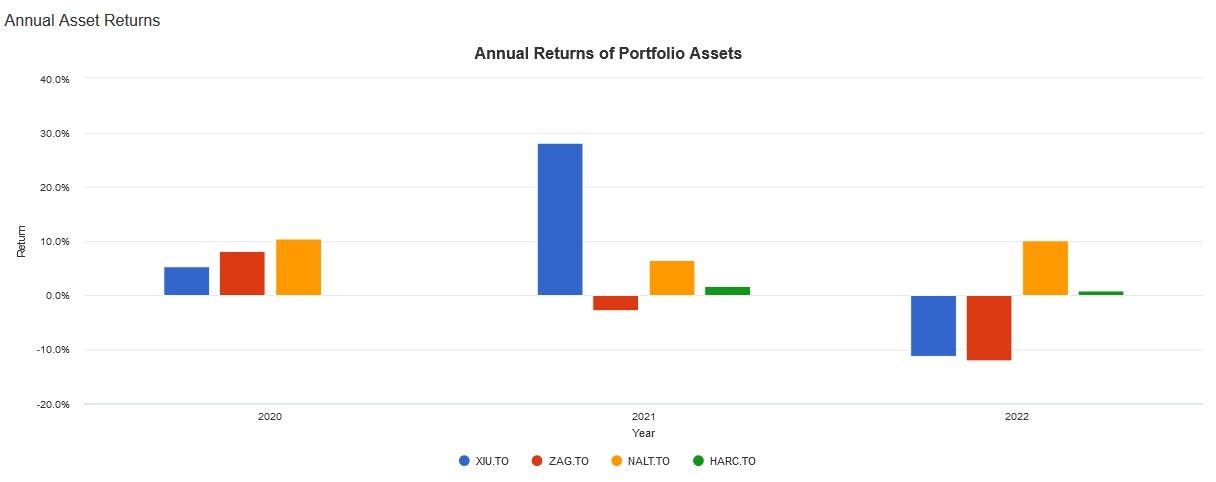
As seen in the image below, in 2021 and 2022, alternative ETFs like the NBI Liquid Alternatives ETF (NALT) and Horizons Absolute Return Global Currency ETF (HARC) delivered a lower correlation with Canadian large-cap equities and Canadian aggregate bonds, while achieving positive absolute returns despite the ongoing bond and stock bear market.

The Risks of Alternative ETFs
The biggest risk of alternative ETFs is a combination of manager risk and style drift. That refers to the possibility of the fund's management team or strategy changing over time, so it no longer resembles its original intent or is as effective. A good way to mitigate this is by spreading out any allocations to alternative ETFs between multiple funds, so you receive the average of their performance.
Secondly, tracking error can be a major concern for some investors. While alternative ETFs have strongly outperformed in high-volatility bear markets, they are likely to lag normal index funds in low-volatility bull markets. There could be years of flat performance. Investors who are too impatient to accept this might prematurely sell their alternative ETF and be left with no protection later on.
Finally, these alternative ETFs have high fees. The amount of trading that goes on behind the scenes, coupled with the use of leverage and exotic asset classes is costly. NALT charges a 0.69% expense ratio, while HARC charges 1.07%. Compare this with the average passively managed index ETF at around 0.1%. Investors who balk at this might be better served by a short-term bond or HISA ETF for reducing risk.
Data as of October 4, 2022.
Please note this article is for information purposes only and does not constitute investment advice.