How to Avoid US Big Tech Concentration Risk and Diversify with these ETFs
With concentration risk on the rise in the S&P 500, it might be a good time to explore investment options beyond just US stocks.


While the strong performance of US equities—the S&P 500 TR Index returned 15.29% for the first half of 2024—has topped the headlines, the factors driving this performance are significant and can have implications for the future. As illustrated in the following chart, 2024's first-half-of-the-year performance for the S&P 500 Index ranks high in recent history. However, when looking below the surface, the index's performance is largely attributable to a few firms, namely Microsoft, Apple, Nvidia, Alphabet, and Amazon, collectively weighing approximately 30% within the S&P 500.
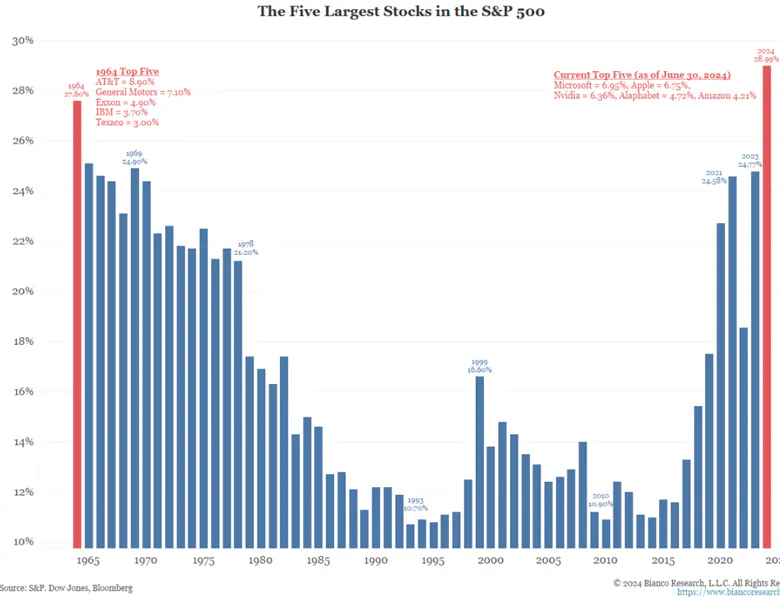
While each firm's performance has been noteworthy thus far in the year (see the following chart), each representing some aspect of the prevailing 'Semiconductor or Artificial Intelligence' opportunity, their strong influence on US equity markets indicates growing concentration risk. The ironic implication of this market shift is that investors who buy ETF solutions that passively track the S&P 500 Index are not receiving the diversification they intuitively believed they would get.
A market in motion, with new developments arising
Against the backdrop of growing concentration risk within the S&P 500 Index, the performance of US Small-Cap equities has begun to take off recently. As illustrated in the following chart, during July 2024, there were numerous spikes in the daily performance of US Small-Cap equities and an observable trend of outperformance relative to US Large-Cap equities, occurring at the latter end of the month.
The shift to US Small-Cap equities could be viewed as a rotation away from the concentration risk posed by the S&P 500 Index. Alternatively, given the sensitivity of US Small-Cap equities to changes in the interest rate environment, it could be hypothesized that market participants are taking an early position in US Small-Cap equities if a rate cut occurs in the upcoming US Federal Open Market Committee meeting.
Furthermore, unanticipated developments on the US political front will also affect the investment environment.
ETF ideas to diversify your portfolio beyond US equities
The confluence of events and activities in the market environment supports an active management approach. With the high degree of concentration present in US equity markets and a measure of uncertainty arising, exposure to differing asset classes would be worth considering.
While US equity markets have undoubtedly provided strong returns, there are compelling broad-market and single-market opportunities in other geographies and asset classes. The chart below reflects this with the year-to-date performance for different markets as of June 2024.
Within the commodities space, investors can utilize the iShares S&P/TSX Global Base Metals ETF (Ticker: XBM) to gain exposure to companies involved in producing or extracting base metals that are essential to the global economy. Alternatively, should investors desire a more distinct commodity exposure, Global X Canada's Global X Copper Producers ETF (Ticker: COPP) and Global X Uranium ETF (Ticker: HURA) are worth consideration.
Within the emerging market equities space, investors can utilize the AGF Emerging Markets ex China Fund (Ticker: AEMX). This actively managed solution invests in growth-oriented companies located in or with significant business interests in emerging market countries excluding China. The manager will use a bottom-up investment approach to identify companies with significant business interests in emerging market countries outside of China that are trading at a significant discount to their expected earnings potential.
If a more specific emerging market focus is desired, the iShares India ETF (Ticker: XID) provides comprehensive exposure to a broad cross-section of Indian equities. XID tracks the performance of the Nifty 50 Index, which represents the performance of the top 50 companies listed on the National Stock Exchange (NSE) of India. These companies are selected based on market capitalization and liquidity, providing a benchmark for the Indian equity market.
Finally, for investors seeking exposure to purely value-oriented US equities, the RBC North American Value Fund (Ticker: RNAV) aims to identify undervalued quality companies in Canada and the US-based on criteria such as assets, earnings, and cash flow. The manager's active management approach provides for a lower level of volatility than a portfolio of growth companies.
For global equities exposure, excluding the US, the Vanguard FTSE Developed All Cap ex North America Index ETF (CAD-hedged) (Ticker: VI) seeks to track the performance of a broad global equity index that focuses on providing coverage of developed markets, excluding the US and Canada.
Please note this article is for information purposes only and does not in any way constitute investment advice. It is essential that you seek advice from a registered financial professional prior to making any investment decision.